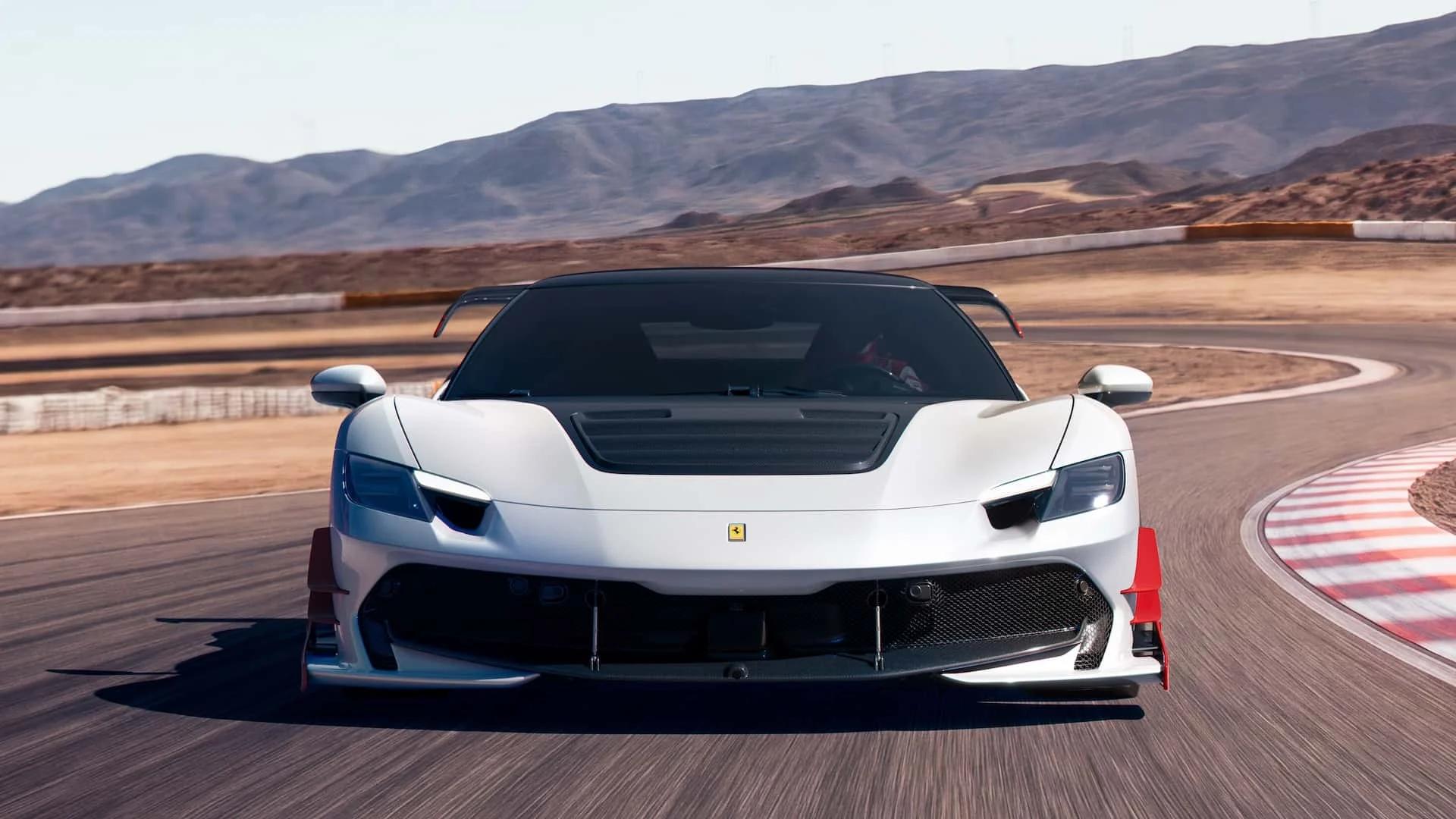
Ferrari has revealed the road-legal 296 Challenge Stradale with a 2,992 cc twin-turbo V6, no traction battery and no electric drive motor. It produces 670 CV at 8,000 rpm, weighs a claimed 1,330 kg dry with the relevant lightweight options and develops 617 kg of downforce at 250 km/h.
The car made its public debut at the 2026 Ferrari Finali Mondiali at Circuit de Barcelona-Catalunya in Montmeló. Ferrari presented it beside the 296 Challenge Evo, the updated competition model scheduled to enter its one-make series in 2027. The two programmes were developed together, but the Stradale retains the equipment and calibration needed for public-road homologation.
Ferrari has not published one global transaction price. Regional prices reported at launch cannot be applied to another market without accounting for tax, specification and allocation, while local delivery timing remains subject to the manufacturer and its dealers.
Less power than the hybrid, and 140 kg less mass
The V6 has a 120-degree bank angle, two turbochargers mounted within the vee and dry-sump lubrication. Peak torque is 740 Nm at 6,250 rpm and the engine can reach 8,500 rpm. An eight-speed dual-clutch transmission sends power to the rear wheels.
That layout creates a counterintuitive hierarchy within the 296 family. The plug-in-hybrid 296 GTB has an official combined output of 830 CV, and the later 296 Speciale raises that figure to 880 CV. The Challenge Stradale is less powerful because its electric machine is absent. Ferrari has instead concentrated on mass, throttle response and consistency during circuit use.
The dry-weight claim is 140 kg below the corresponding 296 GTB figure. Removing the battery and electric motor accounts for much of the difference, but Ferrari also fitted a transmission with a lighter shaft and casing. Carbon fibre is used for the bonnet trim, rear wing, one-piece door panels and tubular seats. The company says those seats weigh 25% less than the racing seats used as its reference.
Official performance figures are 0-100 km/h in 2.8 seconds, 0-200 km/h in 7.9 seconds and a top speed above 300 km/h. Ferrari quotes a 1 minute 18.5 second lap of Fiorano. These are manufacturer results, not Carboratory test data, and Ferrari has not supplied the full test conditions for an independent comparison.
An aerodynamic number that needs its speed attached
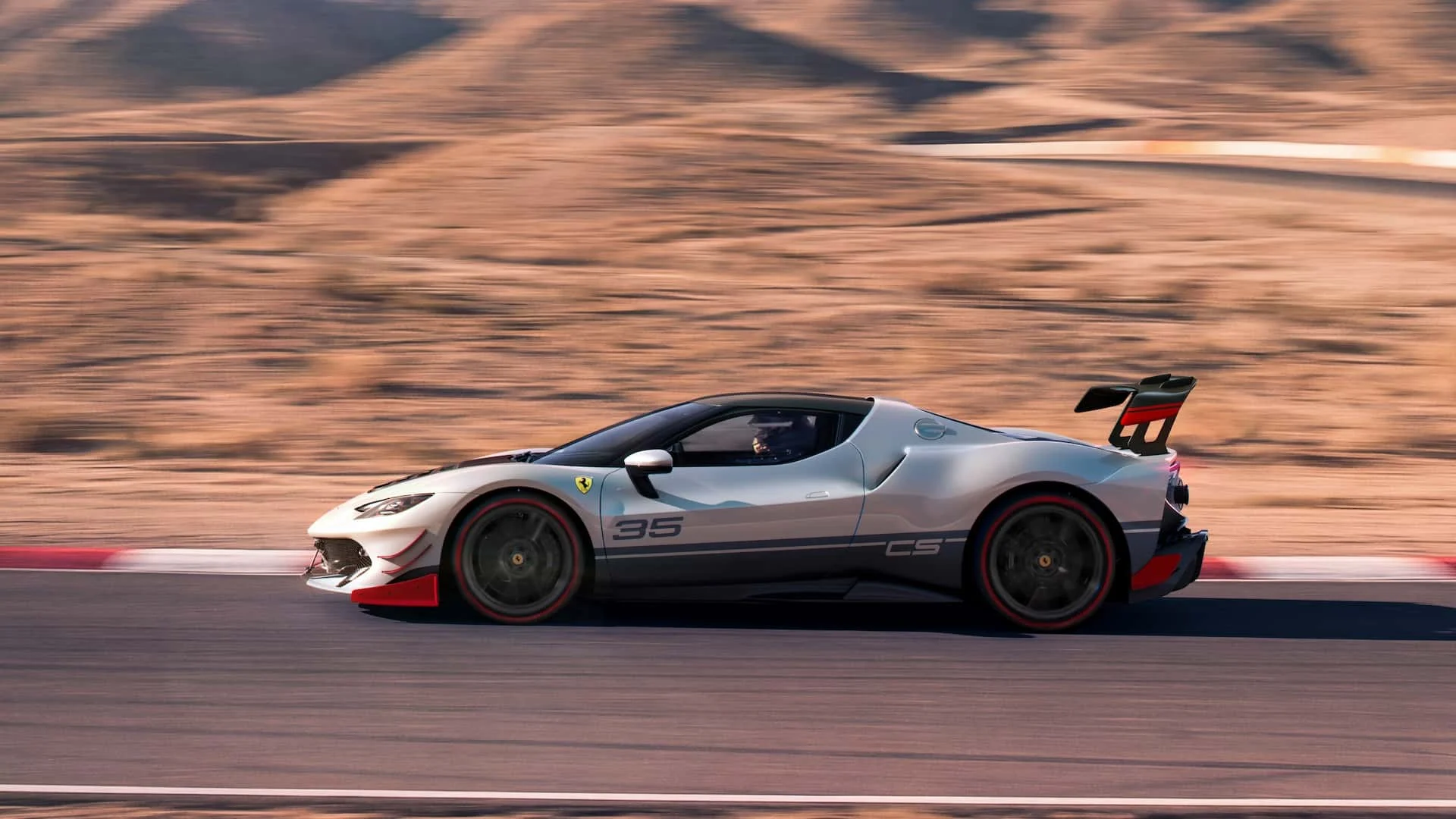
The side view shows the extended front splitter, low body and fixed rear wing. Ferrari press image via Motor1.
The 617 kg downforce claim applies at 250 km/h. It is 72% higher than Ferrari's figure for the 296 GTB, but it should not be read as a constant load available at road speeds. Aerodynamic force rises with speed and the quoted comparison belongs to the specified test point.
At the front, an extended splitter and curved flicks control air around the bumper. A closed floor and vortex generators work with a large double-keel diffuser. Ferrari also uses two ducts it calls “aero dampers”, linking the underbody and upper surface to reduce the change in aerodynamic load when the nose pitches under braking.
The fixed rear wing contributes approximately 270 kg at the reference speed. Unlike the Challenge Evo race car's swan-neck arrangement, its supports approach the wing from below. Ferrari says that change was needed to meet road homologation requirements, including those in the United States.
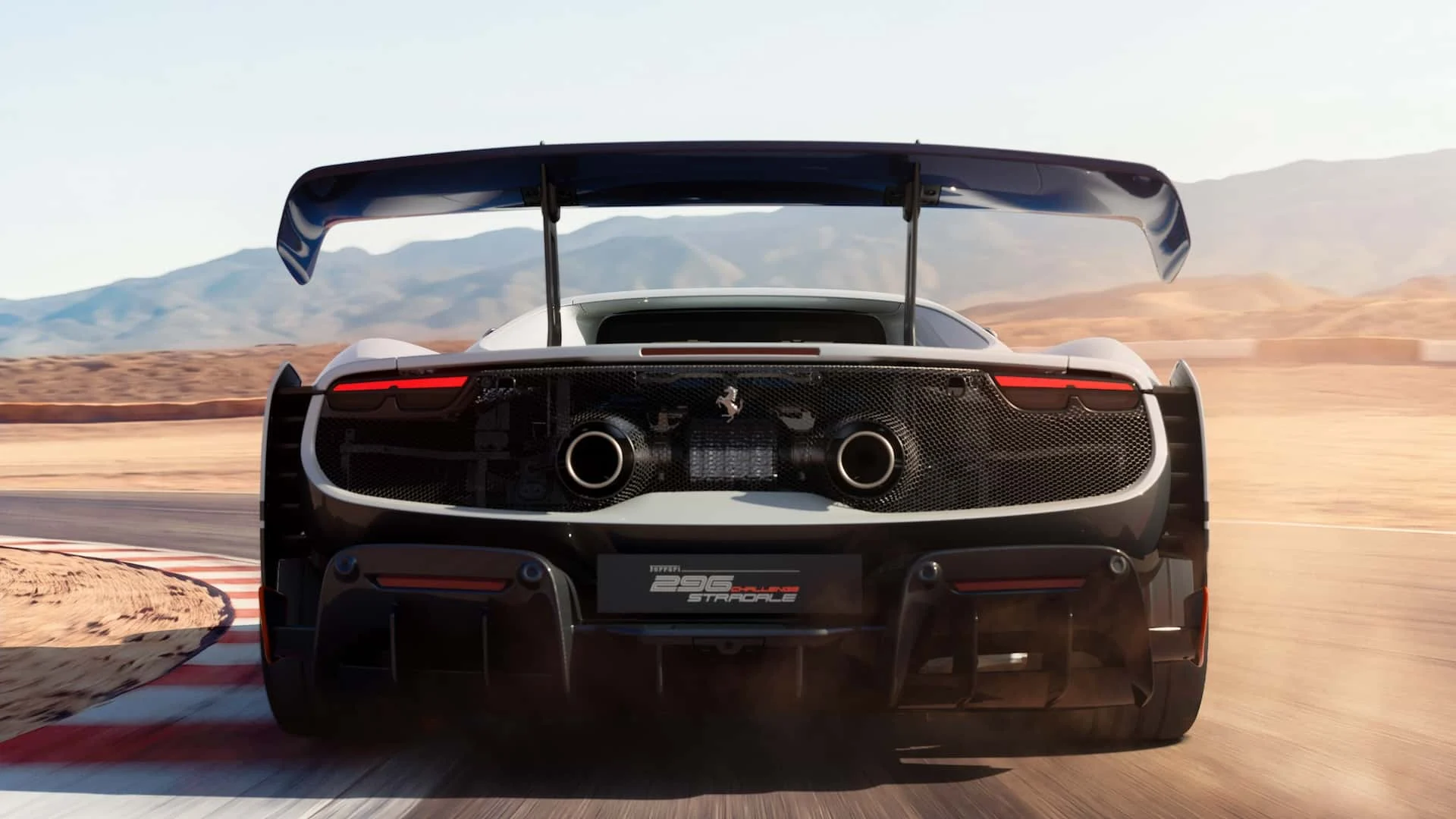
The rear combines a fixed wing, exposed metal mesh, high exhaust outlets and a large diffuser. Ferrari press image via Motor1.
Chassis figures describe a deliberately narrow brief
Ferrari reports 68% less roll gradient than the 296 GTB, a 7% increase in maximum lateral performance and a 34% increase in stability. The springs are roughly twice as stiff and use an additional spring in series, a layout derived from the Challenge Evo. Semi-active dampers gain two extra rebound settings so the car can retain some wheel control over public-road surfaces.
Pirelli P Zero R tyres are standard, with P Zero Trofeo RS semi-slicks available as an option. Their behaviour in cold or wet conditions will not match a normal road tyre, so the option matters beyond lap time. Ferrari also introduces predictive, track-oriented traction control managed through the FIVE control architecture derived from the F80.
With no hybrid system, the brakes receive no regenerative assistance. Carbon-ceramic discs measure about 398 mm at the front and 380 mm at the rear. Ferrari quotes 101 metres for a stop from 200 km/h. Tyres, temperature, surface condition and vehicle specification all affect whether that figure can be reproduced.
The gearbox uses 296 Challenge shift logic under heavy load and can complete a change in about 170 milliseconds. At low speed it adopts a smoother strategy derived from the SF90 XX Stradale. That dual calibration illustrates the central compromise: the car is intended for circuit use, but must still leave the paddock under its own road registration.
A stripped cabin that remains road equipment
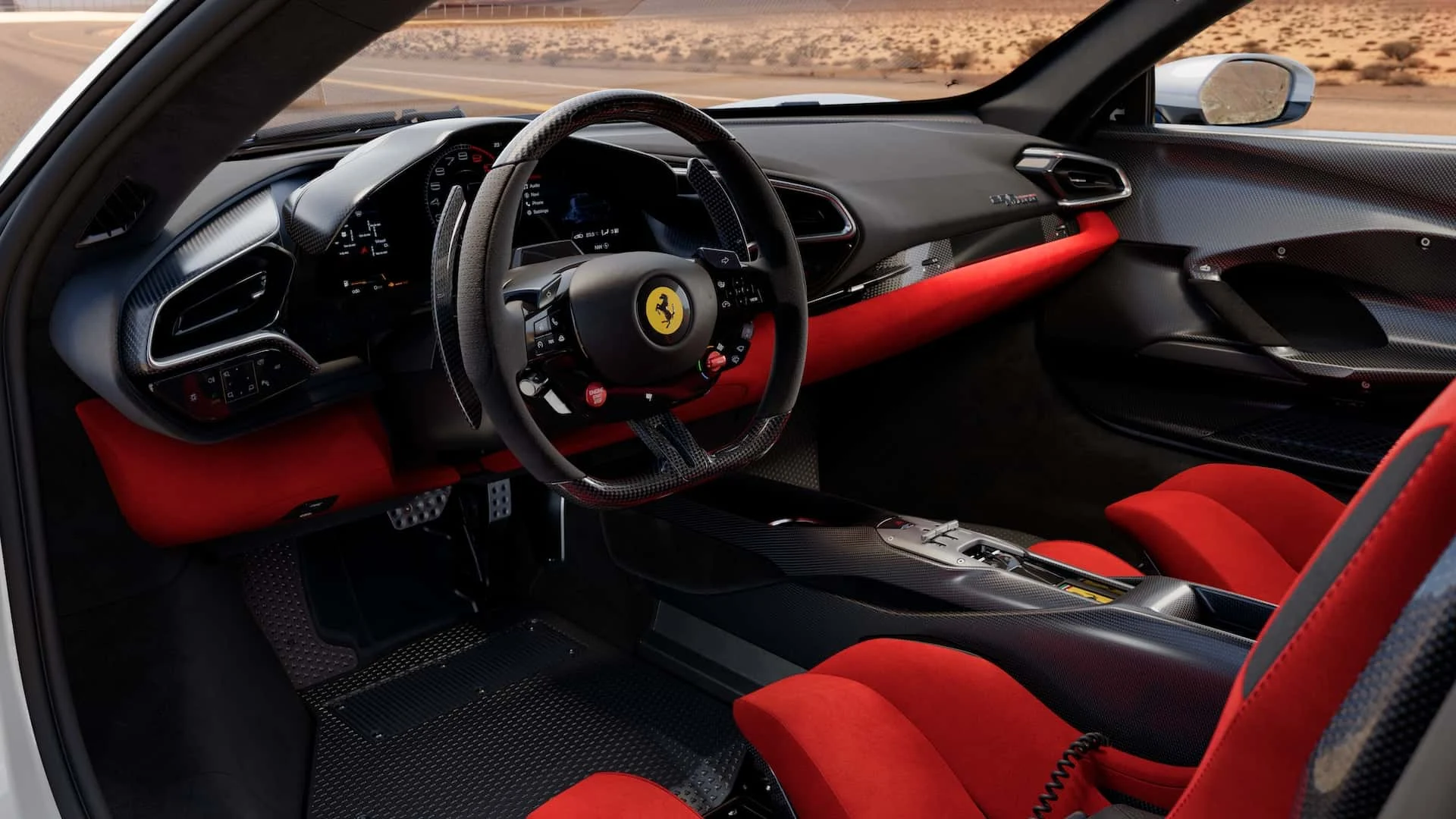
The cabin uses one-piece carbon door panels and lightweight tubular seats. Ferrari press image published by Motor1.
The doors lose conventional armrests and storage pockets. Ferrari offers removable seat covers on a production model for the first time, exposing part of the carbon structure, while a further specification can remove trim beneath the seats and lower centre console.
It is still not a 296 Challenge Evo with number plates. The road car needs homologated glazing, lighting and occupant equipment, and its low-speed transmission map and adjustable dampers acknowledge use outside a circuit. Exact standard equipment will vary by market and configuration.
The missing information is as relevant as the specification already published. Ferrari has not provided a universal on-sale price, a complete market-by-market delivery schedule or independent durability and road-comfort measurements. The 296 Challenge Stradale is therefore clearly defined as a technical product, but its availability and cost must be confirmed locally rather than inferred from launch reports.