
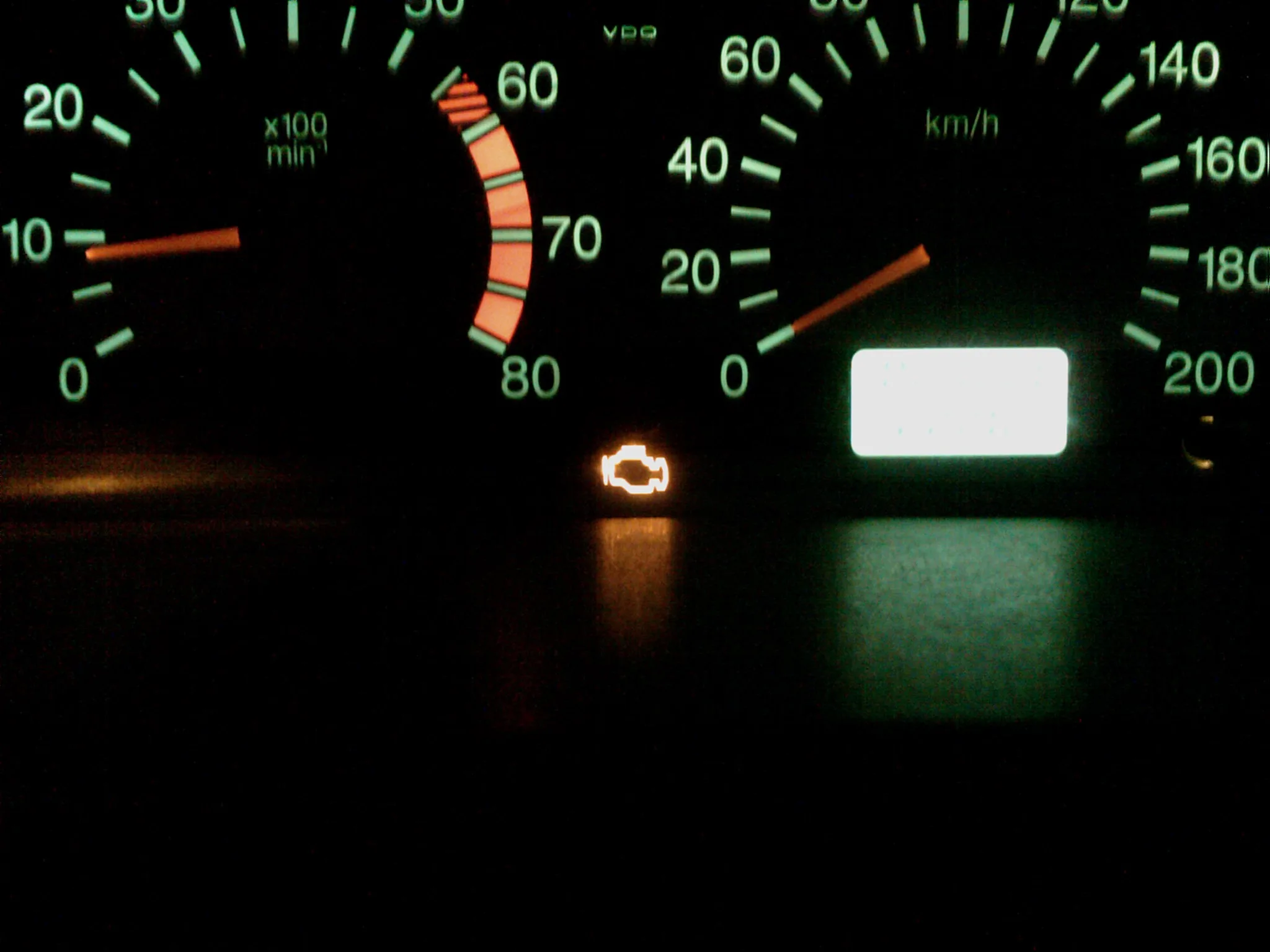
Image: .kkursor/Wikimedia Commons, CC0. Converted locally to WebP for this article.
A check-engine light can return after a repair because turning the warning off is not the same as proving that the fault has been fixed. The OBD system may switch the light back on after it runs the relevant checks again. The cause may be an intermittent electrical connection, a vacuum or exhaust leak, an incomplete repair, or a diagnostic code that was mistaken for a failed component.
The US Environmental Protection Agency describes on-board diagnostics as a system that monitors engine and emissions-related components, stores diagnostic trouble codes and commands the malfunction indicator lamp, commonly called the check-engine or service-engine-soon light. A code is evidence that the control system saw a condition outside its monitored limits. It is not automatically an instruction to replace the component named in a scanner’s short description.
Clearing the code is not repairing the car
The simplest reason for a returning warning is that a workshop cleared the code before the original cause had been confirmed. The light goes out, but the vehicle computer starts monitoring the system again. If the same condition is detected during a later drive, the code is stored again and the light returns.
California’s Bureau of Automotive Repair explains that OBD readiness monitors must run again after an emissions repair, a battery disconnect or the replacement of an emissions-related component. Some monitors complete during normal driving. Others need particular coolant temperatures, speeds, loads, fuel levels or other conditions. The exact drive cycle is vehicle-specific.
That is why a car can leave a workshop with the lamp off and still return with a warning several trips later. The absence of an immediate warning does not prove that every relevant self-test has completed. A scanner can show whether monitors are ready or incomplete, although inspection rules vary by jurisdiction and vehicle.
A trouble code identifies a system condition
A code mentioning an oxygen sensor, catalyst efficiency, fuel mixture or evaporative emissions does not always mean that the named part has failed. The sensor may be reporting a condition created by an intake leak, incorrect fuel pressure, an injector problem, an exhaust leak or damaged wiring.
Misfire codes work in the same way. A code associated with one cylinder can involve a spark plug, ignition coil, injector, compression, fuel delivery or valve timing, depending on the engine. Replacing a coil without checking whether the fault moves with the coil is a parts swap, not a complete diagnosis.
A proper repair record should preserve the original codes, freeze-frame data and the measurements used to confirm the cause. After the repair, the technician should rerun the relevant tests and, where required, perform a suitable drive cycle. There is no single mileage figure that completes every monitor on every car.
Intermittent faults can pass a workshop test
Electrical faults often depend on temperature, vibration or moisture. A connector may work when the engine is cold and open its circuit after heat builds up. A vacuum hose may leak only when the engine moves under load. A fuel cap or evaporative-system seal may fail intermittently. A sensor can drift outside its expected range only at a particular temperature or engine load.
In such cases, a quick inspection in the bay may not reproduce the problem. That does not automatically make the OBD system unreliable. It means the technician has to compare the stored operating conditions with a more targeted test of the circuit, power supply, ground, pressure or system sealing.
The repair itself can also leave a new path for the warning to return. A connector may not be locked fully, a gasket may be pinched, a hose may still be cracked or a wiring loom may be stretched. Work around the intake or exhaust can create a small leak that changes sensor readings and produces a code similar to the original one.
Battery disconnection can hide the evidence
Disconnecting the battery or clearing codes with a scan tool can turn the light off, but neither action repairs the vehicle. The procedure can also remove useful history and reset the readiness monitors to an incomplete or “not ready” state.
This matters when buying a used car. A dashboard with no warning is not enough evidence that the emissions system is healthy. A scan may show that several monitors have not completed, suggesting that the battery was recently disconnected or the codes were cleared. The legal inspection rules differ between countries, but the technical limitation is the same: the system has not finished checking itself.
A flashing light is a different warning
The EPA distinguishes a steady malfunction indicator from a flashing one. A flashing check-engine light can indicate a severe misfire capable of damaging the catalytic converter. The driver should reduce load and speed and consult the owner’s manual or a repair facility promptly.
A steady light is not equally urgent on every vehicle. The owner’s manual may explain whether the car can be driven to a workshop and which symptoms require stopping. Loss of power, a strong fuel smell, smoke, overheating, rough running or additional red warning lamps increase the risk and change the decision.
What to ask when the light returns
Ask for the complete diagnostic code, not only “it is a sensor”. The useful record includes the original code, freeze-frame conditions, readiness status and the test that confirmed the failed part or system. If a component was replaced, ask what measurement proved that it was the cause and what post-repair check confirmed the result.
When the lamp returns, the new code should be compared with the original. It may be identical, a secondary code or an unrelated fault introduced or revealed during the repair. The correct outcome is not simply a dark dashboard. It is a confirmed cause, a repair that addresses it and a completed verification of the relevant OBD monitors.


