
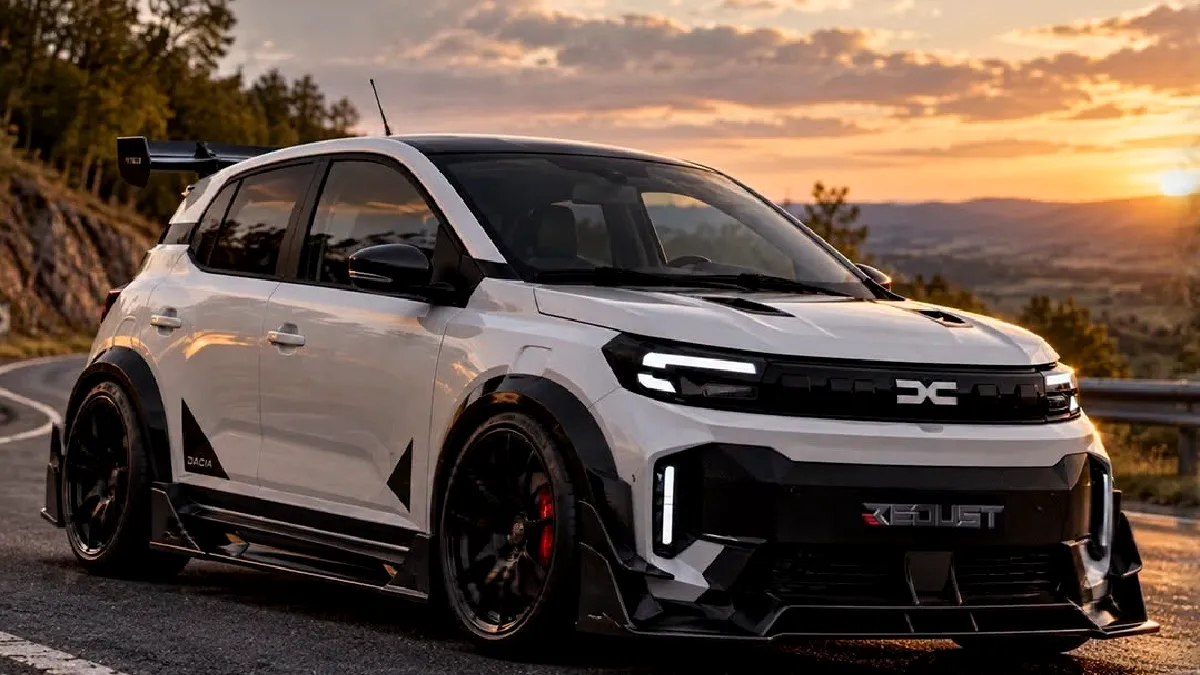
German tuner Carpoint has published renderings that turn the new Dacia Spring into a visual hot hatch. The REDUST-branded design adds wide arches, large wheels, a lowered stance and aggressive aerodynamic parts inspired by competition cars. There is no working prototype and no announced commercial Spring package at this stage.
The images should be read as a design exercise rather than a product announcement. Carpoint has reworked the car digitally, and the renderings do not confirm that the parts can be fitted to a production vehicle. That distinction matters because the aggressive bodywork suggests a level of performance that the current Spring powertrain does not provide.
What Carpoint changed
At the front, the concept uses a large splitter, aerodynamic extensions and canard-style elements around the bumper. The wheel arches are much wider than on the standard car, while redesigned side skirts make the body look lower and closer to the road.
The renderings show wheels that are considerably larger than the standard Spring's wheels. Behind them are large brake discs and red callipers, but those parts exist only in the published images. Carpoint has not announced wheel dimensions, a brake supplier or road-legal approval for this conversion.
At the rear, the design includes a large diffuser, a Formula 1-inspired brake light and a wing that recalls touring-car racing. The flared arches and lowered proportions change the original Spring's silhouette substantially. The visual language fits the hot-hatch idea, but it is not an official Dacia version.
Carpoint is known for Dacia components and conversions sold through its REDUST brand. Its established catalogue covers Duster and Bigster parts such as arch extensions, wheels, exterior protection, suspension components and other accessories. That background explains the visual recipe used for the Spring, but it does not mean a Spring kit is already available.
The mechanical mismatch
The Spring may look ready for a circuit in the rendering, but its battery and motor remain those of a small urban EV. Dacia's official Romanian announcement for the current range lists two motors: Electric 70, with 70 hp and 52 kW, and Electric 100, with 100 hp and 75 kW. The quoted maximum torque is 137 Nm.
The current Romanian range also uses a 24.3 kWh lithium-iron-phosphate battery. Dacia quotes up to 225 km of combined WLTP range for versions with 15-inch wheels and official consumption of 12.4 kWh/100 km. Those are production-car figures, not measurements of the Carpoint concept.
The Electric 100 reaches 100 km/h in 9.6 seconds and has a 125 km/h top speed according to Dacia's technical data. The Electric 70 is slower. Both versions are aimed at urban use. Neither specification automatically supports the visual promise made by oversized wheels, a racing wing and a much lower suspension.
Bodywork does not add motor power. A splitter, wing or wider arch can alter mass, aerodynamic drag and the way the car behaves in crosswinds. Larger wheels can affect comfort, energy consumption and range. A lowered suspension can reduce ground clearance and change the operating conditions for the car's safety systems. Without road testing, it is impossible to say whether the imagined package would improve handling or simply make the car less practical.
What is confirmed and what is not
Carpoint has not announced a commercial kit for the new Dacia Spring. There is no published price, release date, component list or approval information. The wide arches, wheels, brakes, diffuser, canards and rear wing should therefore be treated as digital design elements.
A real conversion would need to answer several technical questions. The wider arches would have to cover the tyres legally without obstructing lights or indicators. Wheels and tyres would need to meet load ratings and approved dimensions. Larger brakes would have to be compatible with the ABS and electronic brake-force distribution. A lowered suspension would need engineering checks and whatever documentation is required for road use in the relevant market.
An EV also makes the weight and frontal-area questions more relevant. Extra bodywork and larger wheels can increase energy use. Carpoint has not published an energy-consumption or range estimate for the concept, and Dacia has not announced a collaboration with the tuner for a performance model.
Where REDUST fits in
Carpoint uses REDUST for Dacia tuning and conversion products. The brand's official material covers Duster and Bigster packages with arch extensions, exterior components, wheels, suspension parts and off-road equipment. It also presents separate sport and off-road themes for the Bigster, showing that the company develops different visual directions for the same manufacturer.
The Spring rendering applies that sport theme to Dacia's smallest electric model. It is not, however, listed as a new product in the REDUST catalogue. A digital concept can be used to explore an idea or gauge public reaction without every part being manufactured later.
What the Spring actually offers
The Spring remains a four-seat urban EV with a small battery and a low-weight focus. Dacia lists AC charging of up to 7 kW, while 40 kW DC charging is available depending on specification. With the optional 40 kW DC system, Dacia quotes a 20–80% charging time of 29 minutes.
Those features explain the model's intended role: daily city trips, manageable running costs and a compact format. A hot-hatch-style body kit could change the car's appearance, but it would not automatically turn the Spring into a performance car.
For now, Carpoint has shown only how such an interpretation might look. If a real product follows, the tuner would need to publish information about parts, price, compatibility, range, brakes, suspension and approval. Until then, the Dacia Spring hot hatch is a rendering, not a production model.


