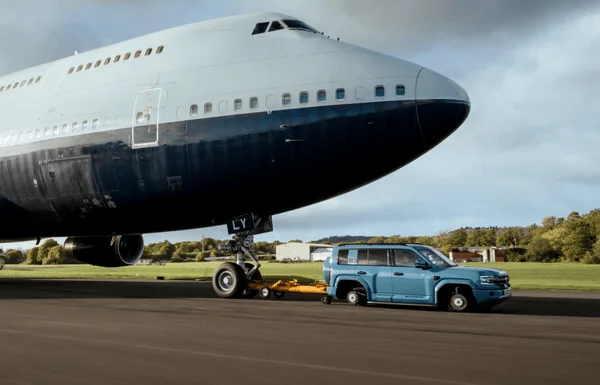
A Denza BAO 5 has moved a Boeing 747-400 weighing about 180 tonnes at Dunsfold Aerodrome in Surrey, Britain. The final run was completed after the wheels on one side of the plug-in hybrid SUV had been removed, leaving two driven tyres on the runway. Denza says the production DMO powertrain was unmodified, but the vehicle carried 4,500 kg of ballast, used axle stabilisers and connected to the aircraft through a purpose-built towing attachment.
The event involved three runs: first on four wheels, then three and finally two. Denza reports a combined distance of 1,600 metres, including stops to film and remove wheels. It claims two firsts—a production car towing an aircraft on two wheels and a Boeing 747 being towed on electric power alone. Those descriptions come from the manufacturer; no independent record certificate accompanied the release.
A production vehicle with substantial preparation
The BAO 5 was an Ultimate trim production-specification vehicle, according to Denza. That does not mean it was taken straight from a customer car park. Passenger seats were removed to make room for ballast, a dedicated coupling was fabricated and small stabilisers were fitted at each axle so the body could remain balanced after two wheels disappeared.
The three-wheel attempt used 2,000 kg of ballast. The two-wheel run raised that figure to 4,500 kg. Extra mass increases the normal force at the remaining tyres and allows them to transmit more tractive effort before slipping. The preparation therefore addressed the main limitation in a low-speed pull: grip, not headline engine power alone.
This distinction also separates the stunt from the BAO 5's legal trailer rating. Denza lists a 2,500 kg towing capacity. The aircraft rolled on its own landing gear on a closed runway, so the SUV was overcoming rolling resistance and inertia rather than carrying 180 tonnes. No road user should infer that the car can legally tow a load anywhere close to the aircraft's mass.
What remained mechanically standard
Denza states that the DMO plug-in hybrid system was unchanged. It combines a turbocharged 1.5-litre petrol engine with electric machines, including a motor at each axle and a generator. Official combined output is 544 PS and 760 Nm.
The front motor is rated at 272 PS and 360 Nm, while the rear is listed at 388 PS and 400 Nm. These individual peaks should not be added to create an alternative system output because they do not necessarily occur simultaneously under the same operating conditions. During the two-wheel pull, the control system's ability to direct torque through the tyres still touching the runway was central to the demonstration.
The 31.8 kWh Blade LFP battery supports an official WLTP electric range of 90 km. UK material gives a combined range equivalent to about 864 km and DC charging at up to 100 kW. Denza did not publish the energy consumed by the aircraft runs, the battery's starting state of charge or a logged power trace. “Electric power alone” is therefore a manufacturer statement about the run, not a full independent energy audit.
Why a 180-tonne aircraft can roll
Pulling an aircraft is not the same as lifting it. The 747's landing gear carries its weight, leaving the car to overcome tyre deformation, bearing losses, inertia and any gradient. Tyre pressures, surface condition, wind and weather all change the force required.
Heavy rain complicated the final filming day. Denza says the team waited until the runway dried enough for the remaining tyres to find traction. Technicians inspected the SUV after each run and reported no visible stress in the powertrain, chassis or tyres. The release does not include independent measurements of temperatures, loads or long-term component condition.
BYD UK senior technician Mark Gallifant drove the BAO 5. The Boeing 747-400 had left active service in 2020 but retained its engines and furnished cabin. That helped keep the quoted aircraft mass representative of a complete aeroplane rather than an empty display shell.
The car itself was far heavier than standard
An Ultimate BAO 5 has an official kerb weight of 3,035 kg. With 4,500 kg of ballast, the prepared vehicle's mass was well over twice the standard kerb figure before allowing for the special hardware and driver. It measures 4,921 mm long, 1,970 mm wide and 1,930 mm tall, with a 2,800 mm wheelbase.
Those numbers explain why the footage should not be treated as a normal capability test. The extra weight was the enabling condition for the final pull, while the stabilisers made a visually dramatic two-wheel configuration possible. Neither is part of the consumer specification.
The BAO 5 is also a plug-in hybrid, not a battery-electric vehicle. The claim that the 747 moved on electric power refers to the propulsion used at the wheels during the attempt. The car still contains a petrol engine as part of its DMO system, and the press material does not provide a detailed independent log of when that engine operated across the entire filming programme.
Aircraft towing has a longer SUV history
Volkswagen used a Touareg V10 TDI to tow a 155-tonne Boeing 747 in 2006. Its official history confirms that the vehicle was also heavily ballasted; an archived technical account cites 4,345 kg of added steel. In 2017, a Porsche Cayenne S Diesel moved a 285-tonne Airbus A380 for 42 metres and obtained a Guinness record for the heaviest aircraft pulled by a production car.
Denza's aircraft was lighter than the Airbus in Porsche's record. Its claimed novelty lies elsewhere: completing the task with only two driven wheels and using electric traction. Comparing the three stunts requires keeping the different aircraft, distances, vehicle preparation, surfaces and record definitions intact.
For buyers, the demonstration is evidence of controlled low-speed torque management under a carefully engineered condition. It is not a substitute for towing homologation, durability testing or a trailer assessment. The practical number remains 2,500 kg, together with the local licence, gross-train-weight and trailer-braking rules. The 180-tonne figure belongs to an airfield spectacle, not the owner's manual.