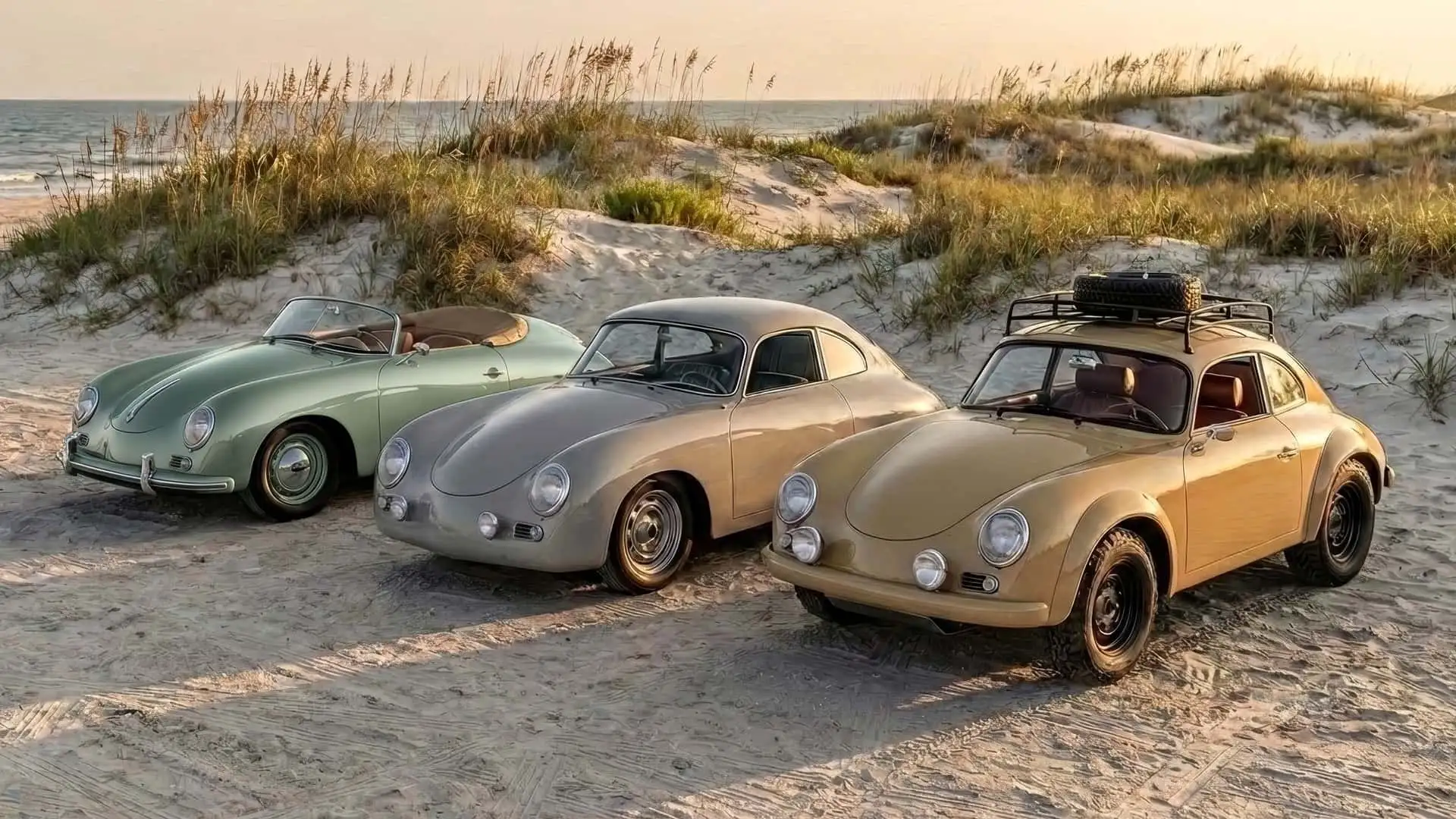
Karmenda Karosserie has opened pre-production orders for three hand-built, air-cooled cars: the Type S speedster, road-focused Type C coupe and off-road Type X coupe. Converted at the European Central Bank's 18 November reference rate, the US base prices run from approximately €122,300 to €172,900 before options, taxes, shipping or registration costs.
The company has not yet displayed a completed demonstrator. Every current image is an official concept rendering, and Karmenda says production specifications remain subject to confirmation. Its first physical Type X is scheduled to appear during Amelia Week in Florida, from 4 to 7 March 2027, with production planned to start in the second quarter of that year.
Three US prices, converted into euros
Karmenda lists its cars in US dollars. The approximate euro figures below use the ECB reference rate of €1 to $1.0968 published for 18 November 2026. They are currency conversions, not European retail prices.
| Model | Approximate base price |
|---|---|
| Type S speedster | €122,300 |
| Type C sport coupe | €163,100 |
| Type X off-road coupe | €172,900 |
| Heritage Type C, donor Porsche included | €256,900 |
| Heritage Type X, donor Porsche included | €271,800 |
A reservation deposit converts to roughly €4,600 and is credited against the purchase price. Karmenda's published payment schedule then calls for 50% when production starts, 25% at the beginning of assembly and 25% when the car is released after quality control. Contracts completed by 7 March 2027 qualify for a 10% introductory discount.
None of those figures includes European VAT, customs charges, ocean transport, inspection or homologation work. Karmenda has announced no European distributor or EU type approval. A titled Volkswagen chassis in the United States does not automatically establish that the finished vehicle can be registered in a particular European country.
Type X combines 305 mm of travel with a 149 kW claim
The Type X uses a titled Volkswagen chassis that Karmenda reinforces and modifies. Its 2,332 cc air-cooled flat-four is rated by the company at approximately 149 kW. A built four-speed transaxle, off-road differential, all-terrain tyres, skid plates and rally lights support the dirt-road brief.
Long-travel double A-arms are fitted at the front, with fabricated, extended and boxed trailing arms at the rear. Karmenda claims 305 mm of suspension movement at each corner, plus a track increase of 152 mm and a 127 mm wheelbase extension. The roof-mounted Safari Rack visible in many renders is optional and converts to about €1,100.
These are announced specifications, not Carboratory measurements. No independent test has established engine output, structural durability or off-road behaviour. The Amelia Week demonstrator is meant to provide the first public look at a physical Type X.
Type C puts the same engine into a road package
The Type C shares the 2,332 cc engine and claimed 149 kW output, but changes the chassis specification for paved roads. It uses double A-arms at the front and adjustable trailing arms at the rear; a rear double-A-arm system is optional. Vented, cross-drilled disc brakes are specified at all four corners, along with rack-and-pinion steering.
The standard transmission is a built four-speed with tall gearing, while a five-speed conversion is offered at extra cost. Dual 48 carburettors are listed in the technical sheet. Karmenda has not published weight, acceleration or maximum-speed data, so the announced power cannot yet be placed in a meaningful performance context.
Type S follows a simpler formula
The Type S is an open speedster built around a shortened, restored and titled Volkswagen chassis. Its 2,110 cc air-cooled four-cylinder engine is claimed to produce about 112 kW, driving through a rebuilt four-speed transaxle. Disc brakes are fitted front and rear.
At the back is a swing axle with a Formula Vee-inspired zero-roll system. Karmenda says the arrangement is designed to mitigate wheel tuck during quick cornering while preserving ride quality. That description comes from the manufacturer; there is no published independent handling assessment or kerb weight.
The lower price does not make the Type S an inexpensive car. At roughly €122,300 before options and import costs, buyers would be commissioning a low-volume, hand-built vehicle from a new company rather than purchasing a factory sports car with an established dealer network.
Standard Kars are not Porsche 356 restorations
The Type X, Type C and Type S in the regular Kollection use Volkswagen chassis and newly created bodies. Karmenda states that it is not affiliated with Porsche, Volkswagen or Erwin Komenda's family, and that its cars carry no Porsche crests or scripts. The 356 supplies the visual inspiration, not the identity of the standard cars.
Karmenda's Heritage programme is different. Heritage Type X and Type C projects begin with original steel-bodied Porsche 356 coupes, which are included in the listed price and retain their identities subject to title rules. The Heritage Type S is built new in steel to original body and chassis specifications and is priced by individual quotation.
This distinction matters for registration, provenance and resale. A Volkswagen-titled Type C may resemble a 356, but it is not an original Porsche. A Heritage conversion starts from an original car, yet its value will still depend on the donor, the scope and quality of the work, and how future buyers view the modification.
The official timetable contains two different estimates
Karmenda's media fact sheet states an eight-month target build period from the start of production for each Kollection car. The model cards on its main website currently say delivery is about six months after production begins. The company also promises that each contract will record the specification, agreed price and projected delivery date.
That written date is therefore more useful than either general website estimate. First customer drives are anticipated around October 2027. Karmenda advertises a transferable, vehicle-wide warranty lasting two years or about 32,200 km, subject to its written warranty terms.
Until the demonstrator appears, the deposit secures a production position for a specification that is still being finalised. The renders establish the design proposal, but they cannot show assembly quality, ergonomics, noise, reliability or how the suspension behaves on real roads.