Euro NCAP has awarded five stars to nine SUVs in its 18 November 2026 test round: the Škoda Peaq, Mercedes-Benz GLE, BMW X5, GWM ORA 5, GWM H7, Kia Seltos, Lepas L4, Lepas L6 and Lepas L8 PHEV. The Nissan Leaf received four stars. The headline result hides substantial differences between the vehicles across driving support, crash avoidance, impact protection and post-crash response.
The electric Škoda Peaq achieved 94% for Crash Protection, the highest result recorded by any vehicle assessed under Euro NCAP's 2026 protocols. The Mercedes-Benz GLE led this group in Safe Driving at 74% and Crash Avoidance at 87%. BMW's X5 followed closely with 71% and 85% respectively. Lepas L6 and L8 PHEV recorded the batch's best Post Crash Safety score, at 95%.
The complete 2026 result table
| Vehicle | Safe Driving | Crash Avoidance | Crash Protection | Post Crash | Stars |
|---|---|---|---|---|---|
| Škoda Peaq | 65% | 78% | 94% | 92% | 5 |
| Mercedes-Benz GLE | 74% | 87% | 90% | 92% | 5 |
| BMW X5 | 71% | 85% | 87% | 92% | 5 |
| GWM ORA 5 | 70% | 71% | 91% | 92% | 5 |
| GWM H7 | 69% | 76% | 88% | 90% | 5 |
| Lepas L4 | 64% | 84% | 90% | 92% | 5 |
| Lepas L6 | 62% | 78% | 87% | 95% | 5 |
| Lepas L8 PHEV | 62% | 78% | 87% | 95% | 5 |
| Kia Seltos | 67% | 71% | 84% | 90% | 5 |
| Nissan Leaf | 59% | 58% | 78% | 85% | 4 |
These percentages are not a simple league table. They describe four stages in Euro NCAP's revised 2026 system. Safe Driving covers occupant and driver monitoring, controls and speed assistance. Crash Avoidance assesses functions such as automatic emergency braking and lane support. Crash Protection includes the passenger cell, restraints, airbags and the consequences for vulnerable road users. Post Crash Safety examines eCall, rescue information, electrical isolation and occupant extraction.
The test year matters. A five-star result from 2018 was awarded under different scenarios and thresholds, so it cannot be compared directly with a 2026 rating by looking only at the star icon. Equipment also matters: Euro NCAP assesses a defined version and the eligible standard safety specification for the European market.
Peaq led in the impact tests, not every category
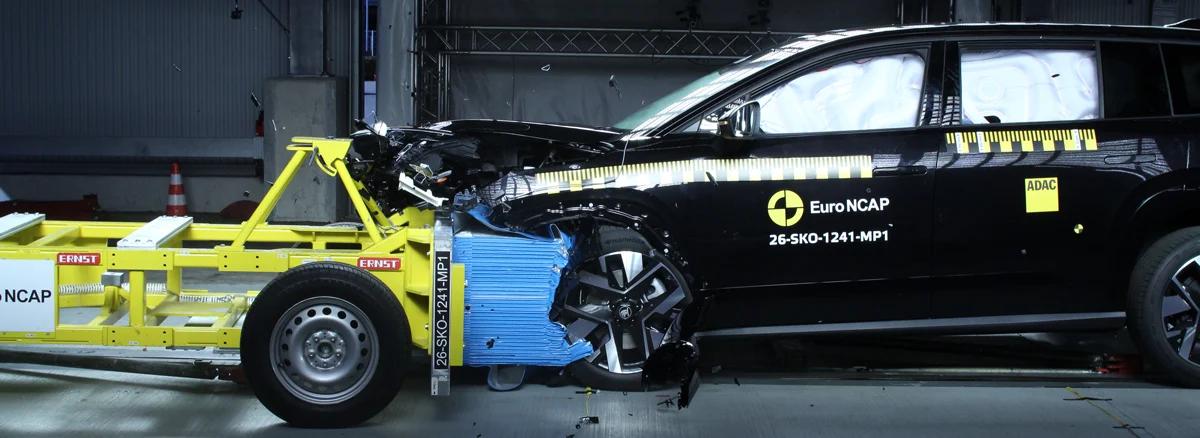
The Škoda Peaq earned maximum points in the full-width and offset frontal tests, the mobile side-barrier impact and the side-pole test. Its standard centre airbag reduced the risk of the two front occupants striking each other in a side collision. Euro NCAP also found good protection for the legs and femurs of vulnerable road users.
The 94% figure should not be read as proof that Peaq was the best vehicle in every form of safety. It scored 65% for Safe Driving, nine points below the GLE. It lacks Child Presence Detection and does not recognise an occupant sitting out of position, such as a front passenger with feet on the dashboard. Those omissions do not cancel the crash-test performance, but they explain why the four percentages need to be read together.
Euro NCAP tested the Peaq Selection 90 with left-hand drive and a kerb weight of 2,259 kg. The rating page lists the electric Selection and Sportline versions covered by the assessment, including rear- and all-wheel-drive configurations. Buyers should still verify that the exact model year and market specification they order are listed under the rating's applicability section.
GLE and X5 performed better before a collision
The diesel Mercedes-Benz GLE achieved the strongest active-safety profile in this batch. Its 74% Safe Driving and 87% Crash Avoidance results were accompanied by 90% Crash Protection and 92% Post Crash Safety. Euro NCAP says it is the first car tested in 2026 that already satisfies the requirements for a 2027 five-star award.
That does not mean the GLE escaped criticism. Driver chest protection in the offset frontal test was rated adequate rather than good, and cyclist head protection was poor in some impact areas. Euro NCAP also described the large SUV as a somewhat aggressive partner in a frontal collision. The result illustrates why protection inside a heavy vehicle and the forces it imposes on another vehicle are separate questions.
BMW X5 recorded 71% for Safe Driving, 85% for Crash Avoidance, 87% for Crash Protection and 92% after a crash. In Euro NCAP's roughly 2,000 km on-road check across Spain, Italy and France, its speed-assistance system identified the local limit correctly in 91% of cases, covering 97% of the distance travelled.
The X5 also had limitations. Dummy readings indicated marginal chest protection for the driver in the offset test and for the rear passenger in the full-width test. Pedestrian pelvis protection was largely poor. The five-star rating therefore describes a balanced overall threshold, not flawless results at every sensor and body region.
Why the Nissan Leaf stopped at four stars
The Leaf scored 59% in Safe Driving, 58% in Crash Avoidance, 78% in Crash Protection and 85% in Post Crash Safety. Euro NCAP links the weaker avoidance result mainly to the absence of standard front-corner radars, which restricts performance in crossing-traffic scenarios. A centre airbag is optional rather than standard on the assessed specification.
Four stars do not mean the Leaf failed every safety task. It received full credit for important manual controls, driver acceptance of the lane-support intervention and its provisions for rescue teams to extract occupants. Its result is lower than the nine SUVs chiefly because the 2026 scheme evaluates accident prevention and standard equipment alongside physical impact performance.
The difference between an optional and a standard component is practical. A buyer cannot assume that a centre airbag or radar fitted to a higher trim was included in Euro NCAP's result for an entry version. The rating page and the local equipment list must be checked together.
Five stars still require reading beyond the badge
The remaining results reinforce that point. GWM ORA 5 reached 91% for Crash Protection but 71% for avoidance. Lepas L4 scored 84% in Crash Avoidance, more than some larger and more established models, while its Safe Driving result was 64%. Lepas L6 and L8 led after a crash at 95%, yet both recorded 62% for Safe Driving. Kia Seltos obtained five stars with 84% in Crash Protection and 71% in avoidance.
For a family buyer, occupant detection, child-presence warnings and rescue access may deserve close attention. In dense urban use, pedestrian and cyclist detection, intersection braking and dooring warnings are more relevant. Frequent motorway users may prioritise driver monitoring, lane-support behaviour and accurate speed-limit recognition.
The star rating is a useful filter, but the four category percentages identify why a car achieved it. The test year, evaluated derivative and standard equipment then determine whether the result applies to the vehicle in a showroom. Euro NCAP's November round is a clear example: nine cars share the same five-star headline while showing markedly different safety profiles beneath it.