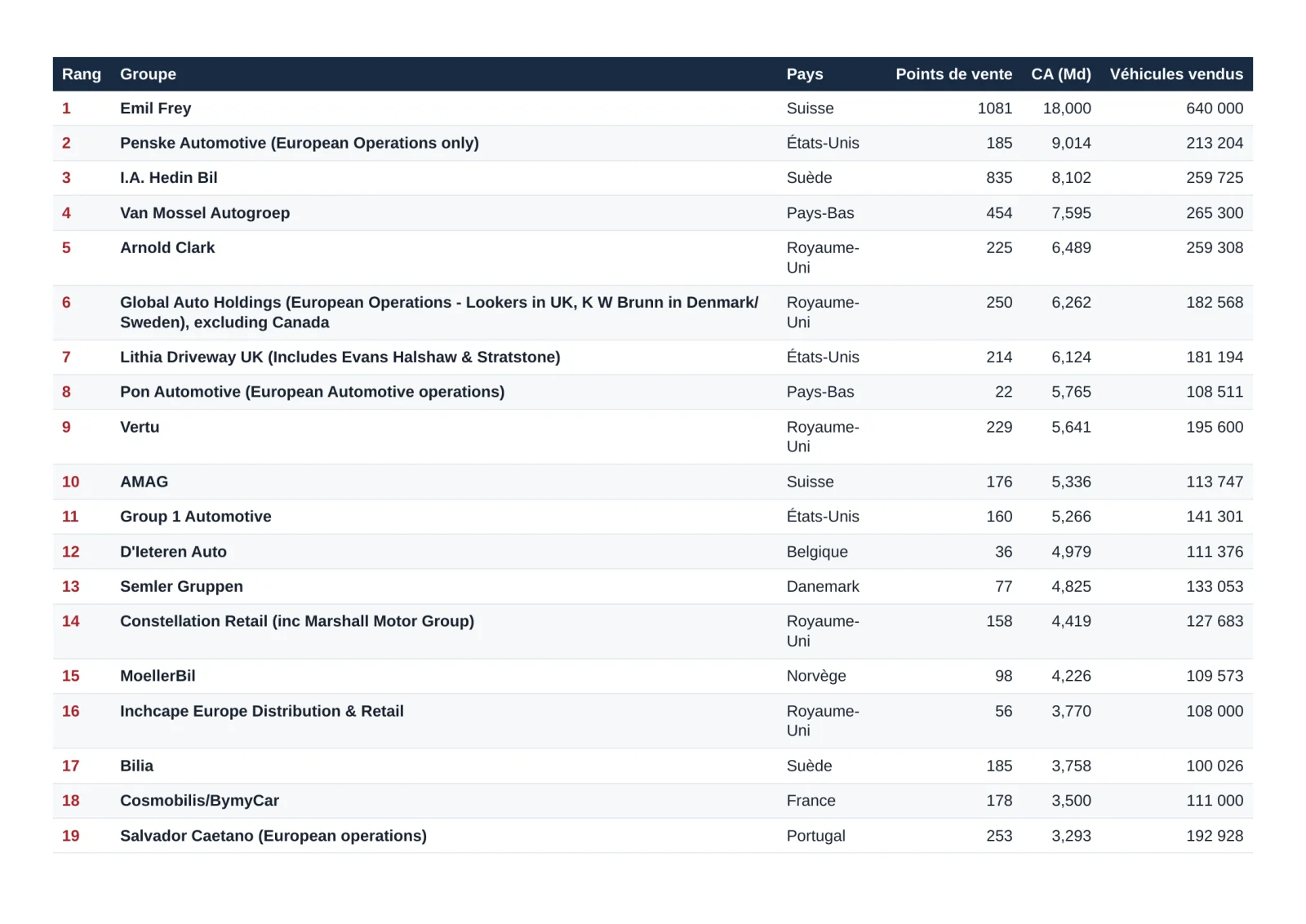
Emil Frey remains Europe’s largest automotive distribution group, with estimated revenue of €18 billion and 640,000 vehicles sold. That puts the Swiss group comfortably at the top of the 2026 ranking prepared by the International Car Distribution Programme (ICDP) with Automotive News Europe. Penske Automotive’s European operations rank second on €9.014 billion, followed by Sweden’s I.A. Hedin Bil on €8.102 billion.
The year in the ranking’s name needs an important qualification. Published on November 24, 2026, the table measures 2025 activity, or the closest available financial period, rather than sales generated during 2026. It also uses a restricted scope for several global companies. Penske, Global Auto Holdings, Lithia and Salvador Caetano, for example, are represented by the European operations specified in the table, not by their entire worldwide businesses.
Europe’s ten largest dealer groups
| Rank | Group | Headquarters listed | 2025 revenue | Vehicles sold |
|---|---|---|---|---|
| 1 | Emil Frey | Switzerland | €18.000bn | 640,000 |
| 2 | Penske Automotive, European operations | United States | €9.014bn | 213,204 |
| 3 | I.A. Hedin Bil | Sweden | €8.102bn | 259,725 |
| 4 | Van Mossel Autogroep | Netherlands | €7.595bn | 265,300 |
| 5 | Arnold Clark | United Kingdom | €6.489bn | 259,308 |
| 6 | Global Auto Holdings, European operations | United Kingdom | €6.262bn | 182,568 |
| 7 | Lithia Driveway UK | United States | €6.124bn | 181,194 |
| 8 | Pon Automotive, European automotive operations | Netherlands | €5.765bn | 108,511 |
| 9 | Vertu | United Kingdom | €5.641bn | 195,600 |
| 10 | AMAG | Switzerland | €5.336bn | 113,747 |
Emil Frey’s revenue is almost twice the figure attributed to Penske’s European operation. That does not mean it sells twice as many cars at the same margin. These groups combine different proportions of importing, new and used retail, aftersales and other services. Vehicle mix, transaction value, accounting scope and financial year can also differ, so revenue is the ranking measure rather than a direct proxy for profit or operational efficiency.
Van Mossel advances and AMAG returns to the top ten
The first three places are unchanged. The most visible move near the top is Van Mossel, whose revenue increased by roughly 22% to €7.595 billion. Global Auto Holdings climbed four positions after adding the KW Bruun/Wismo activities in Denmark and Sweden. AMAG returned to the first ten, displacing D’Ieteren Auto, now ranked 12th.
The full list contains 50 groups. Its entry threshold rose by 3.8% to about €1.55 billion in annual revenue. Poland’s Cichy-Zasada is the only new entrant, at number 39 with €1.8 billion in revenue and 59,919 vehicles sold. The published table contains no group headquartered in Romania.
Across the top 50, average revenue grew 6.5%, new-vehicle volumes increased 4.9% and the number of franchise points rose 6.8%. The average ranked company generated €3.64 billion and represented 21 brands through 174 franchise points.
The top 50 now account for 16.3% of the market
ICDP calculates that the largest 50 groups hold 16.3% of Europe’s automotive retail market, up 0.9 percentage points in one year. The programme’s forecast for 2030 is 18.9%, but that figure is a projection rather than a confirmed outcome. ICDP has lowered it from an earlier 19.9% expectation, reflecting a quieter period for large mergers and acquisitions.
The term “franchise point” also requires care. It does not necessarily identify a separate building. One multibrand location can host several manufacturer contracts and therefore several franchise points. Counting them as distinct physical dealerships would overstate the property network of groups that concentrate brands on shared sites.
Consolidation continued in 2025, but much of it came through small transactions. A total of 658 franchise points changed ownership. The average deal covered fewer than five franchises, and only eight transactions involved ten or more. The picture is therefore not one of a handful of spectacular takeovers, but of many local acquisitions that gradually enlarge regional groups.
Chinese brands are accelerating network growth
New brands are helping established dealers expand their portfolios. ICDP says 74% of the top 50 represent at least one newly arrived brand, with Chinese manufacturers responsible for much of the recent franchise growth. Around half of new Chinese-brand outlets are located in multibrand sites, about twice the proportion seen among established marques.
The model is practical for both parties. A dealer can place a new name in an existing facility, limiting the upfront cost of a dedicated showroom. A manufacturer gains immediate access to sales staff, workshops and local logistics. The customer benefit is less automatic: aftersales capacity, trained technicians, parts supply and a durable warranty organisation matter more over time than the number of badges displayed at launch.
The expansion is also taking place while Chinese brands gain share in Europe. Dataforce figures cited in the industry analysis put their combined share at 10.8% during the first ten months of 2026, and 18% in the United Kingdom. Those are regional registration figures, not proof that every new franchise will succeed or remain open.
Consolidation varies sharply by country
Europe is not one uniform dealer market. In the Netherlands, the ten largest groups account for around 52% of sales and the top 50 for 85%. France’s top-50 share has risen from 28% in 2016 to about 54%, while the United Kingdom is at 48%. Italy is lower at roughly 32%.
Germany remains much more fragmented: its top 50 hold about 22%, and the first ten only 10%. The contrast helps explain why the same acquisition can be strategically decisive in one national market yet barely move the overall structure in another.
High concentration does not by itself demonstrate better or worse prices. Large groups can fund stock, technician training, digital systems and sophisticated used-car operations. At the same time, fewer independent owners can narrow the number of genuinely separate competitors in a city. The practical effect must be judged by local brand representation, workshop capacity and ownership links, not merely by the logo above the showroom.
What the ranking means for car buyers
Dealer size should not be the only test when choosing where to buy. Buyers should identify the legal entity providing the warranty, check whether another authorised workshop can handle repairs, ask for realistic parts lead times and understand which services are operated by the dealer rather than the manufacturer.
The ranking is best read as a map of commercial power, not as a customer-satisfaction table. It says nothing directly about vehicle prices, workshop quality or profitability. What it does show is that Europe’s largest groups continue to expand, often by combining more brands within existing sites, while the market as a whole remains fragmented enough for further consolidation.