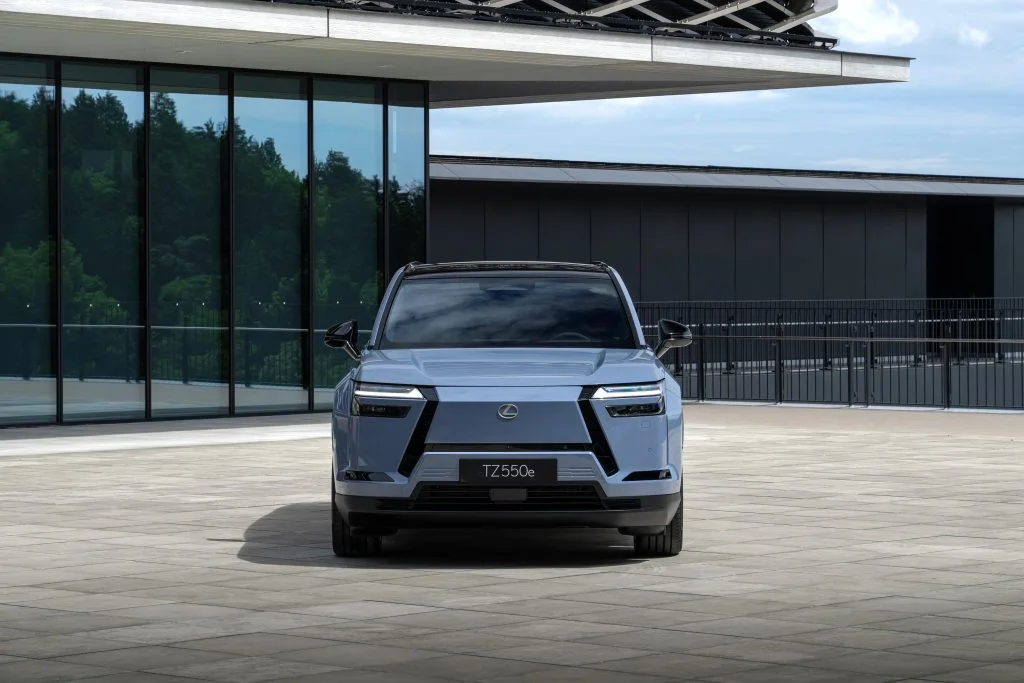
Lexus has priced the six-seat TZ electric SUV in Britain ahead of its spring 2027 sales launch. The TZ 450e Premium Plus starts at the equivalent of approximately €89,500, using the European Central Bank reference rate on 25 November 2026. That conversion explains the UK positioning; it is not a price forecast for the euro area because taxes and local equipment differ.
All three British versions use a 95.8 kWh battery and DIRECT4 all-wheel drive. The range opens with the 308 hp TZ 450e Premium Plus, while the 402 hp TZ 550e is offered in Takumi and Takumi Design trims. Lexus has previously announced additional battery and power configurations for continental Europe, so the UK range should not be assumed to apply unchanged in every country.
Three British specifications
The TZ 450e Premium Plus includes a panoramic roof, 14-inch multimedia screen, head-up display, digital rear-view mirror, Intelligent Parking Assist and heated and ventilated front seats. Its digital key can be shared with up to seven users. The UK on-road figure converts to around €89,500 at the ECB reference rate for 25 November 2026.
The TZ 550e Takumi increases output to 402 hp and adds 22-inch wheels, Dynamic Rear Steering and Interactive Manual Drive. The latter simulates eight gear ratios, an engine soundtrack and steering-wheel feedback. It is a programmed experience layer rather than a mechanical multi-speed transmission. Its UK price is equivalent to roughly €97,300.
Takumi Design adds model-specific 22-inch wheels, two-tone paint, Bright Bamboo trim and a 21-speaker Mark Levinson audio system. The converted UK price is about €99,200. These equivalents use the official list prices and the same ECB reference rate; they should not be read as official retail prices in Germany, France, Italy, Spain or Romania.
Battery, range and charging
Lexus's European launch material describes 77 and 95.8 kWh battery options, depending on version, with provisional driving ranges of up to 450, 480 or 530 km. The newly priced UK line-up uses the larger 95.8 kWh pack. Final range remains dependent on powertrain and equipment, and the exact homologated figure for each national version must be checked before ordering.
The battery accepts up to 150 kW DC. Lexus estimates approximately 35 minutes for a 10–80% charge in suitable conditions. A 22 kW AC onboard charger is also specified. Liquid cooling and preconditioning help bring the pack to a suitable temperature, either automatically when a rapid charger is programmed into the navigation system or manually before arrival.
Thirty-five minutes is a manufacturer estimate, not an independent charging test. Ambient temperature, charger output, battery state and the charging curve will affect a real stop. A 150 kW peak is modest for a premium electric SUV with a 95.8 kWh pack, although peak power alone does not reveal how consistently the vehicle maintains that rate.
Five metres long and six seats
The TZ is 5,100 mm long, 1,990 mm wide and 1,705 mm high, with a 3,050 mm wheelbase. It is 210 mm longer than the Lexus RX, and its wheelbase exceeds the RX's by 200 mm. The battery sits entirely under the floor. With no fuel tank behind it, Lexus has been able to mount the third row lower and provide two individual captain's chairs in the second row.
Lexus quotes 290 litres of VDA luggage space with all seats in use and up to 2,017 litres in its launch technical sheet. The European retail page displays 1,984 litres for its pictured configuration. That difference is a reminder that measurement and market specification need to be matched; neither figure should automatically be applied to every version.
The provisional kerb weight is 2,630 kg and braked towing capacity is 1,500 kg. Lexus claims a drag coefficient of 0.27. Front MacPherson struts and a model-specific rear multi-link arrangement support the large body, while 20- or 22-inch wheels are used according to grade.
Rear steering addresses the car's footprint
Dynamic Rear Steering can turn the rear wheels by up to four degrees. At low speeds they move opposite the front wheels, reducing the minimum turning radius from 5.8 to 5.4 metres. This is useful context for a car that is almost two metres wide before its door mirrors are considered.
At higher speed the rear wheels turn in phase with the fronts to improve stability. Lexus also integrates the system into Rear Comfort mode, coordinating rear steering, braking balance and DIRECT4 torque distribution to reduce lateral head movement for passengers.
Regenerative braking offers five selectable levels through the steering-wheel paddles and can provide up to 0.2 g of deceleration. The European material does not state that the TZ can always stop completely without the brake pedal, so full one-pedal driving should not be treated as confirmed.
Two eAxles and simulated shifts
An eAxle is fitted at each end of the vehicle. DIRECT4 varies torque between the front and rear axles according to grip and the selected drive mode. European prototype data describe each motor as producing 167 kW and 268.6 Nm, with combined system output limited below the mathematical sum.
For the TZ 550e, the European preview lists about 300 kW or 408 hp and 0–100 km/h in 5.4 seconds, while the UK sales release describes its local version as 402 hp. These figures are not necessarily contradictory: national specifications and power conversions can produce small differences. The final homologated data for the purchased version take precedence.
Interactive Manual Drive is reserved for the more powerful British TZ 550e versions. Paddle inputs select eight virtual ratios, with a tachometer, artificial combustion-engine sound and feedback through the steering wheel. It changes the driver's cues but does not alter the fact that propulsion comes from two electric drive units.
Europe in 2027, with national details to follow
Lexus says the TZ reaches Europe in 2027, and its UK launch is scheduled for spring. Lexus Romania also advertises availability from spring 2027, but does not yet show a local price or complete trim structure. Other European markets will publish their own combinations of battery, output and equipment.
The UK announcement therefore answers one question while leaving another open. It establishes that a highly equipped TZ will sit around the €90,000 mark when the British price is converted, but it does not create a common European tariff. Buyers still need country-specific WLTP range, charging equipment, warranty, standard safety features and taxes before making a like-for-like comparison.