Mazda no longer depends on the MX-5 for brand recognition to the extent it did a decade ago, according to Mazda UK sales director Laura Brailey. Her argument is commercial: the roadster accounts for a comparatively small share of the range, while models such as the CX-5 have made Mazda familiar to a much broader group of buyers. It was not an announcement that the MX-5 has been cancelled.
That distinction matters because Mazda's global leadership continues to present the roadster as the product that embodies its “Joy of Driving” philosophy. The company's 2026 Integrated Report, published in November, says approximately 1.27 million MX-5s have been sold since 1989. Mazda also says it is considering the development of a next-generation car. The immediate story is therefore about a changing brand portfolio, not a confirmed end for the two-seat sports car.
What Mazda UK actually said
Auto Express asked Brailey whether she could imagine a Mazda range without the MX-5. She answered that she could, then explained that Mazda is less reliant on the model for fame because other cars now carry more of the public recognition. The CX-5 was her example. Its size, practicality and global availability put it in front of customers who would never shop for a small rear-wheel-drive convertible.
Mazda UK managing director Jeremy Thomson added a different part of the picture. He said the British operation intends to keep evolving the current model and retain it for as long as UK rules allow a combustion-engine version to remain on sale. He also discussed progressive electrification beyond 2030, while acknowledging that some enthusiasts believe an MX-5 needs a combustion engine.
These are comments from the UK sales organisation, not a product cancellation issued by Mazda Motor Corporation in Hiroshima. Thomson noted that Britain accounts for about 2% of Mazda's global sales. He described the United States as roughly half of the total and Europe as 13%, with the UK the region's second-largest market. The figures explain both why British feedback matters and why it cannot determine a global sports-car programme alone.
The CX-5 changed the commercial balance
Mazda announced in January 2026 that cumulative production and sales of the CX-5 had passed five million units. The manufacturer identifies it as its best-selling model since 2018. A five-seat crossover operates in a far larger market than a two-seat roadster, and its replacement cycle has a direct effect on factory utilisation, dealer traffic and company earnings.
That does not mean the CX-5 and MX-5 serve the same purpose. A high-volume SUV can make the badge visible in cities and family car parks. A specialist sports car can demonstrate engineering priorities in unusually concentrated form: low mass, direct controls, a natural seating position and predictable responses. The first supports scale; the second can shape how enthusiasts interpret the brand.
Mazda's own strategy now tries to extend those human-centred traits across the full range. The company says it will concentrate investment on design, driving feel and vehicle integration while working with partners where scale is essential, including software and electrification. The all-new CX-5 uses Mazda E/E Architecture+, developed with Toyota and other partners, but Mazda says its own integration work is intended to preserve distinct behaviour and usability.
Global Mazda still gives the MX-5 a special role
Mazda CTO Ryuichi Umeshita's message in the 2026 Integrated Report describes the MX-5 as the product that embodies Joy of Driving. It records roughly 1.27 million worldwide sales since 1989 and more than 10,000 Japanese sales during 2025. Mazda says that was the first time the Roadster had reached that domestic annual level since 1998, helped by increased demand from younger customers.
The same document broadens the point beyond one model. Mazda defines driving enjoyment through trust, controllability, reduced fatigue and the ability to operate the vehicle naturally. It links that thinking to pedal placement, seating, control logic, safety and design. Under this definition, the MX-5 can be the clearest example without being the only car responsible for Mazda's identity.
This resolves the apparent contradiction. The UK business can be less reliant on MX-5 sales and publicity because crossovers do more commercial work. Global engineering leadership can still use the roadster as a reference for the qualities that should survive in larger, electrified and software-defined vehicles.
The current car is already diverging by market
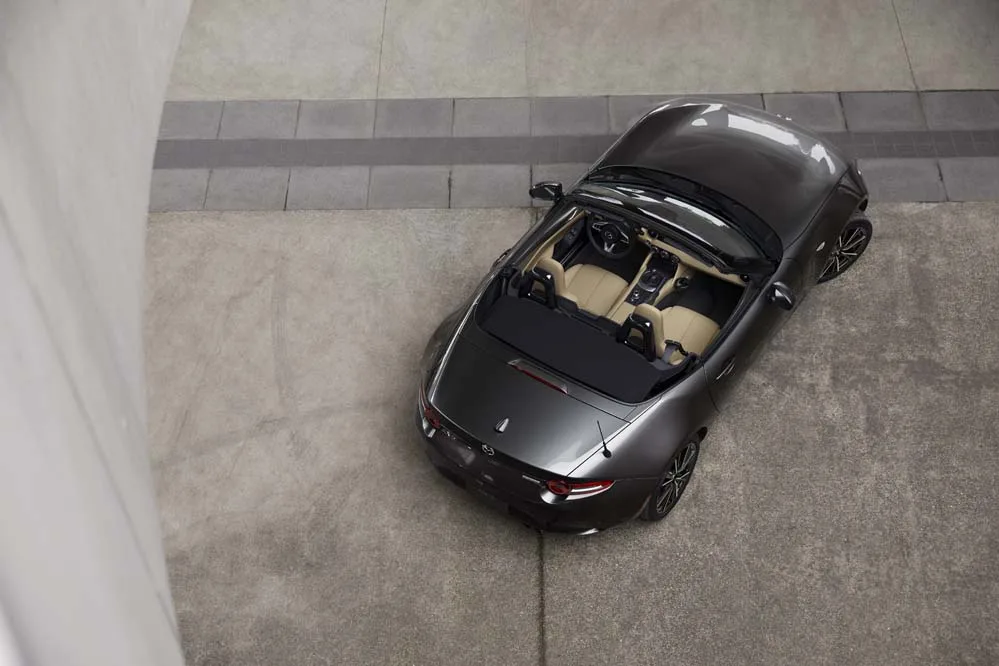
The fourth-generation ND has been in production for more than a decade. In Britain, Mazda has removed the 2.0-litre engine from the new-car range and retained the 1.5-litre version. UK management connects the model's longer-term future to emissions rules and the pace of electrification. It has not announced a fifth-generation launch date.
Other markets illustrate why one country's range is not the whole product story. Mazda North America continues to sell a 2.0-litre 2026 Miata with a six-speed manual across Sport, Club and Grand Touring versions, while automatic transmission is available on Grand Touring. In Romania, Mazda's site currently lists the soft-top from €32,290 and the RF from €34,790, both centred on a 1.5-litre, 136 PS engine, rear-wheel drive and a six-speed manual gearbox.
Prices, engines and regulatory deadlines therefore need a market label. The disappearance of the UK 2.0-litre option does not mean every country has lost it, while a US specification should not be presented as a European one. The same caution applies to the future car.
What is known about a successor
Mazda confirmed to MotorTrend in August 2026 that it is considering development of the next MX-5. CEO Masahiro Moro had told auto motor und sport that the basic structure should be capable of accommodating a future without a combustion engine. He described a target range from just under 1,000 kg to 1,200 kg without relying on expensive materials such as carbon fibre.
Those comments do not confirm that the next MX-5 will launch as an electric car. Nor do they identify a battery, motor, hybrid system, production date or price. They define the engineering problem: create a structure light enough to preserve the car's character while leaving room for powertrain rules that may change during its life.
Thomson's preference for progressive degrees of electrification is compatible with several technical routes, but it is not a specification. A mild hybrid, full hybrid, plug-in hybrid or battery-electric MX-5 would each impose different mass, packaging and cost constraints. Mazda has not publicly selected one in the material available today.
What buyers should take from the debate
For a customer considering the current MX-5, the UK comments do not alter a published warranty, specification or order. Availability must be checked in the relevant country. A buyer waiting for the fifth generation has less certainty: Mazda has confirmed active consideration and technical targets, but no firm arrival date or production powertrain.
For Mazda, the broader issue is whether “Joy of Driving” can remain credible when most customers meet the brand through a crossover. The company's answer is to distribute the philosophy across the range rather than ask one low-volume roadster to carry it alone. That makes MX-5 less necessary as a marketing introduction, but potentially more important as an engineering benchmark.
The evidence does not support a simple claim that Mazda has moved on from the Miata. Its commercial dependence has declined, its UK engine range has narrowed and its eventual electrification remains unresolved. At the same time, the current car is still sold, the global company publicly celebrates its sales and owner community, and work on a successor has not been cancelled.