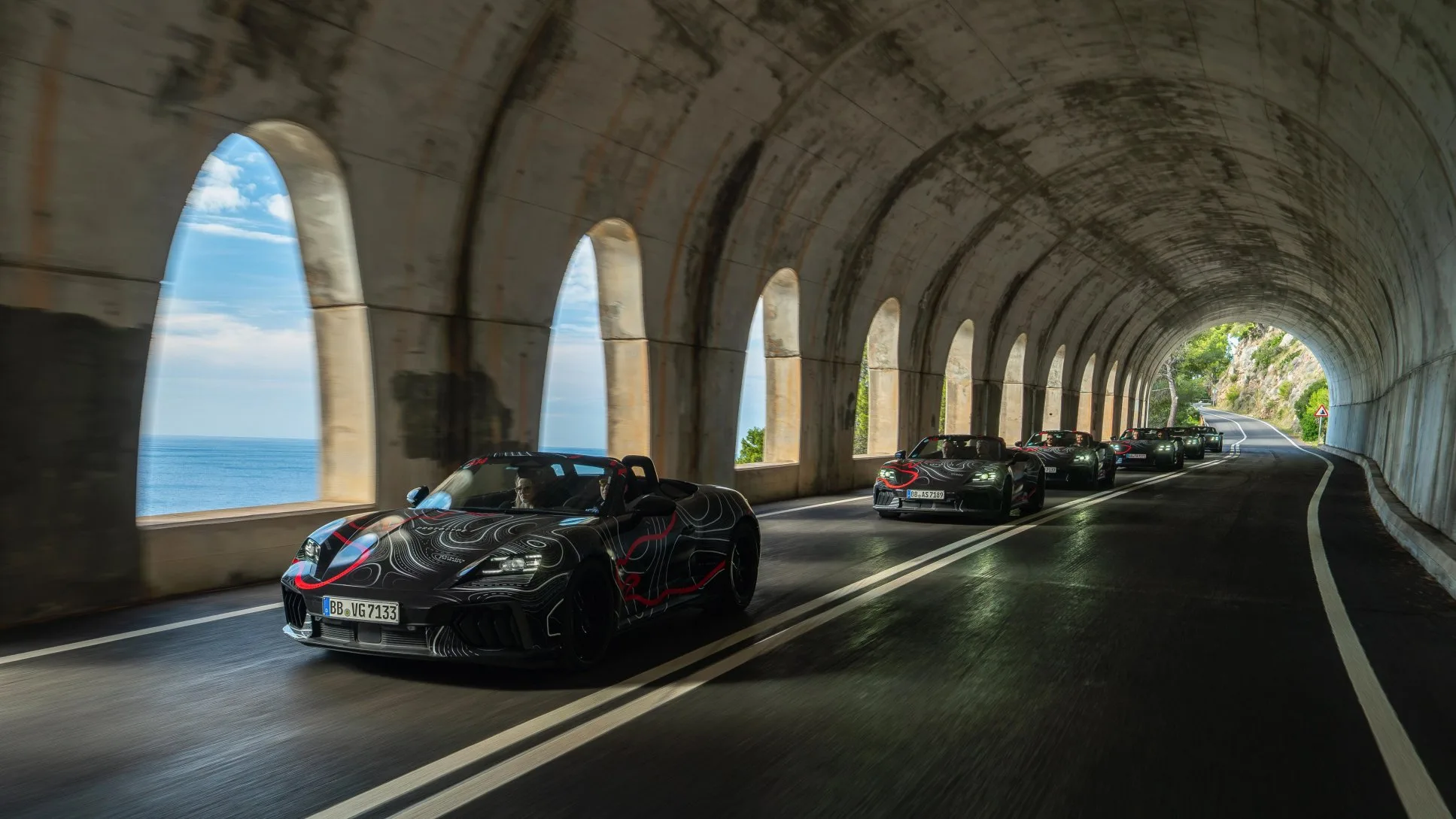
Porsche will reveal its first all-electric 718 Boxster in the first quarter of 2027. The production-intent roadster has entered the final phase of development after a prototype fleet covered roughly four million kilometres in more than 20 countries. Porsche has also confirmed an 800-volt electrical system, a battery installed behind the seats, rear-wheel drive across the range and a 40:60 front-to-rear weight distribution.
This is not the complete launch specification. Battery capacity, WLTP range, maximum charging power, exact outputs, kerb weight and prices remain undisclosed. Porsche's separate product plan confirms an electric 718 Cayman, but the November 25 announcement gives an early-2027 world-premiere window only for the Boxster.
E-Core puts the battery where the engine used to be
Porsche calls the new layout E-Core. Rather than spreading a flat battery below the cabin, engineers placed the pack directly behind the two seats, in broadly the same area occupied by the combustion engine in the previous mid-engined car. That leaves the occupants sitting low and concentrates mass near the centre of the wheelbase.
The quoted 40:60 distribution preserves a rearward bias. It is a deliberate alternative to the skateboard layout used by most electric cars, where cells below the floor can raise the seating position. Porsche has not revealed the pack's physical size or usable energy, so the architecture alone cannot support a credible range estimate.
The 800-volt system should allow high charging performance, but Porsche has not supplied a peak figure or a charging curve. It says the prototypes were tested with five charging standards while travelling through more than 20 countries. Market-specific connectors and final charging times will need to wait for the production reveal.
Rear-wheel drive is confirmed for every version
Every electric 718 Boxster will drive its rear wheels. Porsche says the flagship will be the most powerful 718 yet, accelerating from rest to 100 km/h in less than three seconds and exceeding 250 km/h. Those are manufacturer targets for the top version, not independently measured results, and no figures have been released for the entry model.
Porsche has not said how many variants will be offered or what names they will use. It has, however, detailed some chassis hardware. The steering is based on the system fitted to the 911 Carrera GTS, while rear-axle steering will become available on a Boxster for the first time. Wheel-and-tyre dimensions, brakes and the electronically controlled PTV+ limited-slip differential also draw from the 911.
The company says intelligent lightweight construction keeps the car's mass in the region of current 911 Cabriolet T-Hybrid models. That comparison is less useful than an actual number, which Porsche has not published. It does establish that the battery car will be substantially heavier than the lightest combustion Boxsters, even if it avoids the mass of a front motor and underfloor pack.
Seven virtual ratios and the sound of a flat-six
E-Shift will be standard on every version. When activated, it simulates a seven-speed PDK transmission and lets the driver choose automatic operation or command shifts with steering-wheel paddles. Porsche says controlled torque increases during the process mean straight-line performance is unchanged whether the mode is on or off.
The simulated shifts are accompanied by a reproduced six-cylinder boxer sound based on the 981-generation Boxster GTS. The driver can switch the feature off. With E-Shift inactive, the paddles select one of three energy-recuperation levels instead of virtual gears.
That distinction matters because the car does not require multiple mechanical ratios to deliver its performance. E-Shift is an interface layer intended to give the driver rhythm, sound and an action to perform. Buyers who prefer the uninterrupted acceleration and quieter operation of an EV can leave it disabled.
Testing ranged from Sweden to Death Valley
Porsche reports temperatures as low as approximately -30°C in Sweden and nearly 51°C in Death Valley, California. Prototypes also ran in Las Vegas, Los Angeles and Shanghai traffic. Test routes stretched from 86 metres below sea level to roughly 2,750 metres above it.
The four-million-kilometre figure is the combined distance covered by the development fleet. The programme examined charging compatibility, thermal management, driver-assistance systems and daily operation as well as handling. Porsche says it used five charging standards, a necessary complication for a model intended to be sold across regions with different infrastructure.
Production will take place at Porsche's main Stuttgart-Zuffenhausen plant. The manufacturer has not announced the start of customer deliveries or which markets will receive the first allocation after the world premiere.
The Cayman is confirmed, but not for the same reveal date
Porsche's Sportwagenschmiede ’35 strategy names both the next 718 Boxster and Cayman as all-electric models. It expects the family to contribute to sales during its first full production year in 2028. That document does not provide a separate public-reveal date for the coupe.
The new development release is specifically about the Boxster and places its world premiere in the first quarter of 2027. It does not say the Cayman will debut at the same event. Reporting the roadster date as a joint Boxster-and-Cayman launch would therefore go beyond Porsche's wording.
Combustion 718 production ended in October 2025. Porsche's annual report says 15,856 Boxster and Cayman units were completed at Osnabrück during 2025 before production stopped. The new cars are not simply electric derivatives built alongside the old line; they replace a discontinued generation after a gap in production.
What buyers still need to know
The confirmed details explain how Porsche intends to preserve the low seating position and rear-biased balance of a mid-engined Boxster. They do not answer the practical ownership questions. Range, charging speed, battery warranty, weight, boot space, European pricing and country-by-country delivery timing remain unknown.
Those figures will determine whether the E-Core layout delivers an acceptable balance between track performance and longer journeys. A smaller battery may help mass and agility but reduce motorway range; a larger pack would add energy and weight. Porsche has not disclosed which compromise it selected.
The first-quarter 2027 premiere is therefore the next firm milestone. Until then, the electric Boxster is confirmed as rear-wheel drive, 800-volt and capable of sub-three-second acceleration in its most powerful form. The Cayman exists in Porsche's product strategy, but its own reveal schedule remains open.