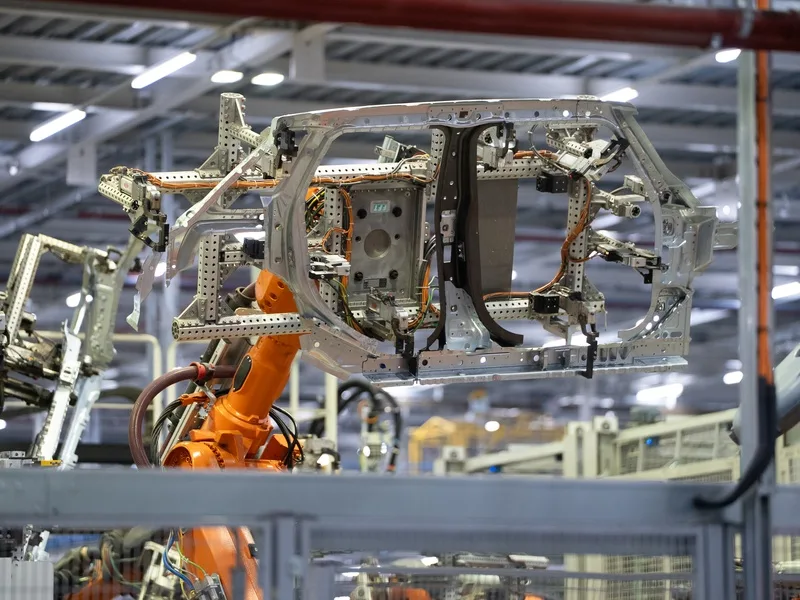
Image: BMW Group/MINI, official 2026 press photograph from the Body in White production area at Plant Oxford.
MINI has temporarily stopped vehicle production at its Oxford plant after a parts shortage forced BMW Group to adjust the factory plan for two weeks. The manufacturer says the change covers this week and next week and describes the supply bottleneck as temporary. It has not identified the missing component, the supplier involved or the number of cars removed from the schedule.
That distinction sets the boundary for interpreting the news. The stoppage is confirmed, but there is no published timetable for recovering lost output and no official estimate of customer delivery delays. Cars already completed, in transit or held by dealers are in a different position from orders that were due to enter assembly during the affected period.
Which MINI models are affected at Oxford
MINI's official UK production page lists the petrol MINI Cooper 3-Door, Cooper 5-Door and Cooper Convertible as the current Oxford-built models. Those are the vehicles directly exposed to the factory's changed schedule. BMW has not released a model-by-model breakdown of cancelled shifts or unfinished orders.
The scope should not be stretched to MINI's entire global range. The current electric Cooper and Aceman are manufactured through a separate production operation in China, while Countryman is built in Leipzig, Germany. Their factories have not been reported as part of the Oxford interruption. This is a local manufacturing pause, not a global shutdown of the MINI brand.
Plant Oxford handles body construction, painting and final assembly. It works within a British production network that also includes Plant Swindon, responsible for pressed body panels and subassemblies, and BMW Group Plant Hams Hall, which supplies engines for Oxford-built cars. The arrangement supports specialised, high-volume production, but final assembly depends on many deliveries arriving in the correct sequence.
BMW has not named the missing part
BMW's wording refers only to “temporary supply bottlenecks”. Without a company disclosure, claims that the interruption involves wiring harnesses, semiconductors, seats or any other specific part remain speculation. The group says it is in close contact with its supplier network, expects the shortage to be temporary and is keeping employees informed.
Modern assembly plants operate with tightly synchronised deliveries and carefully controlled inventories. A car cannot be completed if a required safety, homologation or configuration-specific component is absent. Even an inexpensive part can stop the line when there is no validated substitute, so the commercial value of the missing item does not necessarily indicate the scale of the disruption.
The two-week change also does not establish a structural crisis at MINI. That conclusion would require evidence about a longer duration, repeated failures, multiple plants or a persistent supplier breakdown. BMW's current position is narrower: an operational interruption expected to end when parts supply stabilises.
Oxford's role in British MINI production
The stoppage occurs during MINI's 25th year of modern production under BMW Group. The first new-generation MINI left the Oxford line on 26 April 2001. In its April 2026 anniversary release, the company said 4,671,664 MINIs had been made in Britain since that date.
BMW Group says Oxford and Swindon employ more than 3,000 people together and normally produce around 800 MINIs a day. Under regular operating conditions, a car leaves the Oxford line every 78 seconds. Those figures describe the manufacturer's stated normal pace; they are not sufficient to calculate the exact output lost in this pause. BMW has not disclosed the affected shift pattern, working days or any later recovery schedule.
The history still illustrates the plant's significance. Oxford-made MINIs have been exported to more than 100 countries, and the site has produced 14 model variations across four generations, including hatchbacks, Convertibles, Clubman, Coupe and Roadster. A short interruption therefore affects a highly visible export operation in the UK car industry, even if its final volume effect remains unknown.
The supply pause is separate from the EV investment timetable
The current shortage should not be merged with BMW's 2025 decision to reassess the timing of a £600 million programme intended to support future electric MINI production at Oxford. That programme concerns long-term industrial strategy, product planning and the EV market. The November parts problem is described as a temporary operating event.
Both issues involve the same site, but BMW has not said the production pause was caused by the electrification project or that it represents an abandonment of Oxford. Treating one as evidence for the other would turn two separate developments into a conclusion unsupported by the manufacturer.
Oxford previously produced the MINI Electric, demonstrating that combustion and electric cars can share industrial infrastructure, but the current model map has changed. The factory's immediate programme centres on petrol Cooper derivatives, while future electric allocation depends on a separate investment and product decision.
What the stoppage means for customers
For a customer awaiting an Oxford-built petrol Cooper, 5-Door or Convertible, the practical risk is a revised production slot. There is no reliable universal delay to quote. An order already assembled may continue through logistics, whereas a highly personalised car scheduled for the affected weeks may move to a later build date.
The useful information will come from the order status rather than from multiplying a normal daily production number by two calendar weeks. A retailer can check whether the car has a confirmed build week, whether it has entered production and whether it has been released for transport. BMW has not announced order cancellations, price changes or a technical campaign connected with this supply interruption.
Dealer stock can also soften the immediate retail impact. Buyers flexible on colour or equipment may find a completed vehicle, while a factory order tied to a particular specification remains dependent on the revised line schedule. Delivery effects can therefore vary between countries, dealers and individual orders, including those bound for continental Europe.
What happens next
The first measurable milestone is whether production resumes after the two-week adjustment. If supply stabilises, BMW could recover some volume through later scheduling changes, although no such plan has been published. If the stoppage extends, the company would need to update employees, retailers and customers and explain whether the original temporary assessment still holds.
Until that point, the accurate description is a two-week local production pause caused by an unidentified component shortage. It is significant for Oxford's workers and for customers with cars near their build date, but the evidence does not support claims of a permanent closure, a global MINI shutdown or a quantified wave of delivery delays.