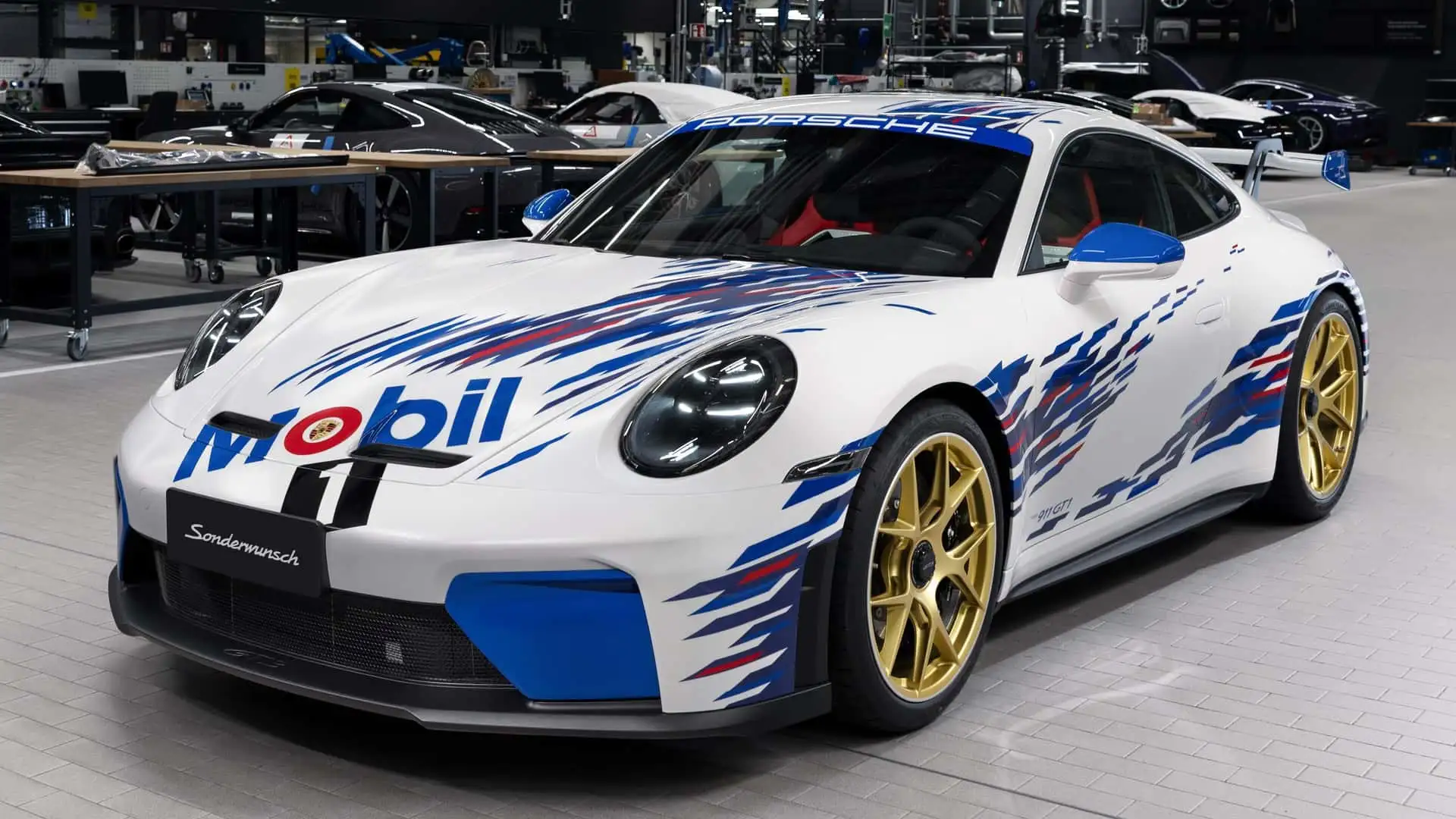
Porsche unveiled a unique 911 GT3 Tribute to 911 GT1 in Guangzhou on November 25, 2026. Initiated by Porsche China and completed through the Sonderwunsch programme, the project marks the 30th anniversaries of both the 911 GT1 and the Zhuhai International Circuit, China's first permanent circuit certified by the FIA.
This is not a limited edition offered for sale, and it is not a mechanical recreation of the GT1 racer. Beneath its hand-painted finish is a current production 911 GT3 with an unchanged powertrain. Porsche China, Porsche Sonderwunsch, Style Porsche and Studio F. A. Porsche spent about a year and a half developing the visual and handcrafted details.
Why the 1996 Zhuhai race matters
The 1996 BPR International Endurance GT Series ended with a four-hour race at Zhuhai. Emmanuel Collard and Ralf Kelleners drove Porsche AG's 911 GT1 to victory after 149 laps. The circuit itself had opened that year, giving the result particular significance in the early history of international motorsport in China.
Porsche China now uses that specific event as the basis for a modern commission. Chief operating officer Phillipp von Witzendorff describes the car as a link between Porsche's racing history and its Chinese community. That is the manufacturer's interpretation; in practical terms, the project is an anniversary object and a demonstration of Sonderwunsch craftsmanship.
The original GT1 was not simply a road-going 911 converted for racing. It was designed around competition requirements, with an architecture much closer to a purpose-built prototype, then homologated through a small number of road cars. The 2026 tribute reverses that logic. It begins with a series-production GT3 and recalls the racer through colour, materials and references rather than through a GT1 powertrain or chassis.
A reinterpretation rather than a replica livery
Club Blue, Jebsen Blue and Guards Red graphics are painted by hand over a white body. Porsche's designers did not reproduce the 1996 pattern line for line; they reshaped it to follow the current GT3's proportions. The prominent Mobil 1 branding refers both to the winning car and to the three-decade relationship between Porsche and the lubricant company.
Club Blue appears on the front airblades, mirrors, rear-wing sideplates, model designation and Porsche lettering. A fine outline of the Zhuhai circuit is drawn on the wing endplates. The bonnet carries the Porsche crest used in 1996 rather than the current badge, a small but historically specific change.
Forged magnesium wheels from the Weissach Package are finished in Satin BBS Gold with Brilliant Chrome rim edges. The rear window is covered by a white carbon-fibre panel with a gold-and-black parallelogram pattern related to the Manthey Kit for the GT3 RS. Black “Born in Flacht” lettering on the rear apron points to Porsche Motorsport's base.
The interior continues the references
Lightweight bucket seats are upholstered in Guards Red leather, with white openings for the belts. A white trim strip crosses the dashboard and centre console, carrying the exterior contrast into the cabin. For the first time on a Sonderwunsch project, Porsche painted both the interior door openers and the ignition switch in Guards Red.
“Tribute to 911 GT1” text appears on the dashboard insert and the leather sections of the floor mats. Carbon-fibre sill plates carry the less formal instruction “Have Fun!” Porsche has not disclosed the commission's cost or identified a private owner.
Sonderwunsch translates as “special request” and sits above Porsche's normal options catalogue. Depending on the commission, it can involve Paint to Sample colours, unusual materials, hand-built details and direct cooperation with designers. This GT1 tribute illustrates how extensively a standard model can be changed visually without altering its fundamental homologated mechanical specification.
The current GT3 powertrain remains intact
The car retains the naturally aspirated 4.0-litre flat-six of the current GT3. It produces 375 kW and 450 Nm, revs to 9,000 rpm and is paired here with a seven-speed PDK dual-clutch transmission. Porsche quotes 0-100 km/h in 3.4 seconds and a 311 km/h maximum speed.
Those are official production-GT3 figures, not independent measurements of the tribute. Porsche announces no changes to the engine, suspension or brakes. The PDK-equipped GT3's WLTP combined consumption is 13.8 l/100 km, with 312 g/km of CO₂; the broader GT3 range is listed at 13.8-13.7 l/100 km and 312-310 g/km, CO₂ class G.
It is also important not to confuse the base model with a 911 GT3 RS. The tribute is built from a GT3, even though a carbon panel pattern references a Manthey component associated with the RS. “GT1” identifies the historical inspiration, not the technical class of the 2026 road car.
A China-led project with a local reference
The world premiere took place in Guangzhou because Porsche China initiated and led the work. When Zhuhai International Circuit opened in 1996, it provided an important permanent venue for China's connection to international racing. Porsche has therefore anchored a global model in a precise local story rather than producing a generic celebration of the GT1 name.
The car also serves a commercial purpose by showing Chinese clients the upper limit of Sonderwunsch personalisation. Luxury manufacturers increasingly use complex commissions to distinguish individual cars beyond conventional option lists. However, Porsche has announced neither replicas nor a customer series, and no price has been published. Availability and resale-value claims would therefore be speculation.
For enthusiasts, the car's value lies in the accuracy of its references: the period crest, Zhuhai map, blue and red paint, gold wheels and Mobil 1 graphic all connect to a documented race. For regular GT3 buyers, it changes nothing about the model line or standard performance. It is a single celebratory car demonstrating how racing memory can be translated into a modern road car without pretending that today's GT3 has mechanically become a 911 GT1.