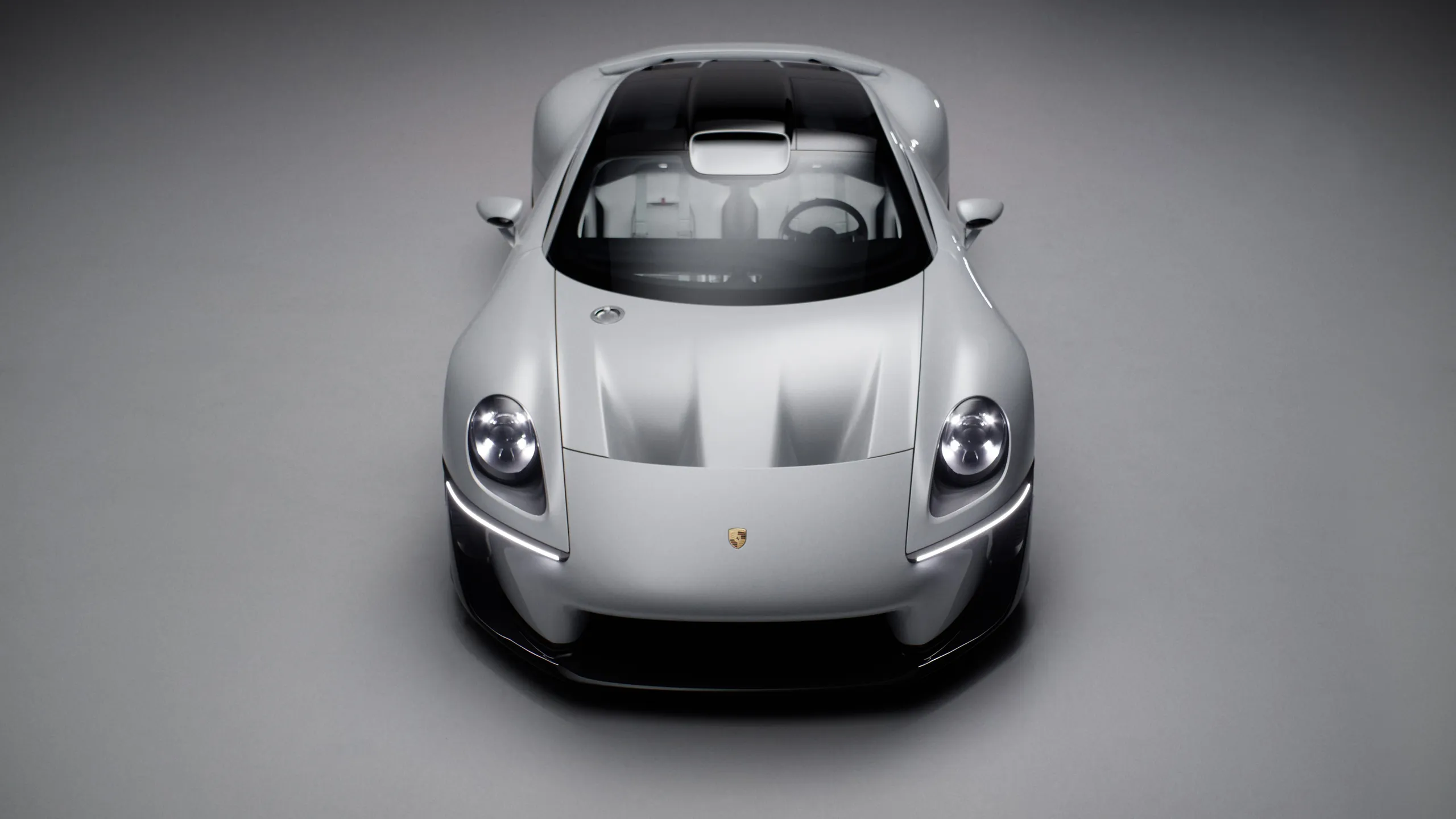
Porsche has unveiled the Mission S in New York as a vision model for a future mid-engine supercar platform positioned above the 911. The company has confirmed the product direction and several design ideas, but it has not published an engine, output figure, price, production date, or performance target. That distinction matters: the Mission S is a statement of intent and design, not a finished road-car specification.
A concept with a clear product message
The reveal took place on a Queens pier overlooking Manhattan. Porsche chose the location because photographs of the mid-engine 550 Spyder were taken there in 1953. The setting connects the new study with one of the cars that helped establish Porsche’s early sports-car identity in the United States. It is a historical reference, not evidence that the Mission S shares a mechanical package with the 550.
Porsche presents the car as part of its “Sportwagenschmiede 35” strategic realignment. Michael Leiters, chairman of the executive board of Porsche AG, says the Mission S represents a mid-engine super sports car platform above the 911. He also describes it as a permanent and versatile addition to the customer offering rather than a one-off hypercar. The wording points to a product family or architecture under development, while leaving the final production model open.
There are important gaps in the announcement. Porsche has not said whether the future car will use a combustion engine, a hybrid system, a battery-electric drivetrain, or more than one powertrain. There is no official information about displacement, cylinder count, electric motors, battery capacity, charging, kerb weight, acceleration, top speed or price. Comparisons with the 918 Spyder are therefore premature; Porsche is defining a new position in the range, not announcing a direct replacement.
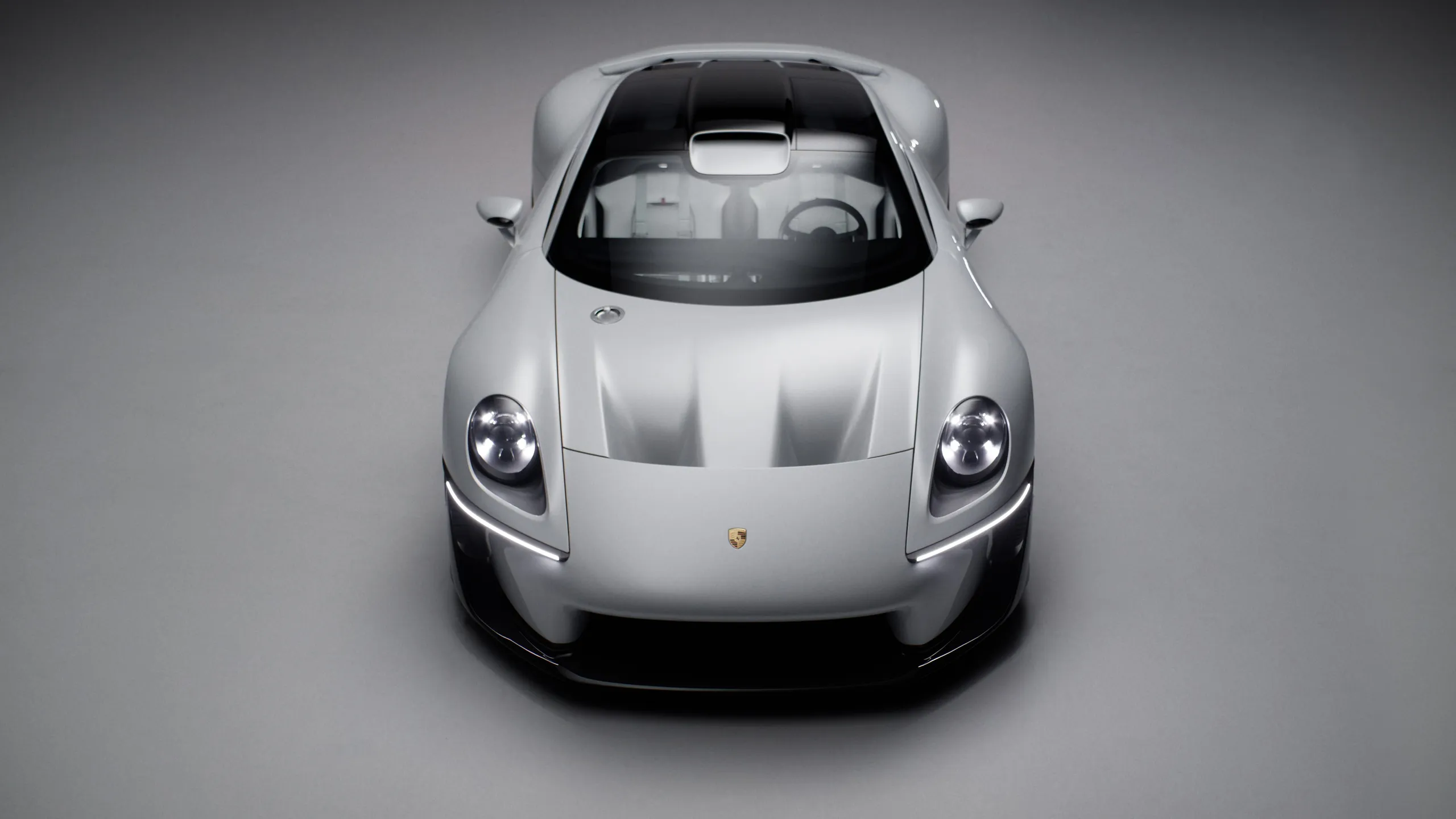
The Mission S combines familiar Porsche proportions with a new mid-engine interpretation. Image: Porsche AG.
Exterior shaped by Porsche history
The central engine layout gives the Mission S the proportions Porsche wanted for the study: a low nose, a set-back cabin and a long, strongly marked roofline. The brand highlights torpedo-shaped front fenders, a pronounced width-to-height ratio and a “floating volumes” approach in which the major surfaces appear to move around the body rather than form one heavy block.
The references are specific. The flat front recalls the 911 GT1. Round headlights and prominent fenders connect the car to the 911. The roofline under the rear wing is said to echo the 959. Porsche also identifies a “car-in-car” rear concept derived from the GT1. These are design relationships, not claims that the new model duplicates the engineering of any of those historic cars.
A continuous main line wraps around the body and links the front and rear lighting signatures. Above that line, the surfaces emphasise the fenders and the upper body. Below it, Porsche makes cooling and other technical functions more visible. The rear wing is fully integrated and active, although the company has not supplied aerodynamic data such as drag coefficient or downforce.
The wheels reinterpret the dial-style design associated with the 928. Porsche says the new version is developed with lightweight construction in mind, but it has not released wheel dimensions, material details or a wheel mass. At the back, a visible cooling fan recalls the Porsche 917. It is one of the concept’s clearest examples of a functional feature being used as part of the visual identity.
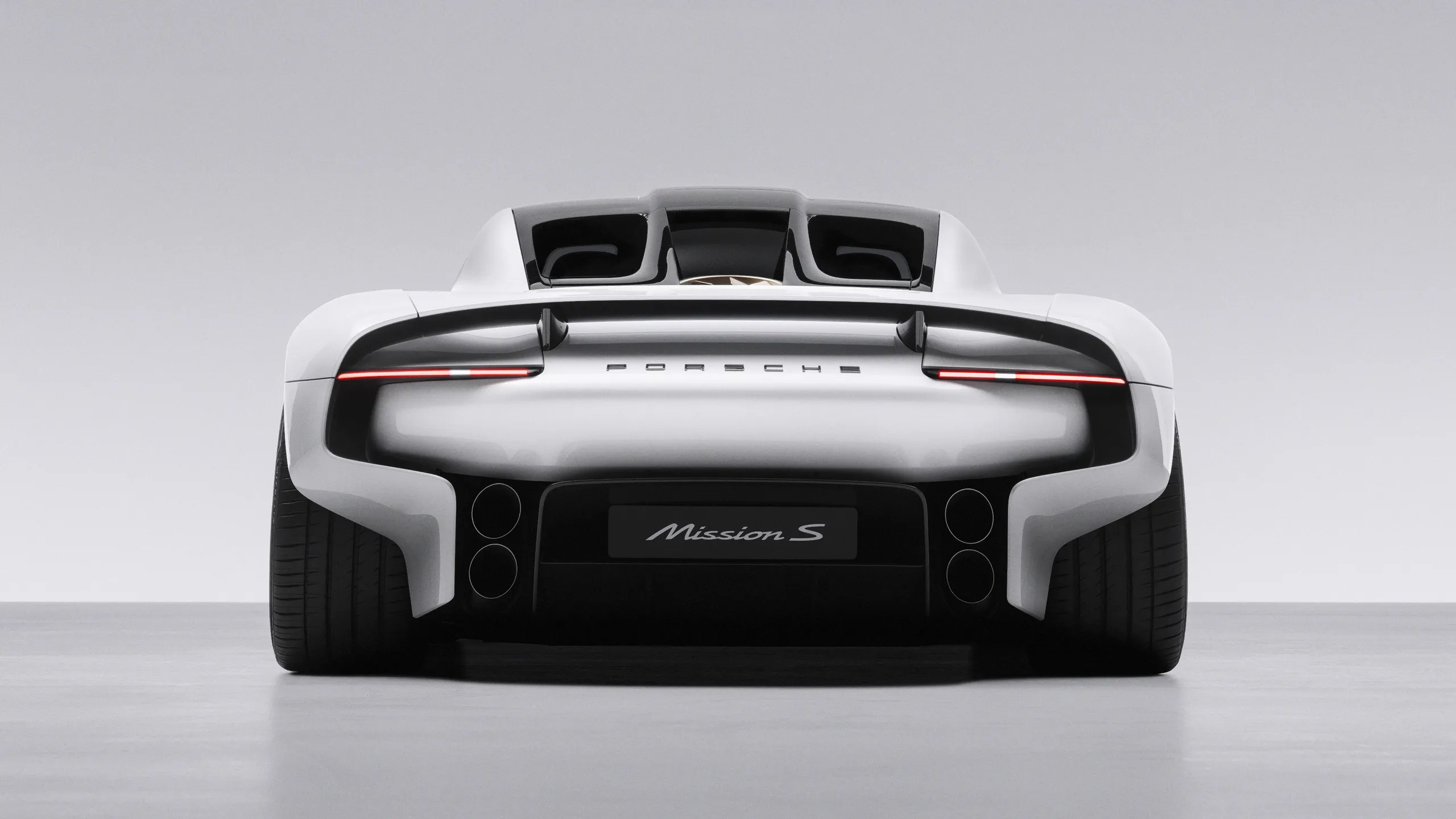
The side profile shows the low roof and central-engine proportions described by Porsche. Image: Porsche AG.
A cockpit that reduces fixed screens
The interior takes a different route from the large-screen layouts now common in high-performance cars. Porsche says the dashboard and door architecture draw on the 550 Spyder and 356. Two lines run across the dashboard and doors, giving the cabin a low, enveloping structure and tying the interior to the exterior theme.
The driver sits behind five circular instrument tubes. The central tachometer uses a digital display with an analogue needle, while the surrounding instruments can rearrange themselves according to the selected driving mode. They may sit next to one another or move into a more layered arrangement. Porsche’s stated aim is to put the most relevant information in the driver’s sightline without adding displays simply for their own sake.
There is no permanently integrated centre display and no fixed passenger screen in the concept. Instead, a retractable smartphone holder compatible with MagSafe can provide navigation or information when required. Porsche also describes a streamlined My Porsche app that accesses the car’s functions and lets the user select historically inspired digital designs for the circular instruments. Whether this arrangement reaches production, and how it would meet road-vehicle software and safety requirements, is not yet known.
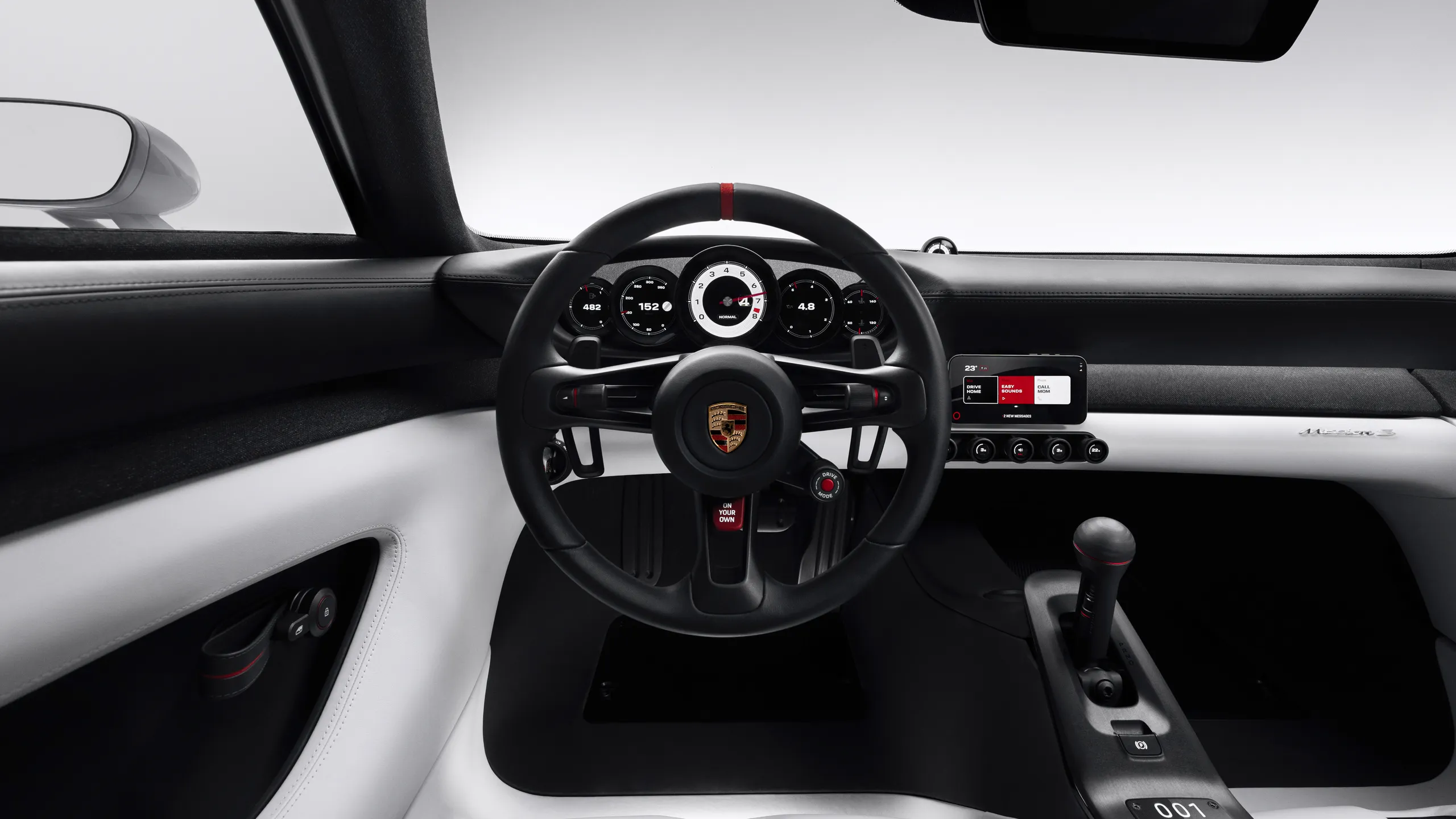
The Mission S cockpit mixes circular instruments, physical controls and digital feedback. Image: Porsche AG.
The concept retains physical interaction in several places. Classic switches and buttons sit beside digital elements. A push-pull control arrangement in the dashboard gives direct access to comfort and driving functions. The redesigned Sport Chrono element keeps an analogue character while adding digital precision. The seats include a central integrated seatbelt buckle and repositioned electric adjustment controls.
Porsche has also shown an “On your own” driving mode. The red steering-wheel button deactivates the driver assistance systems. On a concept, this is best understood as a proposed driver interface. Porsche has not said whether the same control or mode will be offered on a production vehicle, nor has it described the legal and operational conditions that would apply.
What the Mission S does not tell us yet
The announcement establishes a future direction above the 911, but it does not establish a launch programme. Porsche has not named a production model, confirmed a factory, set a date, disclosed volume, or discussed availability in Europe. The company has also not released technical specifications for the platform.
What can be stated with confidence is narrower and more useful. Porsche is developing a mid-engine supercar architecture intended to be a permanent part of the range. Mission S uses that message to connect a low, wide body with references to the 550 Spyder, 356, 911 GT1, 959, 917 and 928. Its cockpit makes the driver the organising principle and limits the number of fixed displays. The next meaningful update will need to explain the drivetrain, structure, performance targets and path from vision model to production car.