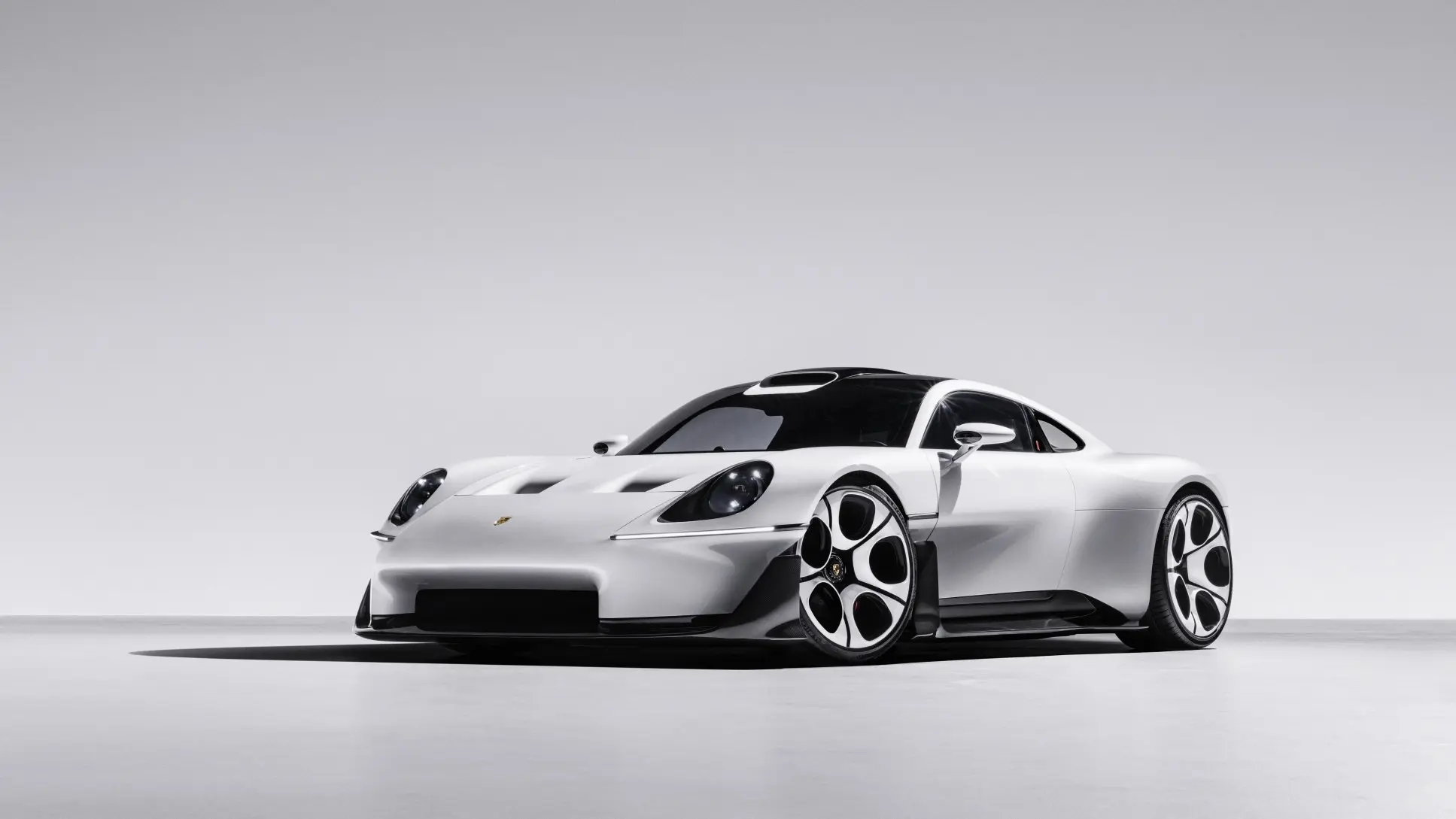
Porsche has revealed the Mission S as a vision model for a new mid-engined supercar platform. The company says the future offering will sit above the 911 and is intended to become a permanent part of its customer range, rather than a one-off hypercar. That is the firmest product information available today. Porsche has not published the production car’s engine, power output, transmission, weight, price, homologation date or performance figures.
A strategic announcement, not a finished specification
The Mission S made its world premiere on 15 October 2026 at a pier in Queens, New York. Porsche chose the location because photographs of the mid-engined 550 Spyder were taken there in 1953. The reference gives the presentation a clear historical frame, but it does not make the Mission S a direct successor to the 550 Spyder, the 918 Spyder or any other previous Porsche model.
Michael Leiters, chairman of Porsche AG’s executive board, said that the Mission S represents a mid-engined super sports car platform above the 911. He also described it as a permanent and versatile addition to the customer offering, rather than a single hypercar project. This wording matters: Porsche is announcing a product direction and a platform plan, not confirming a showroom launch.
The company has not said whether the future car will use a combustion engine, hybrid assistance or another powertrain. There is no official information about displacement, cylinders, electric motors, battery capacity, drive layout, gearbox or emissions. Online estimates about a flat-six, a hybrid system or a particular price therefore remain unconfirmed. The images show a concept vehicle, and concept hardware can change before a production programme reaches homologation.
The exterior uses a catalogue of Porsche references
The design is built around a central engine position, a low roofline and pronounced torpedo-style front fenders. Porsche describes the body as a series of floating volumes, with a wraparound line connecting the front and rear lighting signatures. Areas above that line carry the visual mass, while lower sections expose cooling and lightweight-construction details.
The Mission S does not simply reproduce one historic Porsche. Its round headlamps and fenders refer to the 911. Shut lines integrated into the lighting graphic recall the G model. The low front is linked by Porsche to the 911 GT1, while the roofline beneath the rear wing echoes the 959. A rear car-in-car concept is derived from the GT1. These are design references stated by Porsche, not evidence that the new car shares the older vehicles’ mechanical architecture.
The rear cooling solution is one of the most visible technical ideas. A fan recalls the radiator fan of the Porsche 917, while an active rear wing is integrated into the body. The wheels reinterpret the dial design associated with the 928 and are described as a new lightweight concept. Porsche has not provided the wheel mass, tyre size, downforce data or cooling performance of the show car.
The colour scheme also comes from the company’s racing history. Firn White Metallic, Light Red Metallic, Black Chrome and Special Black are used to connect the vision model with Porsche Motorsport themes. The colour names describe this particular display car; they do not constitute a production paint list.
A driver-focused cabin with fewer fixed screens
Inside, Porsche has chosen a mixture of physical controls and digital displays. Five round instruments sit behind the steering wheel. The central rev counter combines an analogue needle with a screen behind it, and the instrument arrangement can change with the selected driving mode. The stated aim is to keep the driver’s line of sight and the controls aligned with the road ahead.
The interior architecture draws on the 550 Spyder and 356. Two lines run through the dashboard and doors to create the impression of sitting deep inside the car. Seat details include a belt buckle integrated into the centre panel and repositioned electric adjustment controls. They are shown as part of the vision model, so their production status is not confirmed.
Porsche has deliberately omitted a permanently integrated centre display and a fixed passenger display. Instead, the Mission S uses a retractable smartphone holder compatible with MagSafe. The owner’s phone can provide navigation or information when needed. The My Porsche app is presented as the digital access point for the vehicle’s functions and can display historically inspired instrument designs.
The steering wheel carries a red button for an “On your own” mode, which deactivates driver assistance systems. Porsche frames this as a direct-driving experience. It should not be read as a statement that a production car will be legal or safe to operate on public roads with every assistance function disabled. Final equipment and regulatory requirements have not been announced.
Other tactile details include a height-adjustable gear lever and an aluminium key positioned to the left of the steering wheel, following Porsche convention. The company has not said whether the final powertrain will use a conventional gear lever or retain this interface.
What remains unknown for buyers
Mission S is not currently an orderable Porsche. No price, production volume, market launch, European type approval, fuel-consumption figure, CO₂ value or delivery date has been released. It is therefore impossible to compare its running costs, emissions class or Romanian availability with the 911 using official data.
The useful conclusion is narrower. Porsche is working towards a permanent mid-engined supercar line above the 911, and the Mission S establishes the design language and cabin philosophy for that effort. It combines historical cues with a visible cooling concept, a driver-oriented instrument layout and a reduced reliance on fixed screens. Until Porsche publishes technical and commercial information, the Mission S should be treated as a strategic vision model, not as a production specification in disguise.
Image: Porsche AG / Porsche Newsroom. Official press image used subject to Porsche Newsroom’s usage terms.