Run-flat tyres are worth considering when avoiding an immediate roadside wheel change is a priority and the car is approved for them. They buy limited mobility after pressure loss. They do not make punctures less likely, remove the need for maintenance or guarantee that every damaged tyre can carry on to a workshop.
The commonly quoted allowance is up to 80 km at no more than 80 km/h. Treat it as a conditional emergency limit. Michelin says the distance also depends on vehicle load, ambient temperature and the road. The instructions for the particular tyre and vehicle matter more than a general number encountered while shopping.
What the reinforced sidewall actually does
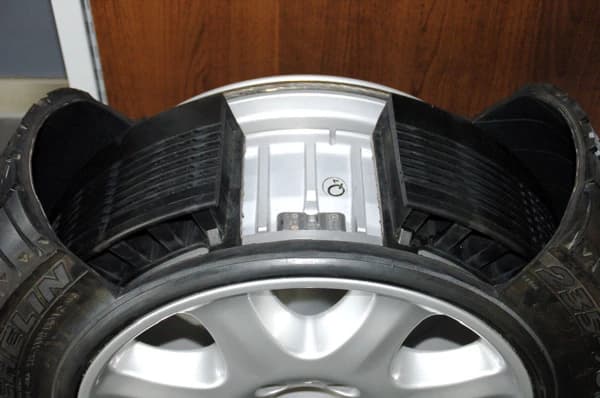
In a self-supporting run-flat, reinforced sidewalls temporarily carry the vehicle after inflation pressure is lost. Bridgestone distinguishes this arrangement from support-ring systems, where a separate structure inside the tyre carries weight beneath the tread. Both provide extended mobility, but their construction should not be treated as interchangeable.
The archival photograph accompanying this guide, taken in 2006, shows an internal support-ring arrangement. It illustrates that second approach rather than the reinforced sidewalls of a contemporary self-supporting tyre. A visible ring inside a cutaway is therefore not a reliable guide to what is inside a tyre bearing a ZP or ROF marking.
Goodyear makes another useful distinction in its consumer guidance: RunOnFlat construction does not reduce the likelihood of punctures or damage. Its purpose is to provide some mobility afterwards. Calling these tyres puncture-proof obscures the decision the driver still has to make when the pressure warning appears.
The dashboard warning matters even if the car feels normal
An ordinary deflated tyre can change the vehicle's behaviour noticeably. A run-flat's supporting structure can make pressure loss less obvious. This is why Bridgestone, Michelin and Goodyear specify tyre-pressure monitoring, rather than suggesting drivers rely on appearance or steering feel.
TPMS is an operating requirement for the systems described here. It is not a substitute for checking pressures. Goodyear advises a manual pressure check at least once a month, along with regular visual inspection. A tyre designed for temporary operation without pressure still needs correct inflation in everyday driving.
After an alert, reduce speed and follow the vehicle handbook's emergency instructions. The aim is to reach a suitable safe location or tyre specialist, not to extract every kilometre from the advertised allowance. A nearby workshop is more useful than an extra stretch of a planned journey made simply because the headline limit has not yet been reached.
Goodyear warns that excessive distance or speed on a damaged run-flat creates heat and wear that can compromise the sidewall. Severe damage can also put a tyre outside the circumstances in which continued travel is permitted. If the car cannot be driven as its handbook specifies, stop safely and arrange assistance.
Repair rules are more specific than a yes or no
There is no sound basis for saying all run-flats can be repaired, or that none can. The manufacturer, location of damage and history of use after pressure loss all matter. A small visible hole does not describe everything that has happened inside the tyre.
Michelin permits one professional repair of its run-flat tyres using the inspection and repair procedure applied to non-ZP products, except where the sidewall expressly prohibits repair. That is a Michelin policy with an explicit exception, not blanket permission to repair a tyre from another manufacturer.
Goodyear also allows no more than one repair over a RunOnFlat tyre's life, after professional inspection and assessment of its history. Its exclusions include damage outside the tread, sidewall injury, inner-liner damage and substantial travel at low or zero pressure. Where suitability is uncertain, its guidance is not to repair.
Continental's Australian SSR information makes repair conditional on a qualified inspection and advises against it if there are signs of operation while underinflated. That regional guidance should not be mistaken for a promise that every local workshop will repair an SSR tyre. Ask for the policy applying to the exact product in the market where it is serviced.
There is an ownership consequence here: keeping a record of when the warning appeared and what happened afterwards gives the specialist information an external inspection alone cannot supply. Goodyear also advises against buying part-worn RunOnFlat tyres because previous damage, repairs and use may be unknown.
Check the car, the wheel and the actual tyre
Michelin uses ZP or EMT markings; Goodyear uses RunOnFlat or ROF, with EMT also appearing on some older products. The tyre size by itself does not establish whether it is a run-flat. On a used car, inspect the tyres currently fitted rather than assuming the original equipment remains in place.
Approval is product-specific. Michelin says its self-supporting tyres require double-hump rims and a vehicle approved for that fitment. It advises against adding them to a vehicle that did not offer the technology originally. A different manufacturer's statement about standard-rim compatibility does not override those requirements.
Switching away from run-flats needs a check too. Pirelli's technical background notes that some cars have suspension characteristics associated with their specified run-flat tyres. Confirm the vehicle manufacturer's advice before changing construction, and establish how the car will deal with a puncture afterwards.
What to compare before spending money
Bridgestone identifies a firmer ride as a possible self-supporting-system compromise. That does not establish a universal comfort ranking: the particular tyre, wheel and car still matter. Manufacturer claims about improved comfort are not a substitute for a comparison on the relevant vehicle, and this guide contains no Carboratory ride or braking measurements.
Obtain like-for-like quotations in euros, keeping dimensions and required ratings consistent and asking what fitting and TPMS work are included. Ask about replacement availability and the workshop's inspection policy as separate questions. A generic price premium cannot describe all sizes, brands and local services.
Run-flats make most sense when their limited escape from a roadside tyre change addresses a real need and the approved fitment is available. Before ordering, locate the tyre's operating instructions and the car's pressure-loss procedure. Those documents establish what happens after the next warning, when the buying decision becomes practical.
© BMK (de.wikipedia.org), Wikimedia Commons, CC BY-SA 3.0. Converted to WebP without cropping; image distributed under the same licence.