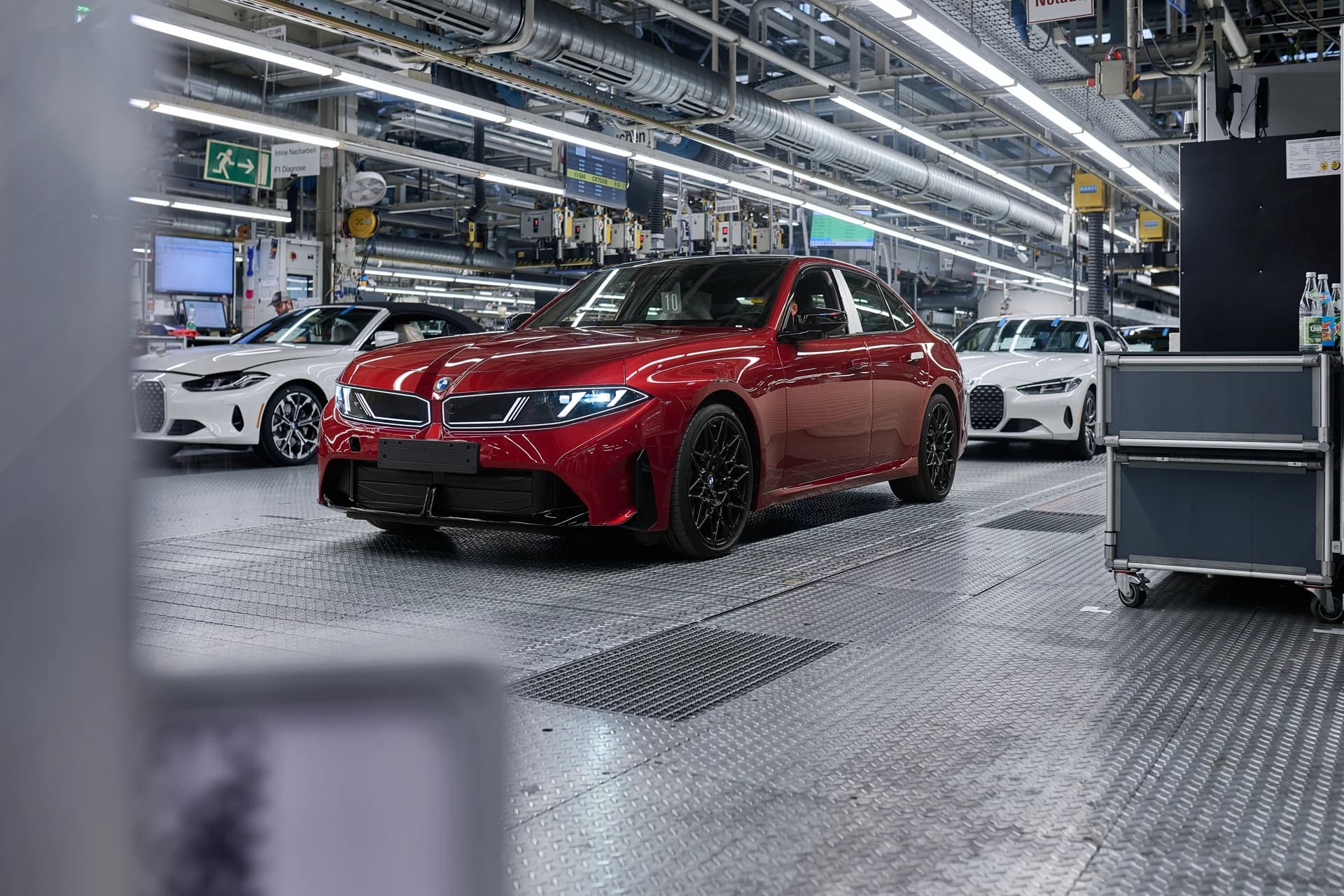
BMW has started series production of the eighth-generation 3 Series Sedan at Dingolfing in Bavaria. Its announcement on 3 November 2026 confirms that production began that week with combustion-engined variants. Plug-in hybrid versions will follow at the same plant in 2027, while the market launch is scheduled to take place in stages from the first quarter of that year.
This is a production milestone rather than a delivery promise for every customer. The release does not assign a handover date to each market or configuration. An individual order still needs its own confirmed specification and delivery terms, even though the new model is now entering the factory's series-production ramp-up.
Two German plants, different powertrain responsibilities
Dingolfing is responsible for the combustion-engined 3 Series and its future plug-in hybrids. Munich builds the all-electric BMW i3, which entered production there in August 2026. BMW is therefore dividing the new model family between two established vehicle plants rather than building every derivative at one site.
The new combustion sedan adopts the Neue Klasse design language and key technologies including Panoramic iDrive, a new electrical and electronic architecture and updated assistance systems. Sharing these features does not establish that the two cars have identical underlying construction. The production announcement describes a common technology direction alongside different powertrain and manufacturing arrangements.
It does not introduce a new performance derivative or attach fresh fuel-consumption figures to the start of assembly. This story concerns the industrial programme. The specification of a particular 3 Series remains a separate question from the date on which the factory begins building it.
Assembly hall 50 mixes three model families
The 3 Series joins BMW 4 Series and 5 Series models on a shared assembly line in hall 50. The equipment is designed to accommodate different powertrain variants. BMW has not disclosed in this release how many daily production slots will be allocated specifically to the new sedan.
Much of the paint-shop and assembly work uses existing lines and established modular processes. The principal adaptations concern Neue Klasse features, including Panoramic iDrive and the associated changes to cockpit pre-assembly. It is an integration into a working plant, rather than a claim that every production stage has been replaced from scratch.
The body shop does have a new powertrain-neutral line inside an existing building. About one third of its approximately 750 robots, along with other equipment, comes from existing production facilities. That reuse is a specific part of the investment approach; the figure should not be reported as 750 newly purchased robots dedicated to this launch.
Quality checks and material movement have separate roles
BMW identifies automatic best-fit adjustment of doors and closures and automated surface inspection among the quality-support processes. These are descriptions of factory controls. They are not independent measurements of the finished car's reliability or evidence of a guaranteed improvement in long-term ownership costs.
Inbound logistics uses automated forklifts, Splitbots and around 250 Smart Transport Robots to assist goods receipt and material supply. Those logistics machines should not be combined indiscriminately with the body-shop robot count: they perform different jobs at different points in the manufacturing process.
BMW places the work within its iFACTORY programme, which combines lean production, resource conservation and digitalisation. The company does not quantify a customer price reduction or a per-car time saving from each of these measures in the production-start release. Such conclusions would go beyond the figures it supplies.
Landshut contributes more than engine castings
The component plant at Landshut supplies crankcases and cylinder heads for four- and six-cylinder engines, together with the propeller shaft. Its role also extends into the cabin: the instrument panel, including the glove compartment, is among the components produced there.
BMW describes a new integrated light box that backlights different surface materials in the cockpit. The lighting technology moved from pre-development to industrialisation and series production at Landshut. It is a concrete example of the work behind an interior feature that appears to the customer as part of a completed dashboard.
This supply arrangement helps explain why the start at Dingolfing is a network event, not merely the introduction of a new shape on the final line. Components and cockpit preparation have to be available alongside the body, paint and assembly operations described in the release.
Keep the investment perimeters straight
The November announcement cites approximately €1 billion invested in further development of the Munich and Dingolfing vehicle plants together. It does not allocate the whole amount to Dingolfing. BMW's separate statement of 30 September identifies another approximately €1 billion for the Irlbach-Straßkirchen battery plant.
That earlier announcement puts the combined vehicle-production and battery-manufacturing investment at roughly €2 billion. It also describes around 760 supplier production locations feeding Munich and Dingolfing during the ramp-up, more than 70% in Europe and more than 30% in Germany. Locations are not necessarily individual supplier companies.
The battery investment supports the electric side of the new family. It should not be presented as a further €1 billion spent solely on the combustion sedan's final assembly line. Separating the two scopes makes the industrial totals understandable without inflating the spending attributed to any one plant.
A return with a long, interrupted history
Dingolfing began building the first-generation E21 in 1980. Several generations of 3 Series Sedan followed until 2004, and the site built the 3 Series Gran Turismo between 2013 and 2021. More than 1.15 million 3 Series vehicles have been manufactured there in total; that does not imply uninterrupted production of every generation.
BMW lists around 18,000 employees, approximately 950 apprentices and roughly 1,350 vehicles a day for the Dingolfing site as a whole. The daily figure covers its wider model programme, not just the new 3 Series. The next announced steps for the sedan are the phased market introduction from early 2027 and the addition of plug-in hybrid production during that year.
Photo: Rainer Haeckl / BMW Group. Supplied with the production announcement; resized and converted to WebP for press use. BMW usage terms.