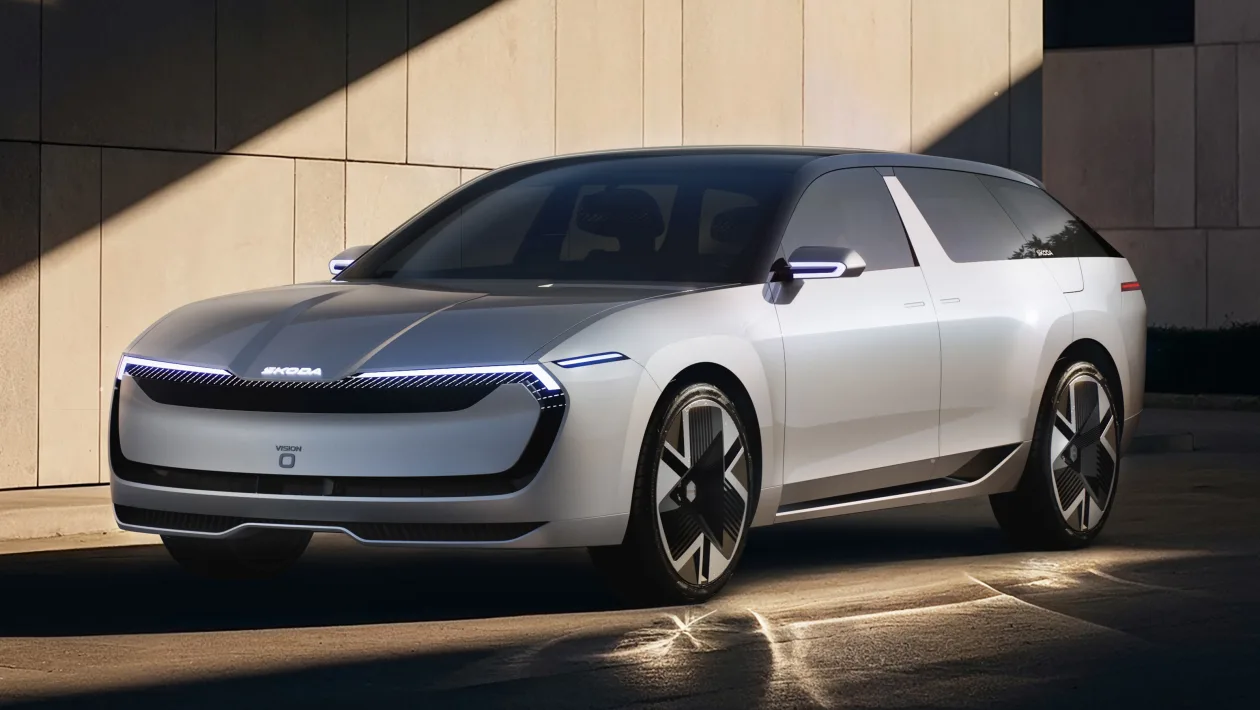
The Škoda Vision O concept. Official Škoda Auto image; it illustrates the brand’s design direction and is not an AI-generated design tool output.
Škoda designer shocked by how good AI is at turning sketches into car designs
Artificial intelligence is becoming part of the early, exploratory phase of car design. Karl Neuhold, Škoda’s head of exterior design, says he has been surprised by the quality of the results produced by generative AI. In an interview with AutoWeek, quoted by Motor1, he explained that a rough sketch can be turned into several convincing vehicle images in seconds.
The important distinction is that this does not mean Škoda is handing its design identity to an algorithm. Neuhold describes AI as a tool that helps designers test ideas faster. The person still provides the starting concept, the proportions, the visual intention and the judgement needed to decide whether a result is useful. AI can expand the number of options on the table, but it does not independently decide what a production Škoda should look like.
Why the result is so useful at the beginning of a project
Car design starts long before a physical prototype exists. Designers work with sketches, references and rough digital models while trying to establish a vehicle’s stance, surfaces, lighting graphics and relationship with the rest of the brand. Many ideas disappear during this stage because they are not technically feasible, do not communicate the right character or simply fail when seen from another angle.
Generative AI can produce a visual response almost immediately. A designer can request alternative front ends, rooflines, wheel designs, materials or lighting signatures and compare them with the original direction. The output is not automatically correct, but it can make an abstract discussion more concrete. A team can see what a proposal might become before investing the same amount of time in a polished manual rendering.
Neuhold’s reaction is significant because experienced designers have seen image-generation systems improve quickly. Earlier tools often produced inconsistent wheels, distorted glazing or surfaces that did not connect properly. A modern system can deliver a much more credible impression of a vehicle, which makes it harder to dismiss as a novelty. That is why the technology is both exciting and unsettling for the people whose work it touches most directly.
A convincing picture is not a production design
The limitations remain substantial. A generated image can show a beautiful body side while ignoring crash structures, pedestrian protection, visibility, cooling, door mechanisms or the packaging of electric components. It may also combine details from existing cars without understanding why those details work together. The visual result can be persuasive while the underlying proposal is impossible to manufacture.
The same applies to brand identity. Škoda’s official design material presents Modern Solid as a coherent language that combines a clear appearance with practicality. A generative system can produce many fashionable shapes, but it cannot be trusted to protect that language without a human brief and a human review. Designers must reject attractive ideas that are generic, impractical or inconsistent with the brand.
Škoda’s Vision O is a useful illustration of the difference between technology and authorship. The official Škoda design page describes the electric estate concept as a preview of the brand’s future direction, with Modern Solid styling, advanced aerodynamics and AI-based solutions for the user experience. The concept shows how AI can also appear in the vehicle itself. It does not prove that the exterior was designed autonomously by AI.
AI can remove repetitive work
The strongest case for AI in a design studio is speed. Preparing a polished visualisation has traditionally required time, software knowledge and repeated manual corrections. If a system can create a first visual pass from a simple sketch, designers can spend more time comparing ideas, correcting proportions and discussing the consequences with engineers.
That matters because car programmes involve many constraints at the same time. A form must look distinctive, but it also needs to work with aerodynamics, lighting regulations, manufacturing processes and the interior package. Faster images allow a team to identify conflicts earlier. They can also improve communication between people who think in different formats: a sketch artist, a clay modeller, an aerodynamicist and a programme manager may all interpret a rough proposal differently.
Škoda already describes AI as a broader development tool. An official Škoda Mobil interview says the company uses AI to complement human skills in virtual development and testing, data analysis, wheel-aerodynamics optimisation, airbag deployment and powertrain work. These applications show a pattern: AI is most useful when it handles large amounts of information or accelerates a defined task, while people remain responsible for context and trade-offs.
The career question is harder
Neuhold also points to a potential cost. If AI can create a convincing render in seconds, design departments may need fewer people for some visualisation tasks. Entry-level designers have often learned by producing variations, cleaning up drawings and making presentation images. Those jobs were repetitive, but they provided a route into the profession and taught important habits.
Removing too much of that work could make it harder for young designers to build experience. The likely response will be a change in the skill set rather than the disappearance of the profession. New designers may need to combine traditional drawing, 3D modelling and materials knowledge with the ability to write precise prompts, identify visual errors and guide an iterative AI process.
That changes the meaning of authorship. The person who selects a result, rejects ten others, corrects the proportions and explains why the proposal belongs to Škoda is still doing design work. The tool can make the process faster, but speed does not remove responsibility.
What this means for future Škoda models
There is no evidence that a future production Škoda will be designed entirely by an algorithm. The more realistic expectation is that AI will appear between the first sketch and the more formal engineering stages. It may help teams explore more alternatives, communicate earlier and reduce the time spent on repetitive visual tasks.
The result could be more experimentation, but only if designers remain willing to discard attractive but unsuitable outputs. Neuhold’s surprise is therefore both a compliment and a warning. AI is good enough to deserve a place in the studio. It is not good enough to remove the studio’s human judgement.
Frequently asked questions
Is Škoda replacing its designers with AI?
No such decision has been announced. Neuhold described AI as a tool used by designers during exploration, not as an autonomous replacement for the design department.
What can generative AI do in car design?
It can turn sketches or visual instructions into multiple concept images, helping teams compare directions quickly and discuss a proposal more concretely.
Can an AI image be used directly for production?
Not by itself. The proposal still requires engineering checks, safety validation, manufacturing decisions, brand review and many design iterations.
What does the image in this article show?
It shows the official Škoda Vision O electric concept. It is used to illustrate the brand’s design direction and is not presented as an AI-generated image.