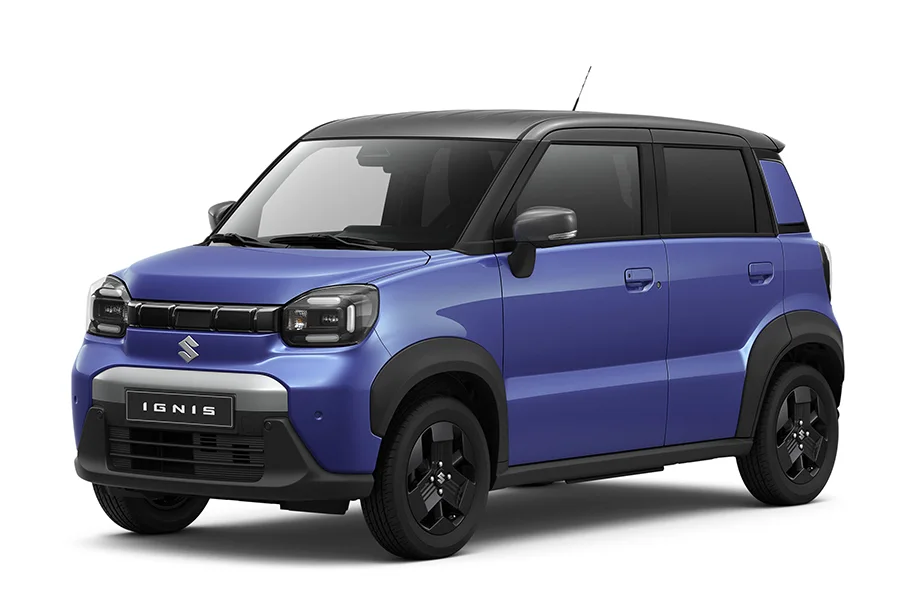
Suzuki has revived the Ignis name for a four-seat electric city car with a 26 kWh lithium-iron-phosphate battery and a 67 kW, or 91 hp, front motor. The company unveiled the production-bound model on 25 November 2026 and says sales will begin progressively in Europe and other markets from summer 2027. Prices, WLTP range, charging rates and individual country launch dates have not been announced.
The manufacturer calls it its first compact EV for global markets. That description places it below the larger e Vitara and gives Suzuki a way to apply its small-car and Japanese kei-car experience to an electric vehicle designed for dense urban areas. It is a genuine official programme rather than a rumour, although the vehicles shown are still described as pre-production examples.
A particularly narrow European EV
The European specification is 3,570 mm long, 1,565 mm wide and 1,635 mm high, with a 2,460 mm wheelbase and 150 mm of ground clearance. Its 9.0-metre turning circle, equivalent to a 4.5-metre minimum turning radius, should be useful on confined streets and in small parking spaces. Few current European EVs combine such a short body with this narrow a footprint.
There are four seats, but Suzuki has not released boot capacity or kerb weight. Those omissions matter: a compact exterior does not by itself establish how useful the cabin will be, while mass will influence efficiency, ride and performance. The battery is mounted beneath the floor within a dedicated HEARTECT-e electric platform, so this is not simply the former petrol Ignis converted to battery power.
Suzuki describes the design with the words “Smart, Iconic, Cozy”. A flowing shoulder line, a visually floating roof and LED signatures inspired by digital numerals distinguish the exterior. Inside, a rounded line runs from the dashboard into the doors, while a wide display sits above a tray said to take inspiration from pottery. These are the maker's design claims; material quality and ergonomics will require assessment in a series-production car.
26 kWh LFP battery, but no range yet
The compact eAxle combines the motor, inverter and reduction gear. Output is 67 kW, equivalent to 91 hp, and peak torque is 133 Nm. Drive goes to the front wheels. Suzuki has not quoted acceleration or maximum speed, so there is no official basis for judging straight-line performance.
The 26 kWh battery uses lithium-iron-phosphate chemistry. LFP cells are commonly associated with long cycle life and thermal stability, but chemistry and nominal capacity are not enough to calculate a dependable driving range. Suzuki has disclosed neither usable capacity nor WLTP energy consumption. AC and DC charging power, rapid-charge time and the availability of battery preconditioning or a heat pump also remain unknown.
Suzuki Germany says homologation, consumption and range will be determined closer to market launch. It also warns that specifications, colours and materials may change before production. That makes any range estimate premature. A small pack could keep cost and mass down for urban use, but its real convenience will depend on efficiency, the usable energy window and how quickly it can recover charge on a longer journey.
An EV-specific chassis and blended braking
The HEARTECT-e architecture places the battery under the floor. Suzuki says the suspension has EV-specific tuning and that development cars were tested in cities and on winding roads in Europe and other regions. Engineers adjusted the setup using the resulting road data, but the company has not published weight distribution, body rigidity or detailed rear-suspension information.
Regenerative and hydraulic braking are coordinated through an electric brake booster. The front axle uses ventilated discs and the rear axle drums, with 175/65 R15 tyres listed for the German specification. Rear drums are not unusual on small EVs: regeneration handles part of the deceleration demand, while an enclosed drum can be less exposed to corrosion during infrequent mechanical use.
Suzuki also refers to an easy-operation accelerator pedal. The official information does not say whether the car can decelerate to a complete stop without the brake pedal, so it would be misleading to present full one-pedal driving as confirmed equipment.
The Honda Super-N is context, not a declared target
Honda's Super-N is an obvious market reference for a very small Japanese electric car. The UK model went on sale in 2026 with a 47–70 kW e-Axle range and a more playful brief that includes Boost Mode, simulated seven-speed shifts and active sound. Honda also advertises roughly 320 km of city range in Britain, converted from its local figure, but that result should not be treated as directly comparable with a still-unpublished Ignis WLTP result.
This comparison is editorial context. Suzuki has not named Honda and has not said the Ignis was developed specifically to attack the Super-N. The two models nevertheless suggest that Japanese manufacturers are returning attention to compact electric cars after much of Europe's early EV growth concentrated on larger, heavier crossovers.
The production Ignis also has a relationship with the e SKY introduced in Japan in November 2026. Suzuki says the global car uses that model's body and powertrain as a foundation, then incorporates tuning informed by testing in Europe and other regions. It is therefore neither an unrelated badge exercise nor necessarily identical to the Japanese car in every market detail.
What European buyers still need to know
Suzuki's summer 2027 timing applies to a progressive European rollout, not a guarantee that every country will receive the car on the same date. Local prices, trim structures, warranty terms and order books will be announced separately. The company has not yet specified its Euro NCAP equipment or rating, either.
The unanswered questions are unusually important for this type of vehicle. Buyers need the combined WLTP range, DC peak and charging curve, AC charger capacity, boot volume, kerb weight, safety equipment and final transaction price. A modest battery can make excellent sense in a city car if it produces a lighter and more affordable product; it can also restrict flexibility if charging is slow or winter efficiency is weak.
For now, the confirmed package is clear but incomplete: a 3.57-metre, four-seat EV with 91 hp, 133 Nm, a 26 kWh LFP battery and a very tight turning circle. Suzuki has chosen dimensions and hardware that fit the Ignis name's urban character. Whether it becomes one of Europe's most useful small EVs will depend on the range, charging and price figures still to come.