Tata Motors has taken control of Iveco Group following the initial settlement of its tender offer on 30 October 2026. The bidder holds 89.42% of Iveco's common share capital, excluding treasury shares. Customers are being told that existing contracts, warranties and support arrangements will continue, while Iveco retains its headquarters in Turin.
The companies presented their combined commercial-vehicle business on 3 November. That operational milestone should not be confused with ownership of every outstanding share: the offer's additional acceptance window runs from 2 to 6 November, with settlement for those shares scheduled for 13 November.
Control has changed before the minority process is finished
The formal settlement release identifies the bidder as TML CV Holdings B.V., wholly owned by TML CV Holdings Pte. Ltd. It held 238,157,212 Iveco common shares after the initial payment. The cash offer price is €14.40 per common share under the offer documentation.
Further steps concerning remaining shareholders are a separate part of the process. The companies say details of applicable post-offer procedures will follow, including potential purchase, squeeze-out or reorganisation arrangements. Their announcement of control does not establish that those later procedures have already been completed.
Governance has changed as well. N. Chandrasekaran is Iveco's chairperson under the board composition announced on 30 October. Olof Persson remains listed as executive director and chief executive. Tata Motors managing director and CEO Girish Wagh also sits on the board as a non-executive director.
The fourth-place claim has a narrower scope
The companies describe a combined business with approximately €21 billion in revenue and around 590,000 vehicle sales. These figures illustrate the scale brought together. They should not be read as revenue newly generated by the combined operation in the few days since settlement.
The announcement calls the business the world's fourth-largest commercial-vehicle manufacturer, but its footnote defines the comparison as truck sales volumes in the segment above 6 tonnes. That qualification matters. It is not a ranking of every commercial-vehicle category combined, nor a league table based on the €21 billion revenue figure.
The wider footprint includes more than 130 countries, 27 manufacturing sites, 25 research and development centres and approximately 9,300 sales and service centres. The companies put the combined workforce at more than 73,000 people. Those totals describe an existing industrial and customer network, not a claim that the transaction has created that many new jobs or facilities.
Iveco keeps its industrial identity
The joint statement says Iveco Group will remain headquartered in Turin, with its brands, teams and industrial footprint retaining distinct identities. Tata Motors says it will support Iveco's existing strategy and investment plans. This is a stated operating principle rather than an announcement that the brands will immediately become one badge.
At the Turin presentation, Chandrasekaran described long-term investment and a two-way exchange of technology and expertise. The statement does not assign new investment budgets to individual factories or publish a schedule of shared models. Claims about innovation and access to markets remain ambitions until specific programmes are announced.
That distinction is useful for customers considering a purchase now. A new controlling shareholder can set strategic direction, but the release does not itself revise the specification, selling price or delivery schedule of an individual truck. Those remain matters for the relevant vehicle offer and contract.
Why the portfolios fit together
Tata Motors brings a commercial range spanning cargo vehicles from below one tonne to 55 tonnes, alongside passenger-transport products with 10 to 51 seats. The joint document highlights its capabilities in India and emerging markets in Asia, the Middle East and North Africa.
Iveco contributes light, medium and heavy commercial vehicles and urban and intercity buses, with established positions in Europe and Latin America. FPT adds powertrain activities covering road, off-road, marine and power-generation applications. The acquired perimeter is therefore broader than trucks carrying the Iveco badge alone.
Across the two businesses, the stated technical capabilities include combustion engines, natural gas, battery-electric propulsion and hydrogen. This is a description of available expertise. It does not mean every model will receive every powertrain, or that a particular shared electric truck has been approved for production.
The companies expect cooperation in engineering, sourcing, distribution and customer networks to support future development. They have not put a quantified saving for a truck buyer alongside that promise in the joint statement. Nor have they announced that all Iveco outlets will immediately stock Tata-branded vehicles.
Defence was separated before Tata gained control
Iveco's former defence business is outside this acquisition. Leonardo completed its purchase of the IDV and ASTRA activities on 18 March 2026. It reported a €1.6 billion price, reflecting the previously agreed €1.7 billion enterprise value less contractual adjustments.
The separated activities had been organised under IDV Group S.r.l., whose entire share capital Leonardo acquired. This was a distinct transaction completed months before the Tata settlement. Counting those military-vehicle operations as part of Tata's newly acquired Iveco business would misstate the deal's scope.
What operators are being promised now
The immediate customer commitment is continuity. According to the joint release, existing customer contracts, dealer and supplier relationships, warranties, aftermarket commitments and captive-finance arrangements continue unchanged, supported by the same teams and networks.
That statement is more concrete for an existing fleet operator than a prediction about future shared platforms. It does not require customers to assume that their servicing route or warranty has automatically changed because the controlling shareholder has changed. Any individual order or maintenance arrangement should still be checked against its own terms.
The next scheduled transaction milestone is 13 November, when shares tendered during the reopened acceptance period are due to settle. Until the companies announce further results, the confirmed ownership figure from the initial settlement remains 89.42%, rather than an assumed 100%.
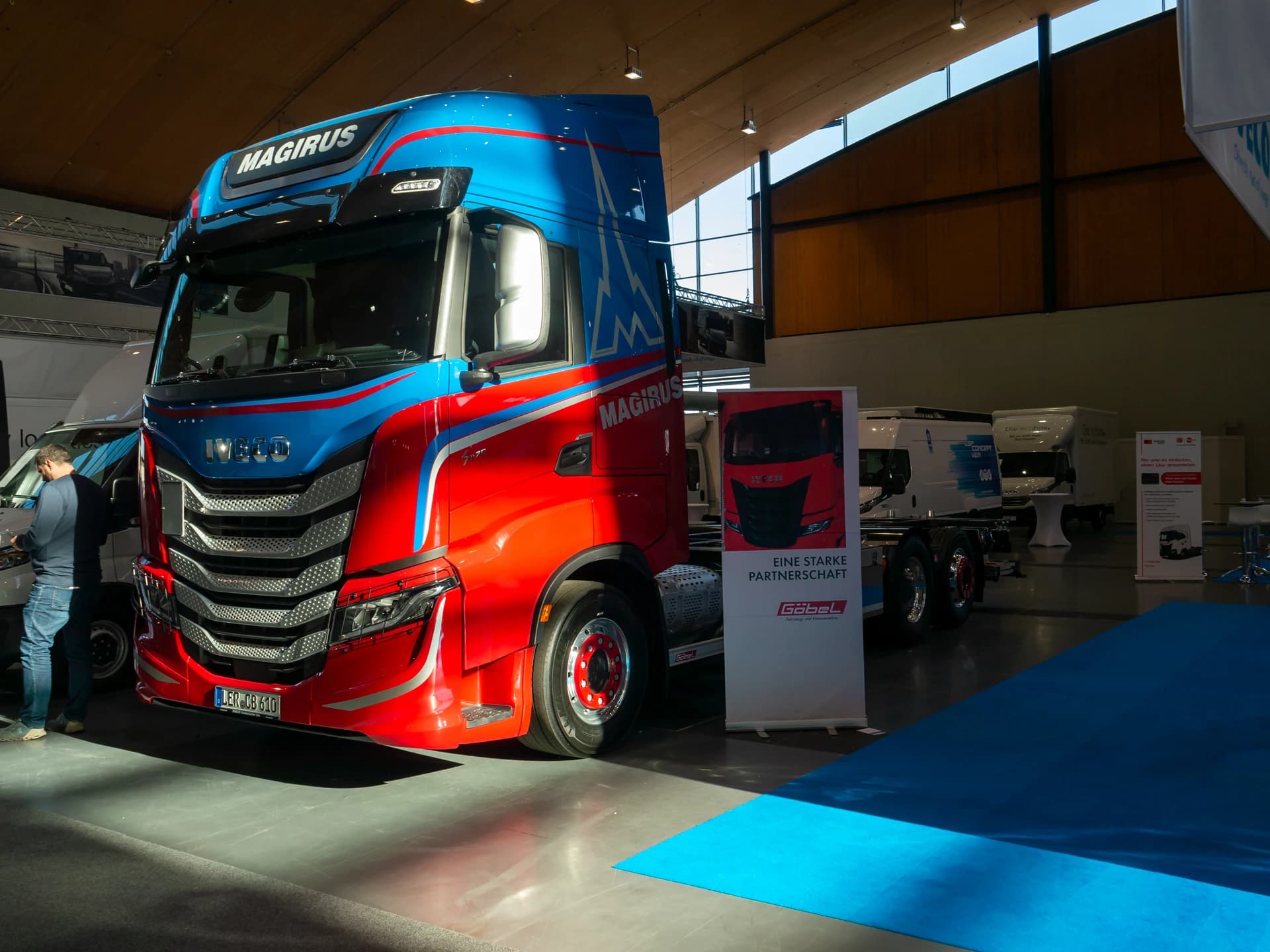
© Matti Blume / Wikimedia Commons, CC BY-SA 4.0. Archival Nufam 2023 photograph, resized and converted to WebP without cropping; image remains under the same licence.