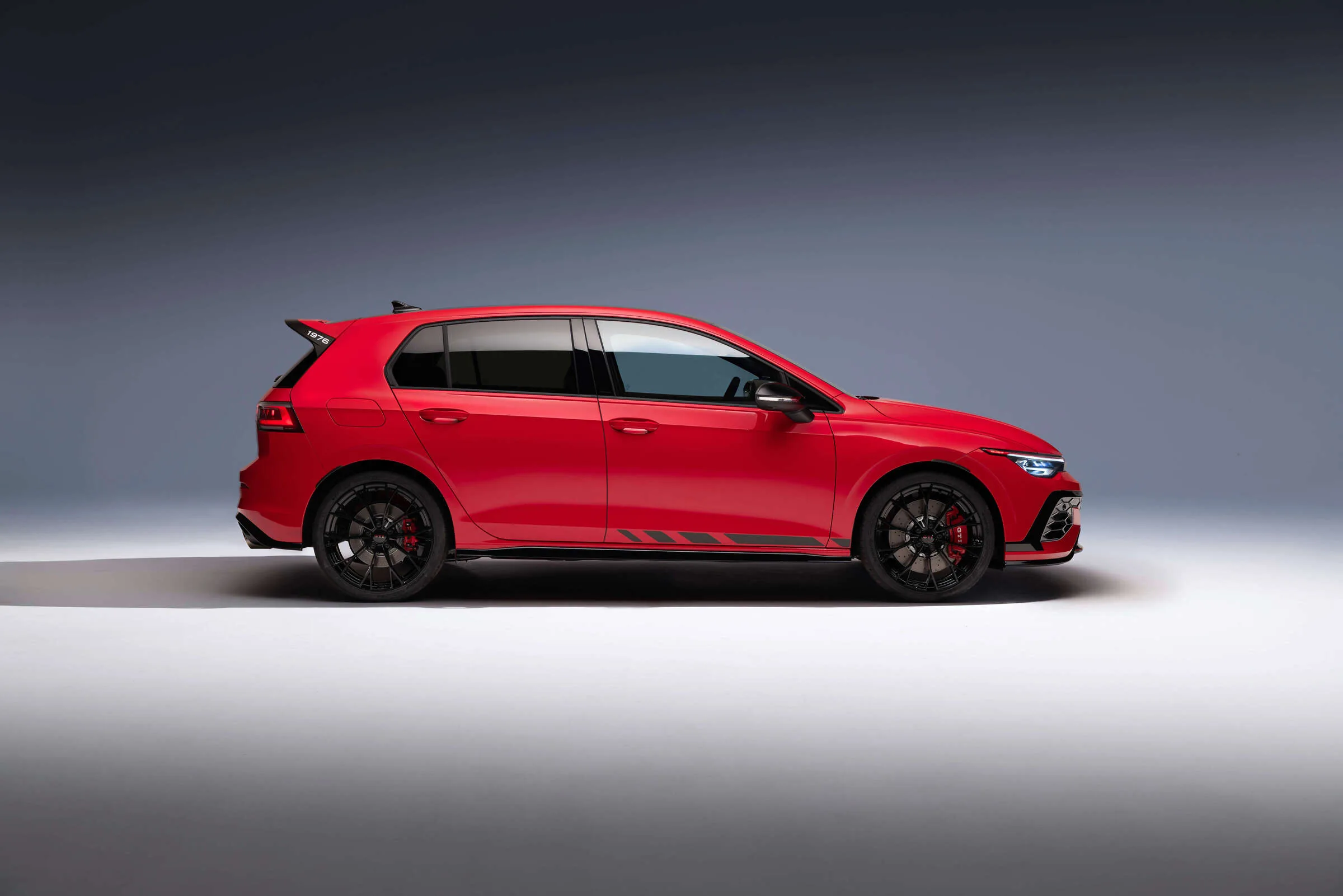
Volkswagen has unveiled a six-speed manual Golf GTI at the Essen Motor Show on 27 November. The car is called Golf GTI 1976, develops 239 kW (325 PS), and will be built in a run of exactly 1,976. Production is assigned to Wolfsburg, with a European launch planned for the first quarter of 2027. The number in the name refers to the year the original GTI appeared, rather than the gearbox fitted to that first car.
The new edition is the only manual GTI in the current Golf range, according to Volkswagen. It is not a promise that the regular GTI or Clubsport will also gain a manual option. The manufacturer has not announced a price, country allocations or an order-opening date, and labels the car as not yet available for sale.
Same output as Edition 50, different proposition
The GTI 1976 matches the 239 kW output quoted for the Golf GTI Edition 50. It has 18 kW (24 PS) more than the current Clubsport. Volkswagen gives maximum torque as 380 Nm, but the footnote identifies that figure as a forecast. A final homologated value could differ. There is no published 0–100 km/h time, top speed or weight for the new manual in the release.
Equal engine power does not imply equal acceleration to the Edition 50. Gear ratios, traction, mass and tyre choice all affect that comparison. Volkswagen has not supplied enough information for a meaningful performance ranking among these variants. What is confirmed is the combination of six manually selected gears and the highest announced Golf GTI output in this limited series.
The manual returns after the present GTI version arrived in spring 2024 without it. Volkswagen frames the car as a response to enthusiasts who wanted a high-output manual GTI. Demand is the company's explanation for the product decision, not a quantified reservation count. With only 1,976 cars planned worldwide, availability in an individual European market remains an open question.
Standard chassis equipment and a dedicated driving profile
Adaptive Chassis Control, or DCC, is standard on the GTI 1976. Volkswagen says the electronically controlled front differential lock is adapted from the Clubsport and calibrated with progressive steering and DCC. The car also receives the Special driving profile developed for the Clubsport and tailored to the Nürburgring Nordschleife. This establishes a chassis specification, but not a measured lap time.
Standard 19-inch Queenstown wheels carry the distinctive GTI design. A second red stripe in the front splitter, GTI 1976 script, graphics on the roof spoiler and mirrors, darker VW badges and a sill decal distinguish the car from other GTIs. The mirrors project a version-specific graphic onto the ground. Three exterior colours are listed: Pure White, Grenadilla Black Metallic and Tornado Red.
Inside, each example gets a “ONE OF 1976” plaque. The golf-ball-style gear knob recalls the first GTI, while new GTI seat covers, red outer-seat belts, a red accelerator, an ArtVelours-trimmed steering wheel and carbon decorative pieces mark out this edition. These details are part of the announced specification for Germany. Volkswagen explicitly warns that equipment may vary in other countries.
What the optional Performance Package changes
The GTI Performance Package is not standard across the limited run. It adds a lighter R-Performance exhaust with titanium tailpipes, 19-inch Warmenau forged wheels and a substantially revised chassis. Volkswagen says the forged wheels reduce unsprung mass compared with the standard alloys, but the release does not quantify a resulting lap-time improvement.
With the package, ride height is 5 mm lower than the Clubsport chassis and 20 mm lower than a base Golf. The list of changes covers stiffer strut and control-arm mountings, altered front wheel carriers to increase camber, rear mounting changes and dedicated calibrations for DCC, steering, ESC and the vehicle dynamics manager. Semi-slick tyres can be specified as another option. The manufacturer has not given the price of the package or a performance claim for a particular tyre configuration.
Provisional combined WLTP consumption for the GTI 1976 is 7.9–8.2 l/100 km, with CO₂ emissions of 180–188 g/km. The figures are preliminary and apply to a car not yet on sale. They are not an independent road test, nor a guarantee of an owner's fuel use. Final market specifications and homologated values will be needed before comparing running costs precisely.
A name rooted in the original, not a copied gearbox
Volkswagen's first Golf GTI made 81 kW (110 PS) when it reached buyers in 1976. The original had a four-speed manual gearbox at launch. Its close-ratio five-speed became standard in 1980, according to the company's model chronology. The six-speed in the new car therefore represents a modern manual choice, while the name and golf-ball shifter supply the historical link.
The first GTI was initially planned for 5,000 units, Volkswagen says, but dealers sold ten times that number in its first year. First-generation production eventually reached 461,690. This new edition reverses the scale: its 1,976-car cap is fixed from the start. The badge is a commemorative number and a hard production limit, not evidence that every market will receive a share.
The Essen show runs to 6 December 2026. Before the planned early-2027 launch, buyers still need a price, order terms, country allocation and final performance data. Those unanswered questions are material to whether the return of a manual GTI can be experienced beyond the show floor.