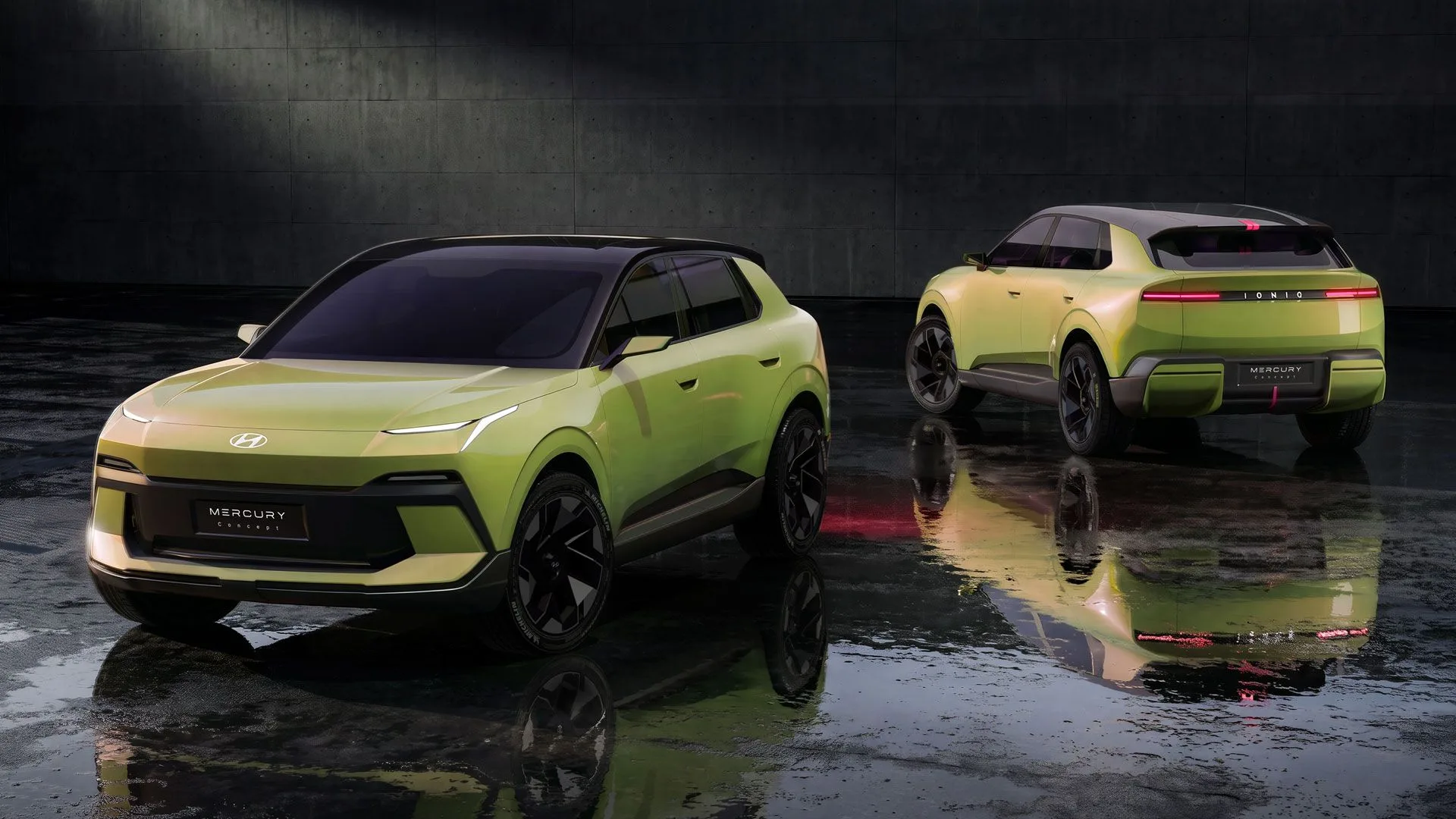
Hyundai unveiled the Mercury Concept at Auto Guangzhou on 27 November 2026 and confirmed that its production successor will be called IONIQ M. The small electric SUV is intended for China, with a launch planned for the first half of 2027 according to Hyundai Motor Group. The manufacturer has released no battery capacity, driving range, motor output or price, and has announced no European sales plan.
The distinction between the show car and the future road car matters. The bright Citrine Neon vehicle on display communicates a design direction. The promised driver assistance, connected cockpit and battery swapping belong to the production programme, but Hyundai has yet to specify how the finished version will implement them.
A Chinese B-segment SUV with a distinct face
Hyundai places Mercury in the B segment and describes it as the most accessible entry in its China-focused IONIQ universe. “Accessible” is a position in the planned range, not a disclosed price. There is no published IONIQ M price list against which buyers can test the claim.
The front has a low, pointed profile Hyundai calls a shark nose. Edge lighting forms an H motif, while the steeply raked windscreen and integrated rear spoiler give the body a forward-leaning outline. The concept also has small hidden M emblems and a bespoke yellow-green paint finish called Citrine Neon. Its side profile shows relatively clean panels, flush door handles and a window line that narrows towards the rear.
These are observable design features of the show car. Hyundai has not said which details will survive manufacturing, meet local regulations or appear on every trim. A photograph cannot establish rear-seat room, luggage volume, aerodynamic drag or crash performance. The company has not released the concept's precise external dimensions either.
Mercury was developed by Hyundai's Chinese design and engineering teams. The company says it was conceived around everyday urban travel in China. That explains the emphasis on a compact SUV rather than another large global IONIQ model; it does not establish that the same vehicle will be sold elsewhere.
Production name and timing
Hyundai Motor Group's Korean announcement explicitly identifies the road-going car as IONIQ M and targets the first half of 2027 for its Chinese introduction. Hyundai's international release gives the broader year 2027. Both are company plans, and neither supplies a customer delivery date or order opening.
The name M also sits within a different China-specific naming sequence. The Venus concept became the IONIQ V sedan, which Hyundai says went on sale in China in September 2026. The Earth concept previews a family SUV scheduled for production in 2028. Mercury therefore fills a smaller SUV slot between a sedan already launched and a larger SUV still in concept form. This sequence should not be confused with the established global IONIQ 5, 6 and 9 range.
At Guangzhou, Hyundai displayed the three China-focused vehicles together. The official event runs from 27 November to 6 December. The display confirms the design debut of Mercury; it does not give journalists a production car to test or customers a showroom specification to compare.
Driver assistance, software and battery plans
Hyundai says the IONIQ M programme involves the Chinese company ZYT, called Zhuoyu in its English release, for advanced driver assistance. The international text describes an L2++ system. This remains a supervised driver-assistance category; the label alone does not provide a list of operating conditions, a safety rating or evidence of autonomous driving. Market-specific approval and the final feature set have not been detailed.
For the cabin, Hyundai names ByteDance's Doubao conversational AI model as the basis of a smart cockpit. It has not published the final screen layout, languages supported, subscription terms, privacy controls or the degree of offline functionality. Those details would matter to an owner much more than the name of the underlying model, and they cannot be read from exterior show-car photos.
Hyundai also plans a battery-swap version with CATL. A swappable pack requires compatible stations, battery standards and commercial terms. None of these has been specified for the IONIQ M, so the announcement cannot yet be translated into a waiting time, running cost or usable network. It is a planned variant, not a service currently available to Mercury drivers.
The manufacturer has also not stated whether all IONIQ M versions will share one battery chemistry, one drive layout or identical software. Describing the entire future range by the proposed swap variant would therefore overstate what the company has disclosed.
Missing figures and what buyers can conclude
There is no official range figure under CLTC, WLTP or another cycle. Battery capacity, charging rate, acceleration, mass and towing capacity are absent as well. Without a stated test procedure, a range number taken from another IONIQ model would be misleading. Hyundai has not given the IONIQ M's exact measurements, so the B-segment label alone cannot settle interior-space questions.
No Chinese price has been announced, and Hyundai has not confirmed imports or homologation for Europe. For a European reader, that is the practical limit of this reveal. The car may be interesting as a preview of Hyundai's approach to China's crowded electric market, but it cannot yet be put on a European purchase shortlist with a delivery date and a verified price.
The company's wider China roadmap includes an extended-range IONIQ V in 2027, a production Earth model in 2028 and two further new-energy models in 2029. Hyundai Motor Group says it aims to introduce 24 models in China by 2030, a total that also includes combustion-engine successors. It is not a promise of 24 battery-electric launches.
The next meaningful checkpoint is the IONIQ M production presentation. It should reveal whether Mercury's distinctive body, the proposed CATL option and the named software partnerships reach customers as described. Until then, the firm facts are the concept's debut, the production name, the China focus and Hyundai's 2027 launch target.