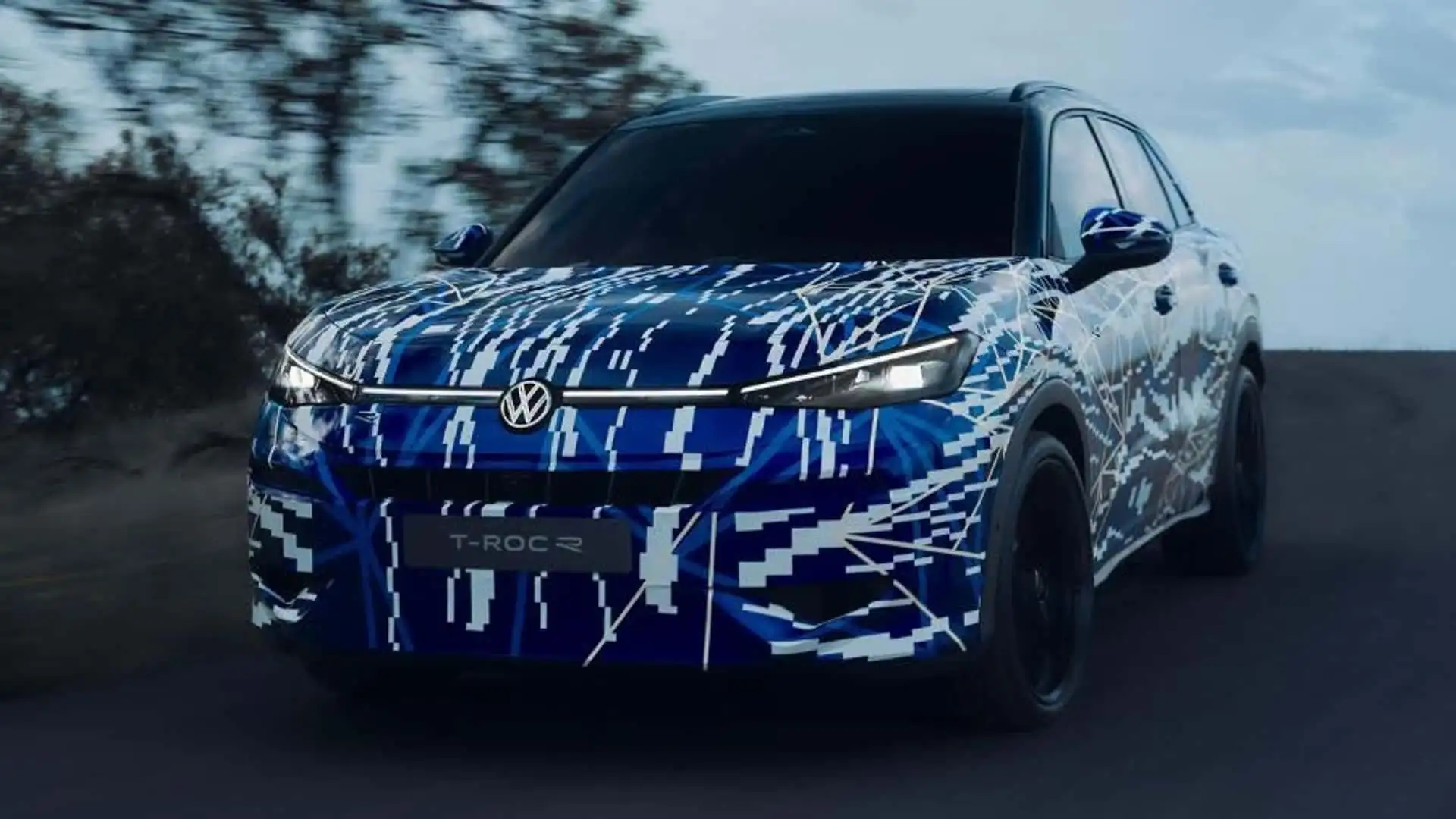
Image: Volkswagen, as published by Motor1. The car is a camouflaged development prototype and its final specifications are undisclosed.
Volkswagen has released camouflaged images of the next T-Roc R, revealing four exhaust outlets, wider-looking wheels and more aggressive rear bodywork. The photographs establish that the second-generation compact SUV will again receive a full R derivative. They do not establish the 333 hp output repeated in early reports.
Volkswagen’s own T-Roc fact sheet provides the firm technical boundary. A stronger version of the 2.0 eTSI is scheduled for the future T-Roc R at the beginning of 2027. It will use 4MOTION all-wheel drive and a seven-speed DSG. Power, torque, acceleration, price and a precise launch date are absent.
What the prototype actually reveals
The rear bumper carries a more pronounced lower section and two separate pairs of tailpipes. The wheel and tyre package appears broader than on an ordinary T-Roc, while the side treatment is distinct from the cosmetic R-Line trim. Motor1 reports 19-inch wheels on the test vehicle, although Volkswagen has not specified the production size.
Quad outlets are an established Volkswagen R cue and make this more than a styling package. Camouflage still hides the details that matter dynamically: brake size, damper hardware, cooling openings and underbody aerodynamics. A photograph cannot confirm the torque-vectoring strategy, drive modes or whether the final exhaust will keep exactly the same appearance.
Why 333 hp is a reasonable guess, not a fact
The prediction comes from the current Golf R. It combines a turbocharged 2.0-litre engine, DSG and all-wheel drive on the MQB evo architecture also used by the new T-Roc. In current European form the Golf R produces 245 kW, or 333 hp, and 420 Nm. Sharing that package would give Volkswagen a ready-made performance system.
Platform commonality does not guarantee identical calibration. The SUV has different mass, frontal area, cooling requirements and emissions targets. Volkswagen could retain the Golf output, reduce it or integrate electrical assistance differently. Until the manufacturer publishes a number, “Golf R power is expected” is accurate; “the T-Roc R has 333 hp” is not.
The electrified 2.0 eTSI family is official
Volkswagen describes the second-generation T-Roc as its first model line with an entirely hybridised engine range. The initial 1.5 eTSI mild hybrids offer 85 kW and 110 kW with front-wheel drive. A 150 kW, or 204 hp, 2.0 eTSI then brings 4MOTION, followed by a second, stronger output level for the R.
That wording confirms the engine family and timing but does not disclose the electrical system’s battery capacity, motor contribution or boost strategy. A 48-volt mild-hybrid arrangement is consistent with the range plan, yet its exact role in the R remains unannounced. There are no final WLTP consumption or emissions values, either.
The baseline T-Roc has changed substantially
The second generation uses MQB evo and Volkswagen quotes a drag coefficient of 0.29 for the regular model. It has more cabin and luggage space, a new infotainment environment and driver-assistance features drawn from larger vehicles. The normal range starts with 115 hp and 150 hp 1.5 eTSI versions, while the 204 hp 2.0 eTSI establishes the all-wheel-drive step below R.
The outgoing T-Roc R offered roughly 300 hp from a turbocharged 2.0-litre engine. Moving to a Golf R-like output would represent an increase of about ten per cent, but straight-line performance will also depend on final kerb weight, gearing and launch calibration. None of those values has been published for the new car.
The buyer questions remain open
Volkswagen has not announced a European price, standard equipment, market list or order date. It is therefore too early to calculate the premium over an R-Line or the 204 hp 4MOTION model. Warranty details for the electrified components, tyre sizes, fuel economy and insurance classification are also unavailable.
There is no confirmed US programme either. The T-Roc has historically been a European-focused model, so prototype coverage should not be read as evidence of a North American launch. Availability will depend on Volkswagen's regional product decisions, emissions approval and production allocation.
The prototype is meaningful evidence of an advanced development programme, not a completed specification sheet. Buyers can rely on four points: an R-badged T-Roc is coming, the engine is a stronger 2.0 eTSI, power reaches all four wheels, and a seven-speed DSG handles transmission. The photographed quad exhausts reinforce its performance intent. The 333 hp and 420 Nm figures should remain labelled as expectations until Volkswagen confirms them.