Volkswagen and Doğuş Otomotiv are examining passenger-car production in Turkey under a letter of intent disclosed on 30 October 2026. The filing establishes an assessment of production options; it does not announce a factory opening, an allocated model or the start of manufacturing.
The distinction matters as attention turns to Volkswagen vehicles developed in China. An existing Chinese model programme is not a Turkish production allocation, and the Doğuş disclosure does not identify a Chinese joint venture as a supplier. Nor does it announce a vehicle for European Union buyers.
What the Turkish filing actually establishes
Doğuş published its notice on Turkey’s Public Disclosure Platform, KAP, under number 1689203. The counterparty is described as Volkswagen Group Companies. The subject is the evaluation of options to produce Volkswagen-brand passenger cars in Turkey, rather than a wider list of vehicles from every brand within the group.
The field for the expected beginning of the new business relationship is empty. The section for significant contractual provisions contains a dash, and there are no attached documents. Neither a production capacity nor a factory location is set out. Those omissions prevent the notice being read as a complete manufacturing plan with a budget and delivery schedule.
Doğuş says the intended collaboration is expected to bring value-added products compatible with new technologies to the Turkish market and contribute to the country’s automotive industry. That is the company’s description of the intended benefit. It is not a reported result, a quantified employment commitment or a promise of a particular retail price.
China is several production partnerships
Volkswagen’s official China profile helps explain why identifying the precise partner would be essential. SAIC VOLKSWAGEN was established in 1984, followed by FAW-Volkswagen in 1991. Volkswagen Anhui began in 2017 with a focus on New Energy Vehicles. These are separate industrial arrangements with distinct vehicle programmes.
The manufacturer’s facts and figures, dated May 2026, list six SAIC VOLKSWAGEN vehicle plants and six FAW-Volkswagen vehicle plants, alongside Volkswagen Anhui’s Hefei MEB factory. This describes the Chinese footprint at the stated reference date. It does not identify equipment, capacity or production that has been assigned to Turkey.
The same official profile lists the Magotan and ID. AURA T6 under FAW-Volkswagen. SAIC VOLKSWAGEN’s range includes the Passat Pro and ID. ERA 9X, while the Anhui operation lists ID. UNYX models and the export-only Cupra Tavascan. The presence of an export product is useful context, but it cannot establish the destination or manufacturing route of another model.
Beijing’s premieres show the technical differences
At its pre-Auto China presentation on 21 April 2026, Volkswagen Group set out four world premieres. They illustrate the variety of its Chinese development work and the limits of treating “China-developed Volkswagen” as a single technical description. The vehicles involve different brands, partners and electronic architectures.
FAW-Volkswagen’s ID. AURA T6 was presented as an electric midsize SUV built on the locally developed China Electronic Architecture, or CEA. Volkswagen associates that architecture with Level 2 driving assistance and over-the-air updates. The announcement concerns the Chinese programme; it does not establish a Turkish specification, a European launch or a local approval date.
Volkswagen Anhui’s ID. UNYX 09 was shown as a near-production electric saloon approximately 5 metres long. According to the manufacturer, it was co-developed with Xpeng within 24 months. That development period is a company claim about that vehicle. It provides no timetable for the Turkish evaluation and should not be used to forecast when a new assembly operation could start.
JETTA X, another premiere, was an electric concept introducing a new design direction for the JETTA brand. The fourth was the AUDI E7X, described as the second production model from the China-exclusive AUDI brand and based on the Advanced Digitized Platform developed with SAIC. Neither its group ownership nor its appearance at the same event makes it part of the Volkswagen-brand subject of the Doğuş notice.
A different software programme, too
Volkswagen describes the Chinese product push as tailored to local customers, from design to cockpit services and driver assistance. That matters when discussing possible production elsewhere: the location where a car is assembled does not, by itself, describe the version, services or equipment customers in another market would receive.
The group’s April announcement also outlined onboard AI agents for CEA-based vehicles and a next-generation CEA 2.0 architecture planned for 2027. These are manufacturer plans for the Chinese technology programme. The Turkish filing does not link them to a specified car, and it does not confirm the same functionality for buyers elsewhere. Level 2 assistance should also retain its meaning as assistance, rather than being described as unsupervised autonomous driving.
What buyers and suppliers still need to know
For a buyer in Europe, the missing details are the model, powertrain, specification, price, warranty and actual market availability. The letter of intent supplies none of those for an EU offer. It therefore provides no evidence for calculating savings or recommending that a purchase be delayed for a particular Turkish-built Volkswagen.
For suppliers following the industrial project, a definitive production agreement, named location and model allocation would be more useful than a speculative catalogue drawn from the Chinese range. The present disclosure identifies an evaluation involving Volkswagen Group companies and Doğuş. The next substantive announcement would need to turn that evaluation into a defined production programme before Chinese-developed vehicles assembled in Turkey could be reported as a confirmed product plan.
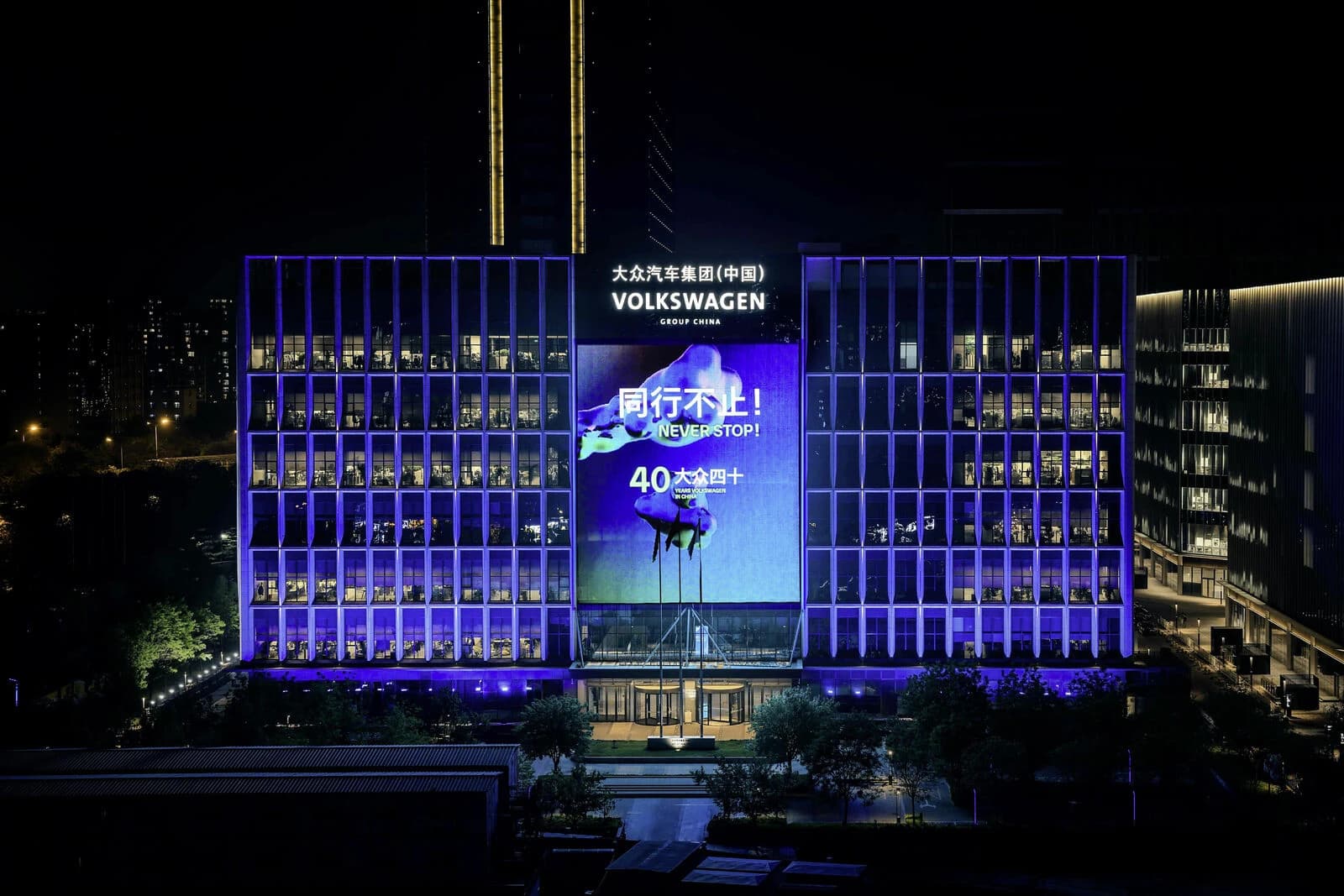
Archive image of a Volkswagen plant in China, not a Turkish production site. © Volkswagen AG, DB2024AL00229. The official image record permits free editorial use.