Audacious Automotive’s IV programme combines the visual inspiration of the original quattro with the structural and mechanical architecture of a B7 Audi RS4. Its 4.2-litre V8, six-speed manual gearbox and Torsen all-wheel drive form the basis for four engine programmes, including naturally aspirated and supercharged versions targeting 10,000 rpm.
The British company limits the programme to no more than 50 individual commissions worldwide. It also explicitly states that it is independent of Audi AG. This is a separate coachbuilding project using Audi source architecture, rather than a new quattro model announced by the German manufacturer.
The engine menu needs careful separation
Stage One is supercharged, with an advertised output equivalent to approximately 447 kW. Stage Two also uses a supercharger and is rated at approximately 559 kW. These metric figures are conversions of the builder’s published British horsepower ratings. They are announced specifications, not Carboratory dynamometer measurements.
For Stage Two, Audacious describes further work on engine internals, cooling, fuelling and the driveline. The public programme page does not supply a complete component list or independent validation report. Buyers are commissioning a defined mechanical specification rather than choosing from a conventional dealer stock list.
Two further programmes pursue the 10,000-rpm target. One is naturally aspirated; the other adds forced induction. Audacious describes dedicated engineering, manufacture and testing for the high-speed engine. It does not publish output or torque for either 10,000-rpm version, so the Stage Two power rating cannot simply be attached to the higher-revving engine.
Why an RS4 understructure matters
The company says every IV starts with the B7 RS4’s complete structural, mechanical, electrical and control architecture. Floor and lower-body structure, suspension geometry, brakes, steering, drivetrain, electrical systems and principal mounting points provide a common foundation. The stated rationale is to retain systems originally engineered to operate together.
Audacious then reworks the package for the IV’s proportions. Cooling, body construction, glazing, materials, interior and mechanical specification are developed around that foundation. Suspension character and intended use can also form part of the commission. Consequently, the public description does not amount to one final specification shared by every proposed example.
The RS4 connection has a specific historical basis. Audi’s archive identifies the 2005 model with a high-revving 4.2-litre direct-injection V8 producing 309 kW and reaching 8,250 rpm. Its standard torque split was 40% front and 60% rear. Those factory figures describe the donor architecture; they are not certification of a modified IV at its proposed engine speed.
Metal and carbon are different construction routes
The hand-formed metal version retains and develops the genuine Ur-quattro’s upper structure, roof and glazing, with new steel and aluminium bodywork integrated around the IV foundation. An original quattro therefore contributes physical structure to this version, rather than serving only as a styling reference.
The carbon-fibre version takes a different approach: it has an entirely new upper body and newly engineered glazing. Audacious says it does not require an original Ur-quattro source car. That does not remove the RS4 architecture from the programme, which remains the common engineering basis. It does mean the two construction routes should not be described as requiring an identical set of donor vehicles.
A reinterpretation with a different engine identity
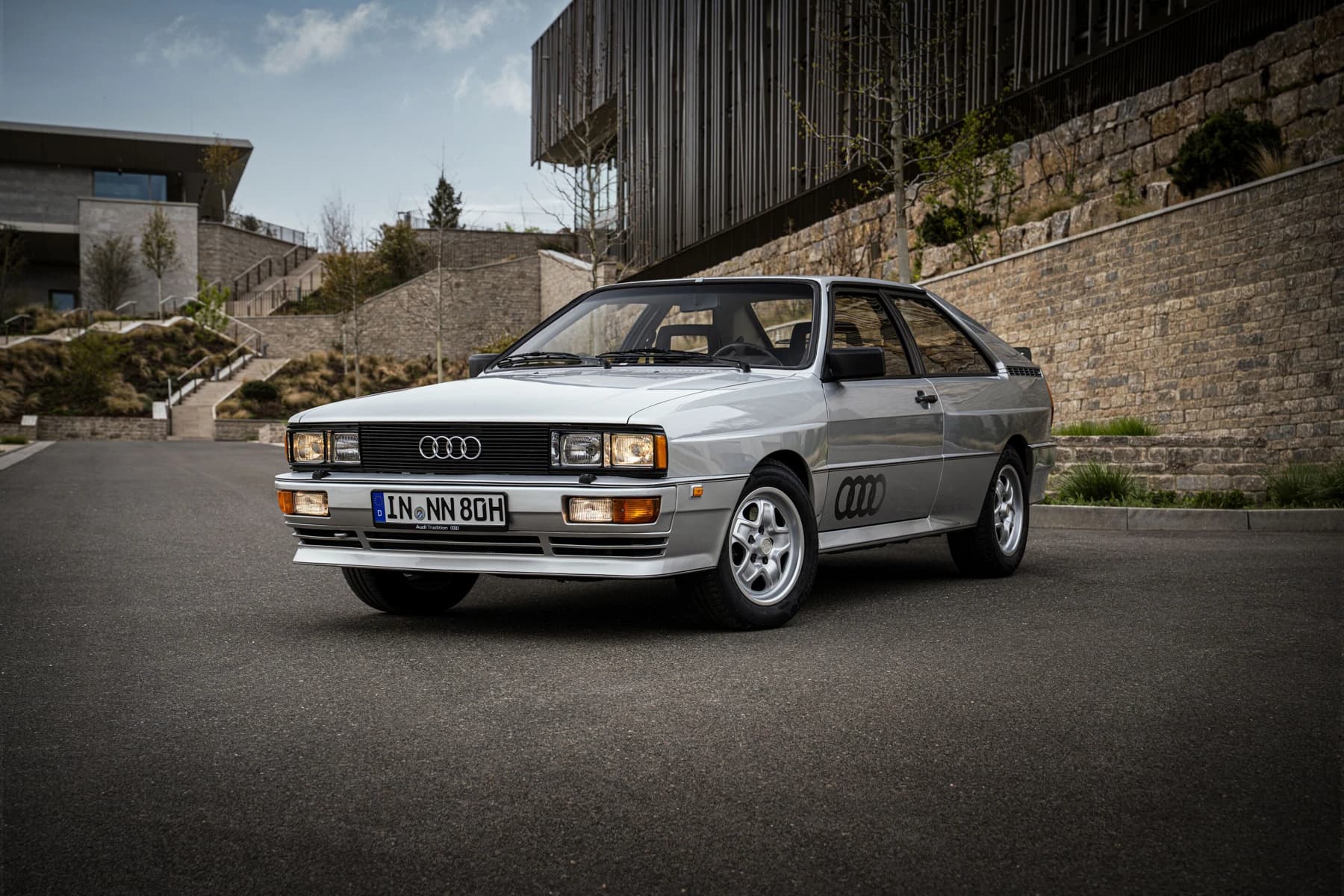
Audi introduced the original quattro in March 1980, with permanent all-wheel drive and 147 kW. That car’s five-cylinder identity is part of the historical reference behind the IV’s appearance. Choosing the RS4 V8 changes the engine concept while drawing on a later stage of Audi’s performance-car development.
The difference is also relevant to the imagery. The archive photograph accompanying this article shows an original 1980 quattro, not a finished Audacious IV or evidence of its proposed V8 installation. The builder’s website restricts reproduction of its own images without written permission; the Audi image carries explicit editorial-use permission.
Commissioning starts at roughly €420,000 equivalent
The published British starting amount converts to approximately €420,000 using the European Central Bank’s reference rate for 30 October 2026. This is an indicative currency conversion, not a euro-denominated sales offer or a final price for a particular national market.
Source vehicles, individual specification, registration and applicable taxes are additional. Prospective clients work directly with founder and designer Mac Zaglewski, and the company invites appointments at its studio near Edinburgh. Exterior detail, body materials, colour, instrumentation, trim and the cabin can be developed as part of the process.
The limit of 50 refers to the intended commission programme. It does not establish that 50 cars have already been completed or that a customer-ready 10,000-rpm engine has been delivered. The public commissioning page does not provide one guaranteed delivery date covering every configuration.
Performance remains a builder claim
Audacious’s headline maximum speed converts to approximately 322 km/h. It is a published performance claim, not an independently verified road-test result. The company’s terms say vehicle descriptions and performance figures may be indicative, projected or based on current development information.
Final specifications can depend on source vehicles, engineering work, local approval and registration requirements, materials and the eventual build decisions. A specific customer agreement therefore needs to establish the engine programme, final mechanical specification and delivery conditions. The 10,000-rpm proposition is the ambitious part of that development programme, rather than proof of a completed, universally specified production car.
Photo: original 1980 Audi quattro, archive image A260728, not an Audacious IV. Copyright AUDI AG; free editorial use is expressly permitted by Audi.
Sources
- Audacious Automotive — IV architecture and engine programmes
- Audacious Automotive — commissioning and indicative price
- Audacious Automotive — company and studio
- Audacious Automotive — indicative specifications and Audi independence
- Audi — 2005 RS 4 history
- Audi — quattro origins
- ECB — 30 October 2026 reference exchange rate
- Audi — archive image and editorial rights