Europe’s Car of the Year 2027 final will be contested entirely by battery-electric cars. The shortlist announced on 30 October contains BMW iX3, Cupra Raval, Hyundai Ioniq 3, Kia EV2, Renault Twingo, Volkswagen ID.Polo and Volvo EX60. The award ceremony takes place at the Brussels Motor Show on 8 January 2027, when one of them will succeed the Mercedes-Benz CLA.
The organiser says this is the first all-electric final in the award’s 63-year history. That establishes the winning powertrain category, but says nothing about which manufacturer will win. The seven names are published alphabetically; their position on the list carries no ranking or points advantage.
One shortlist, several different buying propositions
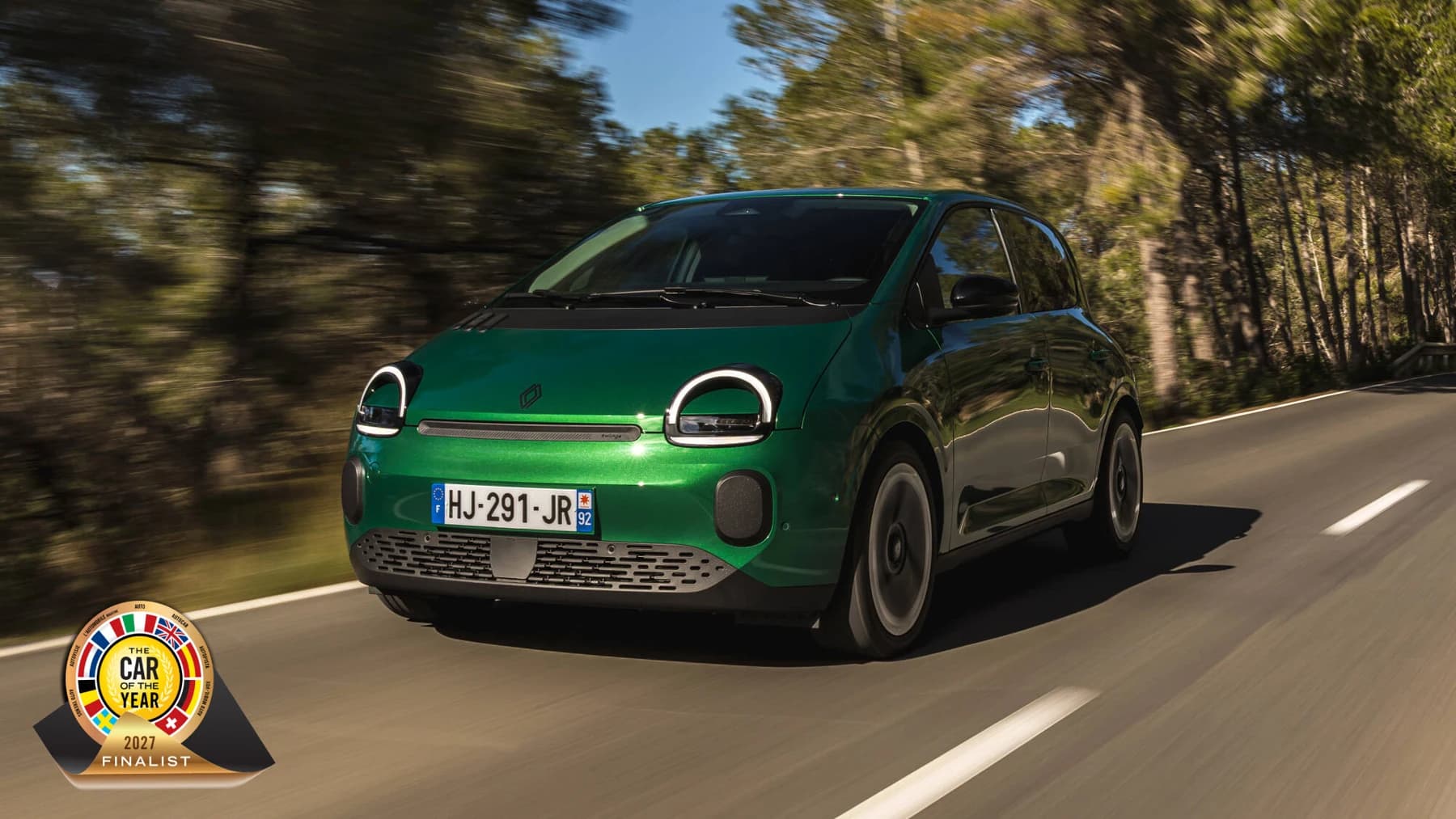
Twingo and iX3 illustrate the distance between the cars that jurors must assess. Renault’s city car measures 3.79 metres and combines a 60 kW motor with a 27.5 kWh usable LFP battery. Its claimed range reaches 263 km WLTP. BMW’s iX3 50 xDrive has 345 kW, a usable battery capacity of 108.7 kWh and an official maximum of 805 km WLTP. BMW’s launch dossier labels its WLTP figures provisional. Neither figure is a Carboratory road-test result.
The rules do not reduce that comparison to a range contest. Price, comfort, safety, functionality, handling, economy and environmental requirements are among the judging criteria. Technical innovation and value for money matter explicitly. A small urban car can therefore enter the same final as a larger SUV without needing to match its battery size or maximum charging power.
Renault also brings a particular competition record: this is its sixth successive final appearance. Megane was shortlisted for 2022, followed by Austral, Scenic, Renault 5 and Renault 4 before Twingo. Scenic won for 2024 and Renault 5 shared the 2025 title with Alpine A290. That history supplies context, rather than points for the current entry.
What the other five contenders bring
Cupra Raval offers two distinct battery families. The 37 kWh net LFP pack accompanies the 85 kW Raval and 99 kW Raval Plus, while the 52 kWh net NMC battery is used for Endurance and VZ. Cupra’s launch material gives approximately 450 km for Endurance, with 155 kW, and approximately 400 km for the 166 kW VZ Extreme launch edition. A single range claim cannot describe every Raval.
Volkswagen ID.Polo and Raval share an industrial location, with production announced at Martorell on 3 June. In that announcement, SEAT & CUPRA quotes up to 454 km WLTP for the Volkswagen and describes vehicle-to-load capability for powering external devices. The two cars remain separate entries on the official shortlist, regardless of their shared factory.
Hyundai’s finalist announcement identifies Ioniq 3 as a compact electric hatchback designed for European customers and built at İzmit in Türkiye. The Long Range version is quoted at up to 497 km WLTP. Hyundai also gives five seats and 441 litres of luggage capacity. Those are manufacturer specifications; the nomination is not an independent finding that its range or cabin leads every rival.
Kia EV2 is a 4.06-metre SUV with 42.2 and 61.0 kWh battery choices in its German launch documentation. The corresponding maximum WLTP ranges are 317 and 453 km on 16-inch wheels. Wheel size changes the published result, making the configuration as important as the model name when comparing the finalist with a dealer’s offer.
Volvo’s EX60 uses the SPA3 architecture. The manufacturer’s July delivery announcement associates up to 810 km with P12 AWD and labels the range figures preliminary, based on WLTP testing standards. Its 16-minute 10–80% charging statement concerns P6 and P10 in that release. Combining the largest range and shortest charging time as though they describe the same version would misrepresent the document.
How nomination turns into an award
The first ballot asks jurors to nominate seven cars without awarding points. The final ballot works differently: each juror distributes 25 points across at least five finalists, with no more than ten for the first choice. The top two choices cannot receive equal scores. Each voter must explain their assessment, and the highest total decides the winner.
If totals are tied, the statutes look first at how many jurors placed a car first, then at second places if required. This is a jury award with a published voting procedure, rather than a public popularity poll. The shortlist by itself provides no basis for calculating winning odds.
The next dates, and a calendar discrepancy
The announcement specific to the 2027 shortlist schedules collective testing at Balocco in Italy for 25–26 November and says votes can be cast until 31 December. The general election page still describes testing in December and gives 29 December as the voting deadline. The newer edition-specific statement is the reference used here, with the discrepancy left explicit rather than silently harmonised.
All seven finalists use electric propulsion, but the award announcement does not establish equal equipment, prices or delivery dates across national markets. Buyers should match any quoted battery and charging figures to the version offered locally. The next confirmed public verdict is the Brussels ceremony on 8 January, following the remaining testing and final vote.
Photo: Renault Twingo E-Tech electric, one of the seven finalists. Renault official press image, released with its 30 October announcement and used for editorial illustration. Finalist status does not mean it has won.
Sources
- Car of the Year — Car of the Year — 2027 shortlist
- Car of the Year — Car of the Year — statutes and voting
- Car of the Year — Car of the Year — general election calendar
- BMW — BMW — iX3 technical press dossier
- CUPRA — CUPRA — Raval launch editions
- Hyundai — Hyundai — IONIQ 3 finalist announcement
- Kia — Kia — EV2 German launch specifications
- Renault — Renault — Twingo finalist press release
- SEAT & CUPRA — SEAT & CUPRA — Martorell production
- Volvo Cars — Volvo Cars — EX60 deliveries and technical notes