McLaren has named its next series-production supercar McL 820 and confirmed an output of 820 PS. The car is coming in 2027, according to the manufacturer's announcement dated 30 October 2026. Further details will follow next year; the short release does not specify its engine, weight, price or exact arrival date.
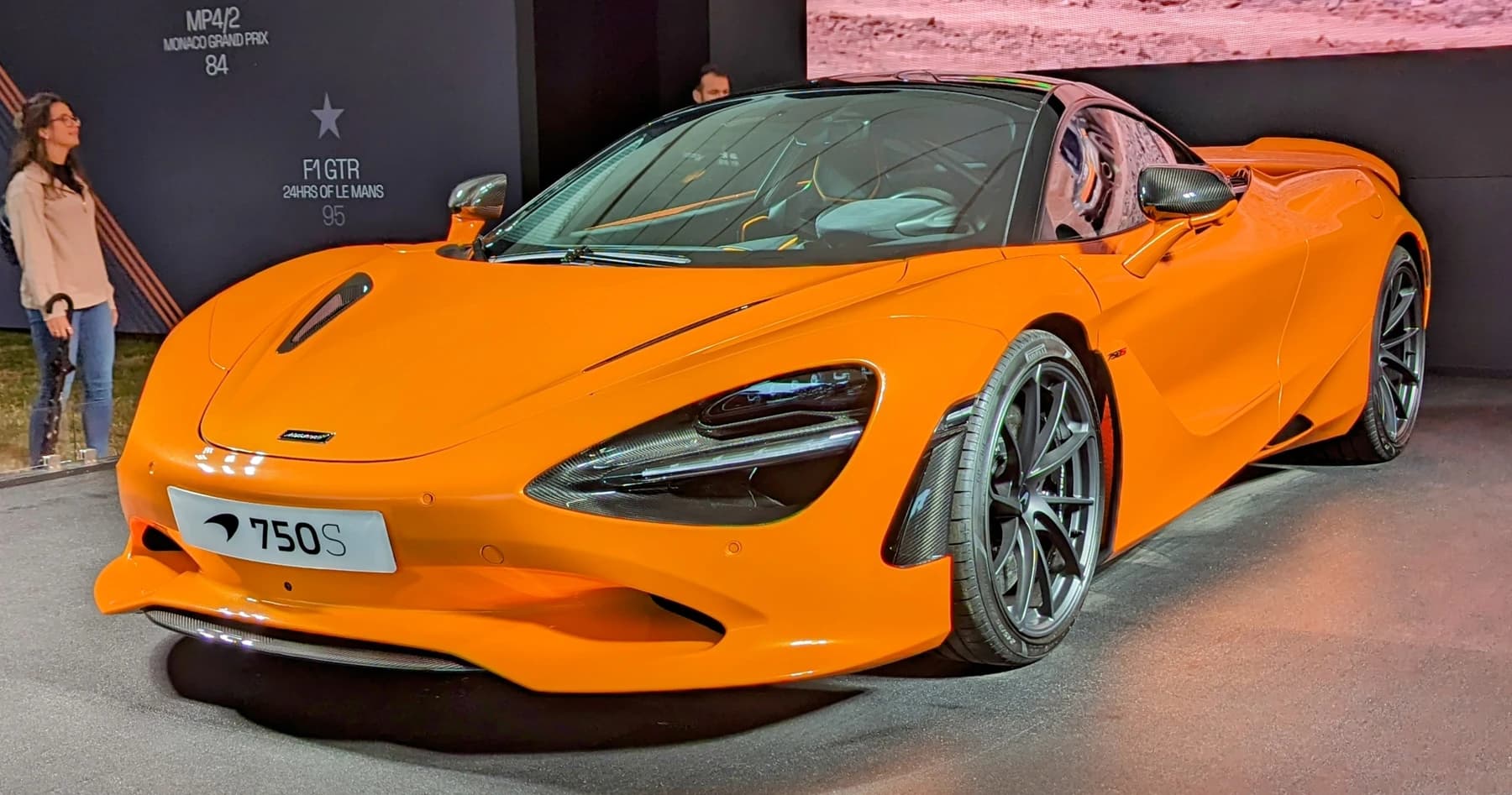
The name was revealed on a camouflaged kiwi sculpture in central London. That installation identifies the project but does not reveal the production car's bodywork. The photograph used here shows the existing 750S as a reference for the outgoing generation, rather than an image or rendering of McL 820.
The number is a power figure, not a full specification
McLaren explicitly says that 820 denotes the car's output in metric horsepower. That is approximately 603 kW. Keeping the unit attached matters: different horsepower conventions can produce different-looking numbers for the same output. This report uses PS and kW consistently so the announcement can be compared with McLaren's own technical documentation.
Against the 750 PS specified for 750S, the announced increase is 70 PS, or approximately 9.3%. Those are calculations from the manufacturer's figures. They do not establish an improvement of the same percentage in acceleration, lap time or top speed, because none of those McL 820 performance measurements has been supplied in this announcement.
Nor does the release identify how the power is generated. There is no confirmed engine configuration, hybrid system output breakdown, battery capacity or electric range in the text. A prediction about a V8 or electrification should therefore remain a prediction. The 820 PS figure alone cannot tell readers how much of the power might come from an engine or an electric motor.
What the existing 750S actually provides as a benchmark
The official 750S brochure, distributed by authorised retailer McLaren Tampa Bay, includes EU and UK specifications dated 25 April 2023. It describes a mid-mounted M840T twin-turbo V8 of 3,994 cm³, producing 750 PS and 800 Nm. Drive goes to the rear wheels through a seven-speed Seamless Shift Gearbox.
Those details belong to 750S, rather than the newly announced car. McLaren's October release does not confirm that McL 820 will retain that engine, transmission or driven-axle arrangement. A familiar numeric naming pattern is not evidence of shared mechanical components, even when the cars occupy the same broad supercar discussion.
For the 750S Coupé, the brochure lists 0–100 km/h in 2.8 seconds, 0–200 km/h in 7.2 seconds and a maximum speed of 332 km/h. These are manufacturer figures, not Carboratory test results. The Spider has the same declared power and 0–100 km/h time, but its listed 0–200 km/h time is 7.3 seconds.
That small difference is a useful reminder that power is only one input into performance. The two 750S body styles also have different weights. Without corresponding details for McL 820, there is no sound basis for assigning the new car a particular acceleration time or claiming a measured advantage over the existing model.
Weight needs the same definition on both sides
McLaren lists a lightest dry weight of 1,277 kg for the 750S Coupé, alongside a DIN weight of 1,389 kg. For the Spider, the respective figures are 1,326 kg and 1,438 kg. Comparing the lightest dry figure of one car with the DIN figure of another would distort a power-to-weight comparison before any driving takes place.
The brochure describes the Coupé's carbon-fibre Monocage II structure and a 30 kg weight reduction against its predecessor. It also documents a rear wing with 20% more surface area, including drag-reduction and airbrake functions. These give readers a reference for the existing car's engineering, without establishing the design or aerodynamic hardware of McL 820.
Other disclosed 750S components include ProActive Chassis Control III adaptive damping and carbon-ceramic brakes, with six-piston front and four-piston rear calipers. A full assessment of the new model will need equivalent chassis and braking information. The confirmed power number cannot substitute for those details or for a controlled comparison on the road or circuit.
McL links the road-car name to a wider identity
The manufacturer describes the McL prefix as drawing on its motorsport heritage. It pairs that prefix with a numerical performance identifier to create a more consistent naming approach across McLaren Automotive and Racing. This is a statement about the brand's naming structure, rather than a claim that the road car uses a Formula 1 power unit.
An official identity announcement on 22 September supplies the background. McLaren said its revised wordmark was inspired by the sign above the family service station in Remuera, Auckland, owned by Bruce McLaren's parents, Les and Ruth. The identity retained the Speedmark, papaya colour and Speedy Kiwi references associated with the company's history.
That September account also referred to the historic M6GT road-car project and the contemporary McL 6GT reveal. The similar prefix does not establish common equipment for McL 820. In particular, the October announcement does not confirm a manual gearbox, even if a separate model with a related name has prompted discussion of one.
Buyers still need a commercial timetable
McLaren has not given a euro price, market allocation or country-specific delivery schedule in the McL 820 announcement. Its 2027 statement is a general arrival window; the separate promise of more information next year does not establish an exact reveal month or customer handover date.
For a buyer comparing a 750S offer with the future car, the next useful documents will be the production specification, equipment list and local terms. Until those appear, a dealer quotation should be read for the exact car and delivery commitment it covers. The announced 820 PS is concrete, but it is still only one part of the purchase comparison.
Photo: current 750S, not the future McL 820. Resized and converted to WebP from the photograph by Calreyn88 / Wikimedia Commons, CC0 1.0.