More battery-electric car owners are considering a hybrid for their next vehicle, but that does not establish a wave of completed departures from EVs. The HERE-SBD 2026 EV perception report puts hybrid consideration among surveyed EV owners at 28%, compared with 23% in 2025. Its category includes conventional hybrids, plug-in hybrids and extended-range electric vehicles, rather than PHEVs alone.
At the same time, 76% of current EV owners surveyed say they are likely to buy or lease another battery-electric vehicle next. Both findings describe stated intentions. Neither is a count of owners who have already sold their car, changed powertrain or placed an order. The figures should not be treated as complementary shares of a single exclusive choice.
Charging confidence reaches beyond the daily routine
The survey finds that 68% of EV owners consider their charging experience better than expected, while 67% say the same about driving range. Yet 54% report having avoided a trip at least once because they were concerned about finding a charger. That is a respondent-level measure, not a claim that 54% of journeys were cancelled.
HERE’s analysis distinguishes familiar charging routines from uncertainty on less frequent journeys. An owner can find home charging straightforward and still worry about an unfamiliar public network. That interpretation helps explain why positive ownership experiences and interest in a combustion-engine backup can exist together. It does not prove that charging concerns caused every respondent’s interest in hybrids.
Reliability is another separate issue. One in five EV owners says a broken public charger once left them unable to charge; 39% say it has happened occasionally or more often. Those answers describe drivers’ experiences, not the percentage of chargers in a country that are faulty. The report does not turn them into an independently measured network uptime figure.
Who was asked, and what the comparison covers
The online survey was conducted by SBD during June and July 2026. Its 4,058 respondents comprised 850 EV owners and 3,208 non-EV owners across the US, France, Germany, Italy, Spain, the UK, India and Australia. Participants had to have purchased a vehicle from 2017 onward, be its primary driver and be the decision-maker for their next vehicle purchase.
Australia was added to the 2026 survey. The five-percentage-point increase in hybrid consideration therefore compares annual research that does not have identical geographical coverage. It should not be described as tracking the same individuals switching their decisions. The public findings also do not provide a subsequent purchase audit for the people expressing interest.
Romania is included in the separate infrastructure analysis, but not in these eight survey markets. That distinction matters when the results travel across borders. Infrastructure coverage of 30 European countries cannot make the 28% finding a Romanian, French or German national percentage; the headline figure is reported across the surveyed EV-owner group.
A hybrid is not necessarily a plug-in hybrid
HERE defines EV as a fully battery-electric vehicle, excluding hybrids. The broader alternative category contains technologies with different charging requirements. A conventional HEV combines an engine with electric assistance and recharges through the engine and regenerative braking, without plugging into an external supply.
A PHEV has both an engine and a battery that can be charged externally. The US Department of Energy explains that regular charging is the best way to maximise its electric benefits and that fuel consumption depends on the distance driven between charges. Choosing a PHEV can provide another way to continue a journey, but does not automatically remove the need for convenient charging if the owner wants to drive electrically.
Extended-range vehicles are also included in the study’s hybrid consideration category. The report does not give a breakdown of the central 28% that would justify attributing it all to plug-in hybrids. It also cannot establish, from consideration alone, how much driving those future vehicles would do using electricity or fuel.
Cost and access shape the next decision
Across all respondents, better value for money is the leading stated EV purchase or lease motivator at 36%, followed by lower running costs at 34% and environmental benefits at 33%. These are perceptions and motivations, rather than a verified ownership-cost comparison for every model and household.
Limited charging-station availability remains a barrier for 40% of all respondents, down seven percentage points from 2025. Driving range follows at 37%, down six points. The denominator here is all survey participants, unlike the EV-owner group used for the 28%, 68% and 54% findings. Keeping those groups separate avoids making one result appear to contradict another.
The infrastructure index answers a different question
HERE and SBD combine the survey with a market-maturity index. Four metrics can contribute up to 25 points each: public chargers relative to road length, average charger power, EV fleet share and public chargers relative to the number of EVs. The maximum overall score is 100.
That ranking measures infrastructure and adoption conditions; it is not a live guarantee that a charger will work or be unoccupied when a driver arrives. Its data and the opinion survey offer different perspectives on the same transition. For buyers, the practical distinction remains access to charging on their own routes, rather than treating a cross-market intention percentage as a forecast of their next purchase.
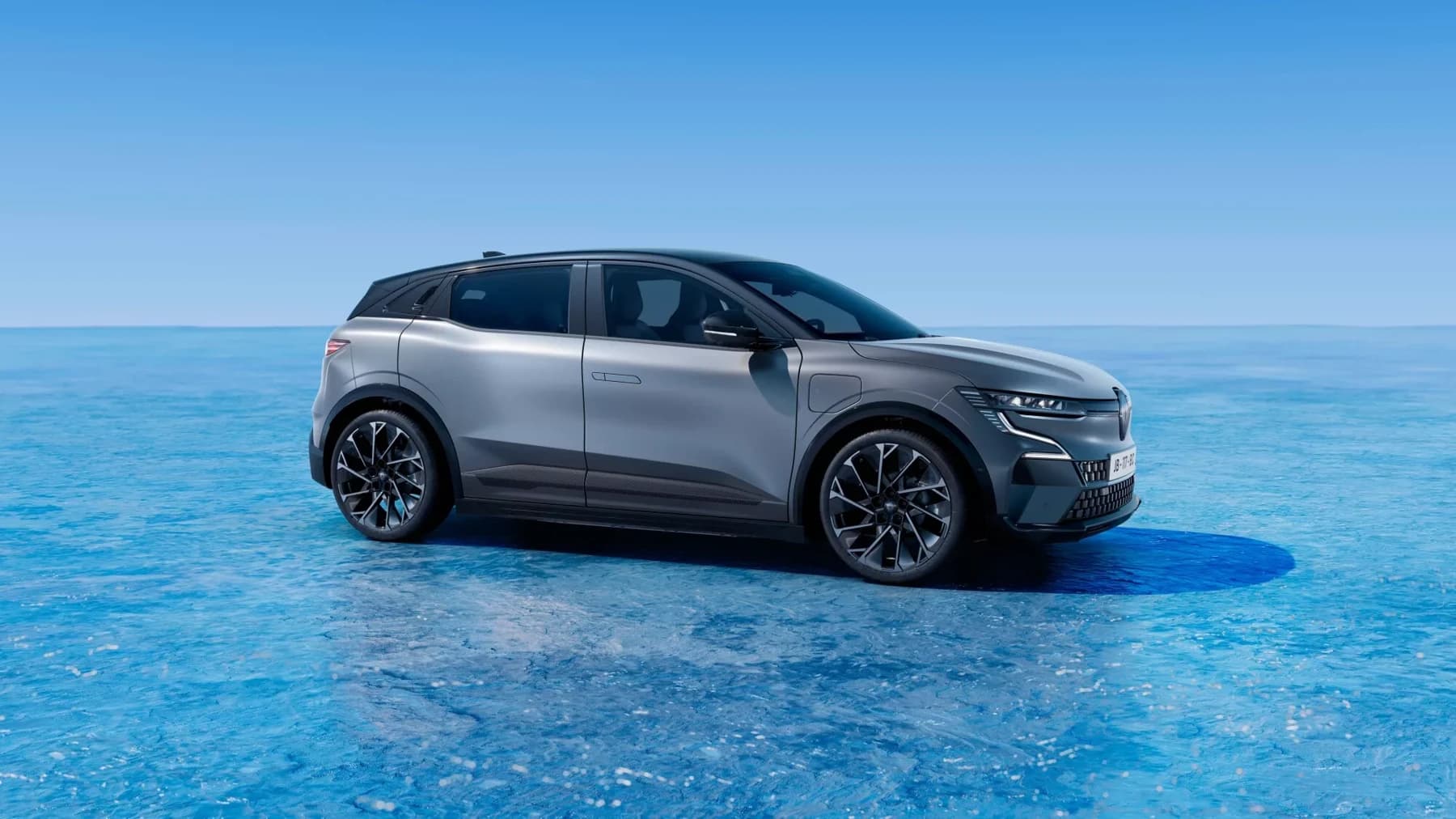
Photo: Renault Megane E-Tech electric, official Renault press image used for illustration. It does not identify survey respondents or imply findings specific to this model.