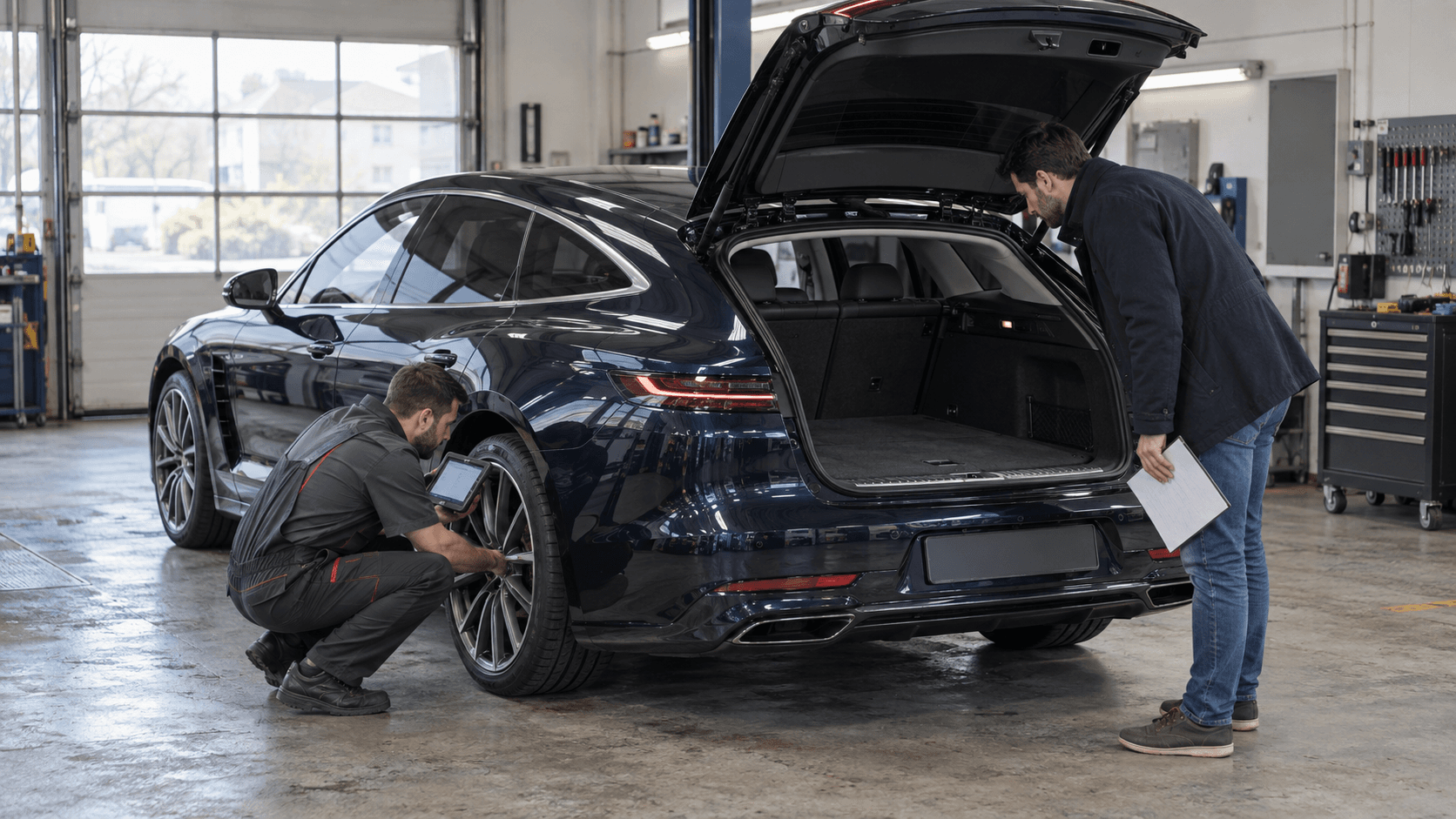
The entry price does not tell you whether the car is a full hybrid or a plug-in hybrid. Illustrative image; the cars do not represent specific models or brands.
5 Chinese hybrid SUVs under €30,000 in Romania in 2026
The short answer
On 29 August 2026, five Chinese hybrid SUVs had, on official Romanian channels, a starting, promotional or stock-unit price under €30,000: MG ZS Hybrid+, Chery Tiggo 4 HEV, BYD Atto 2 DM-i, BYD Sealion 5 DM-i and Chery Tiggo 7 HEV.
For anyone who cannot charge regularly, the three full hybrids — MG ZS, Tiggo 4 and Tiggo 7 — are the coherent options. Atto 2 DM-i and Sealion 5 DM-i are plug-in hybrids and should be analysed as such: they must be plugged in to use the traction battery’s energy frequently. Atto 2 is more compact, and Sealion 5 offers more space for a family.
The lowest figure in the table belongs to an MG ZS identified by VIN in the importer’s stock, not to the whole range. Among range prices, Tiggo 4 starts from €22,990. BYD promotions are announced until 30 September 2026 and can disappear earlier if stock runs out. The €30,000 threshold must be verified on a written offer before a deposit.
| Model and reference version | Hybrid type | Published price with VAT | Traction battery | Official consumption or range marker |
|---|---|---|---|---|
| MG ZS Hybrid+ Explore, stock example | full hybrid | €22,918 | 1.83 kWh | 5.0 l/100 km combined |
| Chery Tiggo 4 HEV Comfort | full hybrid | from €22,990 | 1.83 kWh | 5.3 l/100 km combined |
| BYD Atto 2 DM-i Active | plug-in hybrid | €24,990 promotional | 7.8 kWh | 40 km electric WLTP combined |
| BYD Sealion 5 DM-i Comfort | plug-in hybrid | €27,600 promotional | 12.96 kWh | 62 km electric WLTP combined |
| Chery Tiggo 7 HEV | full hybrid | from €28,990 | ask for the configuration sheet | 5.7 l/100 km combined |
The values are those published by importers on the research date. Homologated consumption and range are not promises for every journey. Temperature, speed, traffic, terrain, load and driving style change the result. On a PHEV, the decisive difference is how often you charge.
HEV or PHEV: the difference you must settle before price
A full hybrid (HEV) has a relatively small battery, charged on the move through energy recovery and with help from the petrol engine. It can run electrically for short stretches, especially at low speeds, but it has no charging cable. The driver fills up with petrol and drives without a new routine.
A plug-in hybrid (PHEV) has a larger battery and a charging port. It can cover tens of kilometres electrically, but the advantage shrinks if the car is not plugged in regularly. The European Commission report based on cars registered in 2021 found, on average, real-world PHEV CO₂ emissions 3.5 times above homologation values, mainly because the cars were not charged and driven electrically as often as the test assumed. The figure describes the European sample analysed, not the consumption of the two BYD models in this article.
Terms such as “Super Hybrid”, “DM-i” or “Hybrid+” are commercial names. The simple question is: does the car have a charging port? If the answer is yes, ask for battery capacity, the equipment’s electric range and AC charger power. The guide full hybrid vs. plug-in hybrid explains the two usage routines separately.
1. MG ZS Hybrid+: the lowest price is for a specific stock car
The official MG stock platform showed a ZS Hybrid+ Explore at €22,918 with deductible VAT. The page identifies the car by VIN, states a 2025 production year and warns that the price is informative, not contractual. The sum brings it under Tiggo 4, but only while that unit remains available.
ZS is a full hybrid, with no plug-in charging. The example’s sheet lists a 1.5-litre engine, 1.83 kWh battery, 197 hp combined power, front-wheel drive and combined consumption of 5.0 l/100 km. 0–100 km/h acceleration is published at 8.7 seconds. These are the stock configuration’s figures; they must not be transferred automatically to another version or another model year.
Entry-level Explore equipment has 16-inch steel wheels, a rear camera and a 10.25-inch central screen. More expensive Exclusive units can add a 360° camera, 18-inch wheels and other equipment. Compare cars by specification, not only by the ZS Hybrid+ name.
MG publishes for its range a basic warranty of 7 years or 150,000 km, including HEV/PHEV systems, with limits and exclusions in the warranty booklet. Ask the dealer for the document for that VIN and confirmation of the start date, especially if the car was produced in 2025 or used for demonstrations.
Worth analysing if: you want a compact full-hybrid SUV and accept watching stock offers.
To check: mileage at delivery, warranty start date, exact equipment, tyres and the final price after preparation and transport.
2. Chery Tiggo 4 HEV: the lowest range price in the selection
Chery Romania publishes a price from €22,990 including VAT for Tiggo 4 HEV Comfort. The Unique version appears on the model list at €23,990. Unlike the MG offer tied to a single VIN, this is a range price, but the dealer must confirm stock, colour and delivery time.
Tiggo 4 is a full hybrid and does not plug in. The Romanian technical sheet lists a 1.5-litre engine, DHT hybrid transmission, 163 hp combined power, 1.83 kWh battery and front-wheel drive. Homologated combined consumption is 5.3 l/100 km, and the boot has 430 litres.
It is shorter than MG ZS and Tiggo 7, at 4,320 mm. The size favours it in town, but a family must try the rear seat, child seats and boot. The dual 12.3-inch screen, 360° camera and assistance systems appear in presentation materials, but the full list differs between Comfort and Unique.
Chery displays a general warranty of 7 years or 150,000 km, with the first two years unlimited by mileage. The 8-year or 160,000 km warranty published for battery, motor and electronic components is described as applying to Chery Super Hybrid models; do not assume it automatically for Tiggo 4 HEV. Ask for the conditions that apply to the exact version purchased.
Worth analysing if: you have no socket and want the most accessible range price, not an isolated stock unit.
To check: Comfort–Unique differences, the cost of the first services, nearby authorised service and lead time for body parts.
3. BYD Atto 2 DM-i: two versions under €30,000, with very different batteries
The BYD Romania offer valid until 30 September 2026 brings Atto 2 DM-i Active to €24,990 and Boost to €28,000, including VAT. Both fit the budget, but they are not the same car from the point of view of electric use.
Active has a 7.8 kWh LFP battery, 40 km combined electric WLTP range and AC charging of at most 3.3 kW. Boost rises to 18 kWh, 90 km electric WLTP and 6.6 kW AC. Total system power is 122 kW for Active and 156 kW for Boost. For a buyer who can charge daily, the €3,010 difference buys a battery more than twice as large, longer electric range and faster AC charging.
Atto 2 is the compact choice of the two BYDs. It is 4,330 mm long and front-wheel drive. Active can be enough if the commute is short and the car returns to a socket every evening. Boost makes more sense for 40–70 km a day, with margin for cold and detours, but real range must be measured on the buyer’s route.
The promotional offer does not combine with other campaigns and is limited by stock. Ask for the proforma to show separately the list price, BYD bonus, colour, cable, delivery costs and the date until which the sum remains valid.
Worth analysing if: you want a compact PHEV and have a reliable socket at home or at work.
To check: Active versus Boost, 3.3 versus 6.6 kW AC, the included cable, the range written in the car’s documents and where you will charge.
4. BYD Sealion 5 DM-i: more space, but slow AC charging
BYD displays Sealion 5 DM-i Comfort at €27,600 through a commercial bonus valid until 30 September 2026. Design equipment costs €30,100, so it exceeds the article’s ceiling by €100 before colour or accessories.
Comfort uses a 12.96 kWh LFP battery and has up to 62 km combined electric WLTP range. The system develops 156 kW, and the boot has 463 litres. The body measures 4,738 mm, enough to be clearly larger than Atto 2, Tiggo 4 and MG ZS.
The compromise is charging. BYD publishes a maximum of 3.3 kW AC and about 4.5 hours for the 15–100% interval on Comfort. There is no DC fast-charging advantage; the car is designed first for slow connection at home or at work. Design equipment has an 18.3 kWh battery and 86 km WLTP, but needs about six hours on AC and exceeds the set budget.
For a family, Sealion 5 can be the more practical alternative to Atto 2. Greater length does not, however, automatically guarantee that a pushchair, luggage and three passengers on the rear bench will fit. Try the car with real objects and check the turning circle in the parking you use daily.
Worth analysing if: you can charge overnight and need a roomier PHEV under €30,000.
To check: real charging time at the available socket, the Comfort–Design difference, boot shape and the promotion deadline.
5. Chery Tiggo 7 HEV: the largest full hybrid in the price cap
Chery publishes for Tiggo 7 Hybrid a price from €28,990 including VAT. The model is a full hybrid, not Tiggo 7 CSH plug-in hybrid, which starts from €34,990. The similar names can produce the costliest confusion on this list: HEV has no charging port, CSH does.
Tiggo 7 HEV combines a 1.5-litre turbo engine with an electric motor and a dedicated DHT transmission. The importer states 220 hp, 0–100 km/h in 8.7 seconds and 5.7 l/100 km in the combined cycle. It is 4,553 mm long, better suited to someone who wants family space but does not want a PHEV routine.
The €28,990 price leaves only €1,010 to the ceiling. A colour, accessories, winter tyres, registration or a delivery package can take the total budget over €30,000. Ask for the offer with all costs, not only the figure on the price page.
On the test drive watch the transmission’s response from rest, engine speed under acceleration, visibility, ADAS alerts and frequently used controls. A rich multimedia system does not compensate for an uncomfortable seat or lane assist that bothers you every day.
Worth analysing if: you want more space than in Tiggo 4 or MG ZS, without plugging in.
To check: that the offer clearly says HEV, not CSH; equipment, real boot space, service intervals and total cost at delivery.
How to choose among the five by how you use the car
You live in a block of flats and have no predictable charging
Drop the PHEVs if you would have to make special trips to a public station. MG ZS, Tiggo 4 and Tiggo 7 are full hybrids and need no cable. Tiggo 4 has the lowest range price, MG can be cheaper through a stock unit, and Tiggo 7 offers the largest body of the three.
You have a socket and do under 40 km a day
Atto 2 DM-i Active can theoretically cover the route within the 40 km WLTP, but without much reserve for winter. Sealion 5 Comfort offers 62 km and more space. If you stay with Atto 2, compare Active with Boost: at €28,000, Boost is still under the cap and raises electric range to 90 km.
You have a family and use a single car
Start with Sealion 5 and Tiggo 7, then check whether charging changes the choice. Sealion 5 can do the commute electrically if it is plugged in regularly; Tiggo 7 works without that discipline. For more expensive PHEV alternatives and space comparisons, see the list of plug-in hybrid cars available in Romania.
You want the lowest price, not necessarily the most suitable model
Separate three types of price: range list, a time-limited promotion and a stock example. MG is a specific VIN; BYD applies commercial bonuses with a deadline; Chery publishes “from” prices. Do not compare €22,918, €24,990 and €28,990 as if they had the same conditions.
How to calculate cost without using the wrong consumption figure
On a full hybrid, record litres filled and kilometres driven over at least two or three tankfuls. Cost per 100 km is:
real consumption (l/100 km) × petrol price (€/l).
On a PHEV, measure socket energy and petrol separately. The formula is:
[energy charged (kWh/100 km) × tariff (€/kWh)] + [petrol (l/100 km) × price (€/l)].
Use the tariff you actually pay. A calculation with cheap household energy does not describe a driver who will charge only at public stations. Include charging losses by reading energy from the meter or wallbox, not only the consumption shown by the car.
Do not use a weighted PHEV consumption of 1–3 l/100 km for a long holiday with a depleted battery. Ask in the technical sheet also for consumption with the battery at a reduced level, then check it with a sufficiently long test. For the wider market context, the comparison MG HS Hybrid+ vs. BYD Seal U DM-i vs. Geely Starray EM-i shows the same difference on SUVs in a higher budget.
The commercial warranty does not replace the legal warranty
MG and Chery publish general warranties of 7 years or 150,000 km, and BYD presents on the dedicated Blade battery page cover of 8 years or 250,000 km, with residual capacity of over 70%. Those figures must not be compared without the full documents. There can be distinct conditions for the car, traction battery, paint, corrosion, accessories, commercial use and roadside assistance.
For each offer ask for:
- the guarantor’s name and the network in which a repair can be carried out;
- the years and kilometres limit for the car, hybrid system and battery;
- the battery capacity threshold, if it is guaranteed;
- mandatory operations and service intervals;
- exclusions for taxi, ride-hailing, modifications or failure to follow charging rules;
- the date from which warranty starts on a stock or demonstration unit;
- transfer conditions to the next owner.
In the European Union, buying a new car from a professional seller benefits from a minimum two-year legal warranty for lack of conformity. The manufacturer’s commercial warranty can add protection, but it does not reduce legal rights against the seller. Ask for the commercial certificate on a durable medium, together with the contract and invoice.
Available data on Chinese-brand reliability do not yet have the same local depth over 10–15 years as for some older brands. The article on Chinese car reliability after 13–48 months explains what studies from China can say and what remains unknown for Romania.
What the written offer must contain
- The full model: MG ZS Hybrid+, Tiggo 4 HEV, Atto 2 DM-i, Sealion 5 DM-i or Tiggo 7 HEV.
- Equipment and configuration code.
- The VIN, if it is a stock unit.
- Production year and mileage at delivery.
- System type: HEV or PHEV.
- Combined power and drive.
- Battery capacity and WLTP electric range for PHEV.
- AC charging power and the included cable.
- List price, discount and final price, on separate lines.
- VAT, colour, options, transport and preparation for delivery.
- Promotion deadline and the stock-availability condition.
- Delivery time and the rule for returning the deposit.
- General, hybrid-system and battery warranty.
- Intervals and indicative cost of the first services.
- The authorised workshop that will take the car in your city.
Checklist before you order a Chinese hybrid SUV
- You have established whether you can legally and regularly charge a PHEV.
- You have calculated daily kilometres for summer and winter.
- You have compared two concrete configurations, not “from” prices.
- You know whether the sum is list, promotion or an offer for a VIN.
- You have asked for the final cost with VAT, colour and delivery.
- You have checked whether an eco-voucher or financing is included.
- You have confirmed HEV or PHEV on the proforma.
- For PHEV, you have confirmed battery, range and AC charging.
- For HEV, you have tested the transition between electric motor and petrol engine.
- You have done an urban test drive and one at national-road speed.
- You have tried regenerative braking and the pedal at low speed.
- You have tested cameras, voice controls and ADAS alerts.
- You have tried a child seat and real objects in the boot.
- You have asked for a CASCO quote before a deposit.
- You have included winter tyres and any extra wheels in the budget.
- You have read the warranty booklet, not only the commercial banner.
- You have checked traction-battery and 12 V battery conditions.
- You have located an authorised service and asked for service costs.
- You have asked in writing about the usual lead time for body parts.
- The contract specifies delivery time and deposit return.
For an overview of the segment, see Chinese SUVs available in Romania. The ranking of Chinese-model registrations in July 2026 shows which models are already in circulation, but it is not a reliability or satisfaction study.
Frequently asked questions
Which is the cheapest Chinese hybrid SUV on the list?
An MG ZS Hybrid+ Explore was shown at €22,918 on the official stock platform on 29 August 2026. The price belongs to a car identified by VIN and can disappear when it is sold. The lowest range price is €22,990 for Chery Tiggo 4 HEV Comfort.
Which models are full hybrids and do not need a socket?
MG ZS Hybrid+, Chery Tiggo 4 HEV and Chery Tiggo 7 HEV are full hybrids. The battery charges on the move, and the driver does not plug the car into a station.
Which models are plug-in hybrids?
BYD Atto 2 DM-i and BYD Sealion 5 DM-i are PHEVs. Both have a charging port. Atto 2 Active offers 40 km electric WLTP, Boost 90 km, and Sealion 5 Comfort 62 km, according to published data for the European versions.
Which PHEV do I choose if I live in a block of flats?
If you do not have a socket or a station available predictably, a full hybrid is the simpler choice. A PHEV can run on petrol, but you will carry a larger battery without often using the system’s main advantage.
Do the prices include the Rabla programme?
The article uses prices published on official pages, without subtracting a hypothetical eco-voucher. A separate campaign can have other conditions. Ask the dealer to distinguish list price, commercial discount, financing and any public aid.
Is Tiggo 7 HEV the same model as Tiggo 7 CSH?
No. Tiggo 7 HEV is a full hybrid and does not charge from a socket. Tiggo 7 CSH is a plug-in hybrid, has a larger battery and starts from a higher price. The full name must appear in the offer and contract.
Does the 7- or 8-year warranty cover every part?
Not automatically. Cover differs between the general warranty, traction battery, electric motor, paint, corrosion, accessories and assistance. There are mileage limits and exclusions. Ask for the warranty booklet for the model and VIN before a deposit.
Is it worth going a little over the €30,000 cap?
Only if the difference buys something used daily: a larger battery, faster charging, space, seats or a safety pack. Compare Atto 2 Active with Boost and Sealion 5 Comfort with Design, then add CASCO, tyres and charging cost. The car budget is not always the full budget for going on the road.
Official sources consulted
- MG Motor Romania: the stock ZS Hybrid+ Explore example and its specifications
- MG Motor Romania: 7-year/150,000 km warranty conditions
- Chery Romania: updated prices for Tiggo 4 HEV and Tiggo 7 HEV
- Chery Romania: Tiggo 4 HEV technical sheet
- Chery Romania: Tiggo 7 HEV launch and technical data
- Chery Romania: warranty and service
- BYD Romania: Atto 2 DM-i offer valid until 30 September 2026
- BYD Romania: Atto 2 DM-i price and specification sheet
- BYD Romania: Sealion 5 DM-i offer valid until 30 September 2026
- BYD: European Sealion 5 DM-i technical data
- BYD Romania: published warranty for the Blade battery
- European Commission: real-world PHEV consumption and emissions
- Your Europe: legal warranty and commercial warranty when buying a car