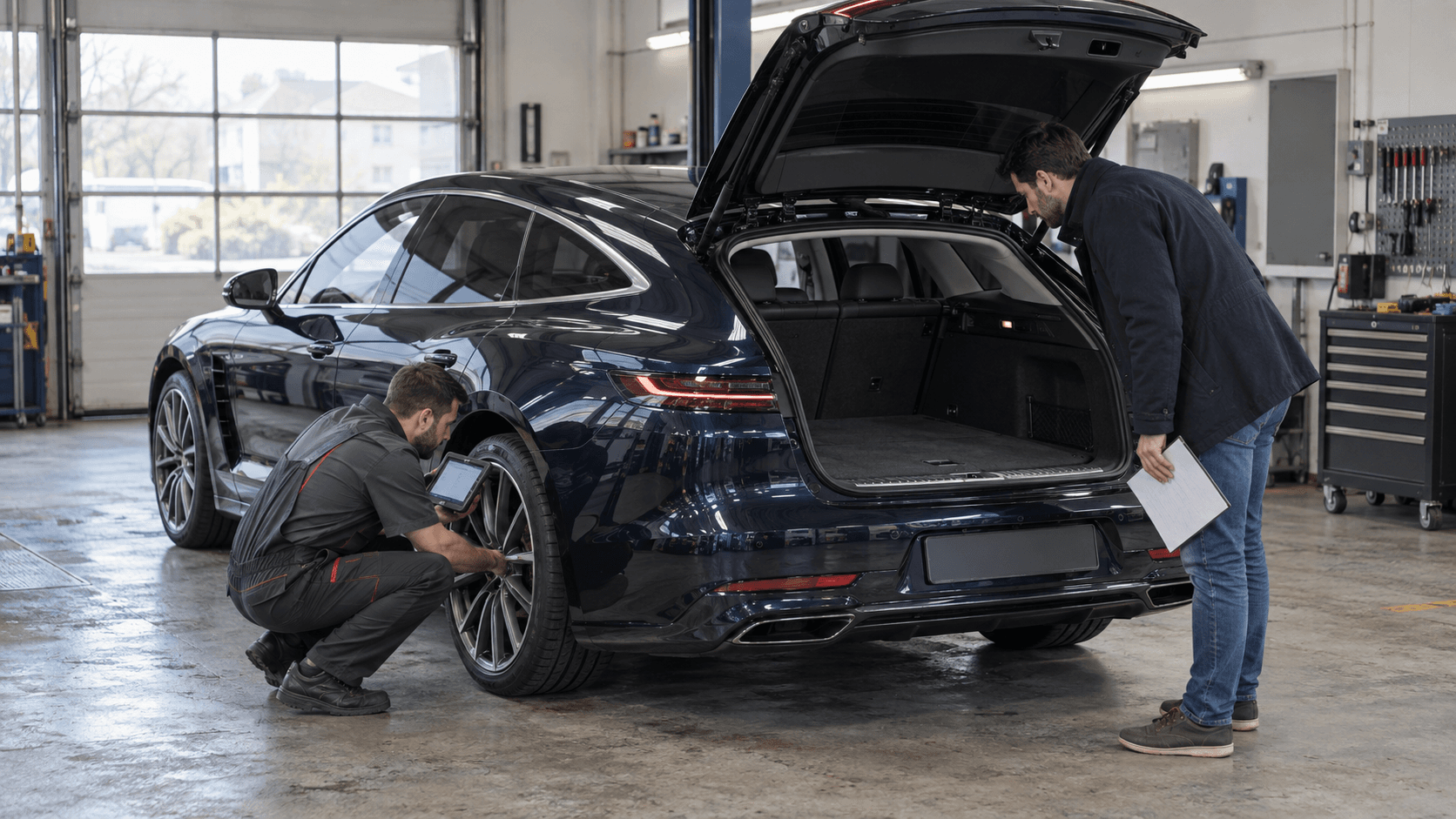
Illustrative image; the car does not represent a specific model or brand.
Used BMW 6 Series GT in 2026: what to check on the 630d, xDrive, Steptronic, air suspension and 48 V
The short answer
A used BMW 6 Series GT G32 can be a very good long-distance car: it has a tailgate, a 610-litre boot, a 3.07 m wheelbase and self-levelling air suspension on the rear axle. It should not, however, be bought as a cheaper 5 Series. It is a premium liftback more than 5 metres long, and the engine, Steptronic gearbox, xDrive, air suspension and electronics must be assessed separately, after the VIN and the actual equipment.
Before you pay, make these checks:
- confirm the car is the G32 generation, not the older 5 Series Gran Turismo F07 described wrongly in the advert;
- identify the engine, drive and model year from the VIN, not only from the badge on the tailgate;
- start the engine fully cold and repeat the test after it reaches normal temperature;
- read every module on diagnosis, including the gearbox, xDrive, suspension, ADAS and the 48 V system, if fitted;
- leave the car parked on level ground and check whether the rear axle holds its height;
- test the Steptronic gearbox in manoeuvres, slow traffic, on a slope and under progressive acceleration;
- check all four tyres, the wheels and the all-wheel-drive system before you choose an xDrive;
- ask for the service history, invoices, a VIN recall check and a written quote for any faults found.
There is no universally “safe” version. A high-mileage 630d that has been maintained and inspected can be easier to assess than a low-mileage car with no invoices and faults cleared before viewing.
Which BMW 6 Series GT you are actually looking at
The 6 Series Gran Turismo G32 was presented in 2017 as the successor to the 5 Series Gran Turismo. BMW initially launched the 630i, 640i, 630d and 640d, in combinations with rear-wheel drive or xDrive, depending on the engine. All used an eight-speed Steptronic automatic gearbox. The update introduced in 2020 changed the design, screens, assistance systems and engine range; at the facelift launch, all engines announced by BMW had a 48 V mild-hybrid system.
| Period | How to recognise it | Configurations found | The check you must not skip |
|---|---|---|---|
| 2017–2020, pre-facelift | headlights and bumpers in the original design, older-generation centre screen | 630i, 640i, 630d, 640d; rear-wheel drive or xDrive by version | the exact engine and transmission, air suspension, long-distance history |
| from 2020, facelift | slimmer headlights, revised grille and bumpers, two 12.3-inch screens in the launch specification | 620d, 630d, 640d, 630i and 640i, depending on market; 48 V in the range presented at the facelift | 48 V battery, starter-generator, electronics, ADAS and software updates |
The range differed between markets and years. A name such as 630d does not by itself say whether the car has xDrive, which emissions standard it meets, what optional suspension it carries or whether it has a 48 V system. Decoding the VIN and the car’s documents take priority over the advert description.
1. Confirm the generation, model year and equipment
The G32 is 5,091 mm long, 1,902 mm wide and has a 3,070 mm wheelbase, according to BMW launch documentation. The dimensions explain the cabin space, but also the cost of tyres, brakes and body parts. The car should be seen on a lift and measured for paint, not judged only in a dark car park.
Check the VIN in the windscreen base, on the body and in the paperwork. Ask for the equipment list and separate standard items from options. Self-levelling air suspension at the rear was standard, but air suspension on both axles, controlled dampers, integral steering and Executive Drive were optional. Two cars with the same engine can have very different complexity and costs.
Do not assume that every G32 from 2020 is a facelift, or that every facelift has the same specification. The first registration date can be later than the build date, and imported cars can have equipment specific to the original market.
2. Choose the engine by how you will use it, not by reputation
At launch, the 630i used a 2.0-litre petrol engine and the 640i a 3.0-litre six-cylinder. The 630d and 640d had 3.0-litre six-cylinder diesels. The facelift also added a 2.0-litre 620d to the range, and BMW presented all updated engines with a 48 V mild-hybrid system.
For long trips and high annual mileage, diesel can make sense, but only if the emissions systems work and the future route lets them operate correctly. For short urban use, petrol avoids some diesel-specific components, without turning the car into a simple or cheap one to maintain.
Do not buy a 630d only for consumption, and do not avoid a 630i only because of the car’s mass. Compare two real examples, with their history and condition. A more powerful engine can come with xDrive, larger wheels, different brakes and more complex equipment; total cost is not just fuel.
3. How to check the engine and cooling system
Ask for the car not to be started before you arrive. From cold, watch the start, idle speed, vibration, noises, smoke and warning lights. Check levels only as the handbook allows and do not open the expansion tank when the engine is hot.
The inspection should include:
- traces of oil or coolant on the engine, undertray and under the car;
- the condition of hoses, connections, radiator and expansion tank;
- running temperature, fan operation and system pressure, checked by a workshop;
- correction values and stored faults, not only lights on the dashboard;
- the history of oil changes, filters, spark plugs on petrol and the fuel filter on diesel;
- consistency between invoices, mileage in the modules and physical wear.
After the test drive, raise the car again. Some leaks appear only after warming up or under pressure. A recently washed engine bay does not prove a problem, but it justifies a closer inspection.
4. On diesel, check DPF, EGR and SCR/AdBlue as separate systems
A 620d, 630d or 640d must be diagnosed for its exact specification. Ask for the relevant particulate-filter values, the history or conditions of regenerations, and the pressures and temperatures measured by sensors. Check EGR, injection, boosting and the SCR/AdBlue system where it is fitted.
Do not accept “it has no faults” without a report. Faults can be cleared before viewing, and a short test does not reproduce a regeneration or a run at constant load. A workshop that knows BMW must interpret the values together with mileage and how the car has been used.
Ask the owner about the daily route. A car bought for motorway use and then driven only on trips of a few kilometres can have a usage profile unsuited to a modern diesel, even if the inspection on purchase day finds no active fault.
5. The Steptronic gearbox must be tested cold and hot
The whole G32 range was announced with an eight-speed Steptronic automatic transmission. The commercial name does not replace the gearbox code, the history and diagnosis.
On the test drive, check:
- engagement in D and R without a large delay or a bang;
- a smooth take-off, including on a slope and in repeated manoeuvres;
- shifts under light, medium and strong acceleration;
- downshifts without unusual shocks;
- behaviour after the engine and transmission have warmed up;
- the absence of vibration or noise at constant speed;
- faults and adaptation values interpreted by a specialist.
Do not automatically apply an oil-change interval read for another gearbox or another use. Ask for invoices and identify the transmission from the VIN, then ask the workshop for a written plan for this specific car. If the seller says the oil has been changed, the invoice must show the date, mileage and materials used.
The guide to checking a used automatic gearbox explains the basic tests without confusing Steptronic with DSG or CVT.
6. xDrive: four tyres and a drivetrain that must be inspected fully
BMW offered xDrive on several G32 versions, and the 640d was presented with standard all-wheel drive at launch. For a buyer, the xDrive badge means extra checks, not a grip guarantee regardless of tyres.
All four tyres must have approved sizes, similar wear and, ideally, the same pattern and the same condition. Do not invent a universal tolerance for tread difference: check the configuration requirements from the VIN and handbook. Inspect the wheels from the inside, because large wheels can be straightened or cracked without it showing easily from outside.
On a lift, check the shafts, joints, gaiters, final drives and traces of leaks. On the road, test tight turns at low speed, progressive acceleration and constant running. Any jerk, vibration or noise must be located before purchase, not automatically blamed on the tyres.
For the wheel inspection, also use the checklist for tyres, wheels and TPMS.
7. Rear air suspension is standard; both axles are not
This is the technical detail an advert can describe wrongly. BMW equipped the G32 as standard with self-levelling air suspension on the rear axle. Adaptive suspension with air springs front and rear, Dynamic Damper Control, integral steering and Executive Drive were distinct options.
Park the car on a level surface and compare left-to-right height. If possible, check it again after it has stood for several hours. At start-up, listen to the compressor and watch how long it works; a workshop must establish whether there are leaks, faulty level sensors, damaged lines or an overloaded compressor.
On cars with air suspension on both axles, test the height adjustment and every available mode. BMW stated for this option a manual lift of 20 mm and a drop of 10 mm under certain conditions. If the car does not have this equipment, the absence of the control is not a fault.
Diagnosis must read the chassis module, and the physical inspection must include the air springs, dampers, arms, bushes and sensors. The dedicated guide to air suspension on a used car gives the full order of checks.
8. The facelift adds the 48 V system and more electronics
In the 2020 update, BMW introduced in the presented range a 48 V starter-generator that could add 8 kW/11 hp temporarily and reduce the load on the combustion engine. The system does not turn the car into a full hybrid and should not be assessed like the traction battery of a conventional hybrid.
For a facelift, ask for diagnosis of the 48 V battery, the DC/DC converter and the starter-generator. Check the history of any replacements, dashboard warnings and 12 V battery voltage. A weak auxiliary battery can generate many symptoms, but do not assume that every electrical fault disappears after replacing it.
The facelift also came with BMW Operating System 7, 12.3-inch screens and extended ADAS functions. Test the camera, radar, cruise control, lane keeping, sensors, parking cameras and reverse-assist only if they appear on the equipment list. After a windscreen change or a frontal repair, ask for calibration documents. The ADAS checklist for a used car explains why a system with no warning light is not automatically calibrated correctly.
9. The liftback body, frameless windows and 610-litre boot
The 6 Series GT is not a saloon. The tailgate rises together with the rear window and was electrically operated as standard. BMW quoted 610 litres with the rear seat up and up to 1,800 litres with the 40:20:40 backrests folded. The almost flat floor and the cover that stores under the floor make it more practical than the coupé profile suggests.
At viewing, check:
- opening and closing the tailgate from every available control;
- the struts, lock, alignment and seals;
- the floor, side wells and the area under the floor for water or repairs;
- folding each rear-seat section and the electric mechanisms, if fitted;
- frameless windows, seals and the short drop/rise of the glass when the door opens;
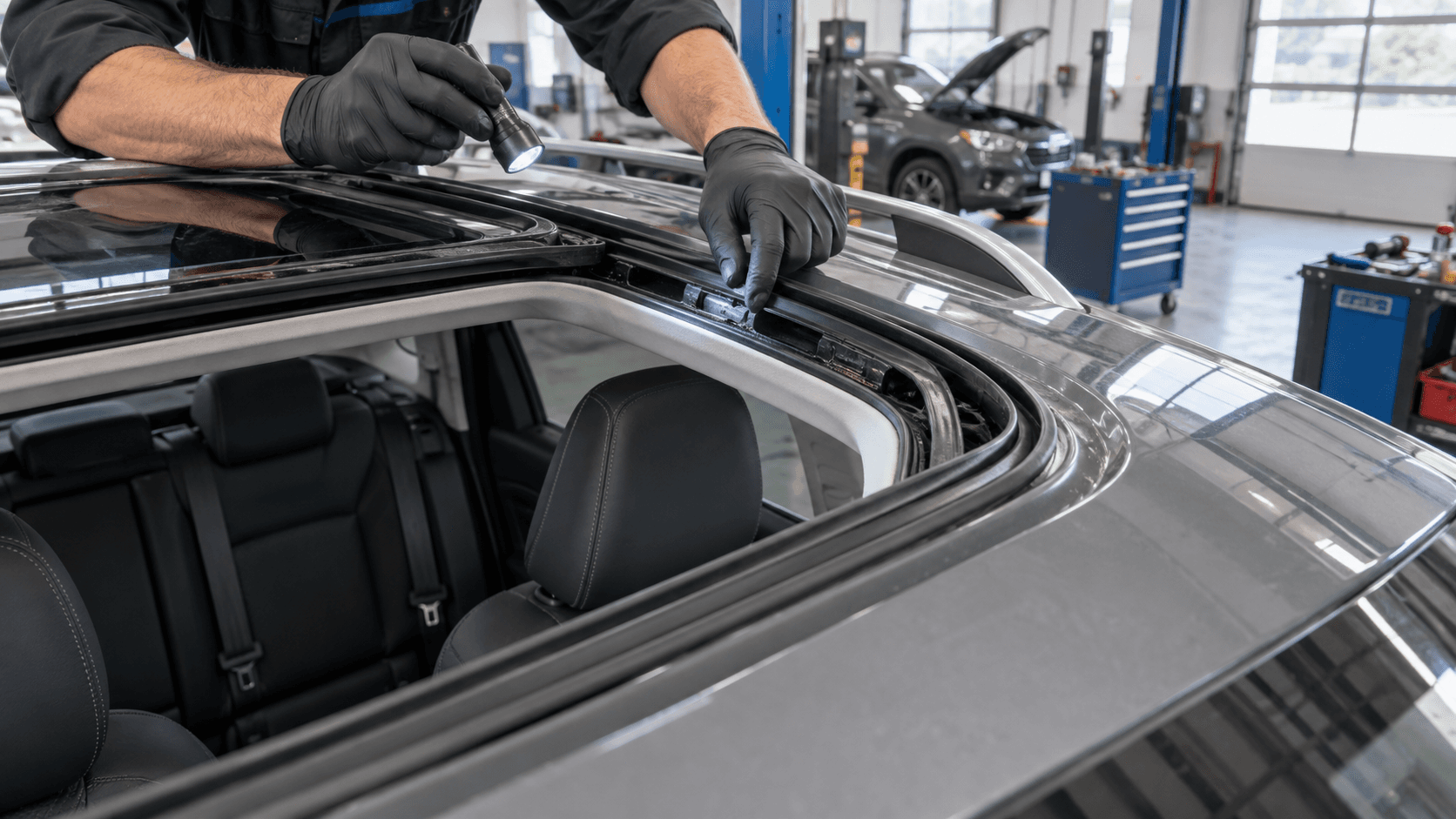
- the panoramic sunroof, drains and headliner for damp traces, if the car is so equipped;
- the active rear spoiler and related faults.
Measure the parking space before you buy. A length of 5.09 m and a width of 1.90 m without mirrors can turn an excellent motorway car into an awkward one in an old garage.
10. History, recalls and the budget after purchase
Check mileage in documents, invoices, MOT/ITP records, modules and RAR Auto-Pass. A car of this type can come from a fleet, leasing or executive transport. Wear on the steering wheel, seat, buttons, boot sill and rear bench must be consistent with the stated mileage.
Enter the VIN in the official BMW tool for technical campaigns and recalls. BMW states that work related to a recall or technical action is covered by the manufacturer. A generic check by model is not enough, because campaigns apply to chassis series and precise configurations.
Do not use a universal annual cost. Ask for quotes for:
- the immediate service and fluids due;
- tyres and wheels in the fitted size;
- brakes and suspension;
- the engine and emissions systems;
- Steptronic and xDrive;
- air suspension and chassis options;
- the 12 V and 48 V batteries, where fitted;
- electrical faults, ADAS and the tailgate.
If the purchase price consumes the whole budget, the car is too expensive for that buyer. The useful comparison is not only with another 6 GT, but also with a used BMW X3 or a used BMW X1 and its costs, if you do not need the space and comfort of a liftback more than 5 metres long.
12-step test drive
- Check the car and suspension height before starting.
- Start the engine cold and watch every warning light in the self-check sequence.
- Listen to the engine, suspension compressor and auxiliary pumps without music or air conditioning.
- Drive slowly over short bumps and check axle noises.
- Repeat D–R manoeuvres on the level and on a slope.
- Make tight turns at low speed to observe the drivetrain and tyres.
- Accelerate progressively and watch gearbox shifts, the engine and any smoke.
- Run at constant speed for wheel, drivetrain or body vibration.
- Brake progressively and then more firmly in a safe place; the car must stay stable.
- Test ADAS systems only in legal, safe conditions.
- After warm-up, repeat manoeuvres and shifts at low speeds.
- Return to the lift, look for leaks and scan all modules again.
Checklist before purchase
- The VIN is identical on the body, in the paperwork, invoices and diagnosis report.
- The G32 generation, build date and pre-facelift/facelift status are confirmed.
- Engine, gearbox, drive and emissions standard are identified from the VIN.
- The equipment list shows exactly which suspension and ADAS systems the car has.
- The engine was started fully cold and retested after warm-up.
- There are no active oil or coolant leaks.
- Engine diagnosis includes real values, not only a “zero faults” screenshot.
- On diesel, DPF, EGR, injection, boosting and SCR/AdBlue have been checked.
- The Steptronic gearbox engages and shifts correctly cold and hot.
- xDrive has been road-tested and inspected on a lift, if fitted.
- All four tyres are approved, compatible and have coherent wear.
- The wheels are not cracked, welded or deformed.
- The rear suspension holds its height and the compressor does not work abnormally.
- Chassis options are tested separately, without assuming they exist on every car.
- The 12 V battery and 48 V system have been diagnosed, where applicable.
- Camera, radar, sensors and parking cameras work and have documented calibration after repairs.
- Tailgate, active spoiler, frameless windows and sunroof work correctly.
- The boot and headliner have no leaks, mould or accident traces.
- The body has been measured and checked on a lift.
- Mileage is consistent with RAR Auto-Pass, ITP records, invoices and modules.
- Recalls and technical actions have been checked by VIN at BMW.
- There is a written quote and separate money for the post-purchase service.
For the full inspection order, use the step-by-step guide to buying a used car. If the example has worked in a fleet, add the checks for a car coming out of leasing.
Frequently asked questions
Is the BMW 6 Series GT a 5 Series GT with another name?
The G32 replaced the 5 Series Gran Turismo F07, but it is a different generation, presented in 2017. Do not automatically transfer engines, parts, problems or service recommendations from the F07 to the G32.
What boot does the BMW 6 Series GT G32 have?
BMW quotes 610 litres with the rear seat up and up to 1,800 litres with the backrests folded. The tailgate includes the rear window, and the floor is almost at load-sill height.
Does every BMW 6 Series GT have air suspension?
The G32 has standard self-levelling air suspension on the rear axle. Air suspension on both axles and the other chassis systems were optional, so equipment must be confirmed from the VIN.
Does every BMW 6 Series GT have xDrive?
No. The range included rear-wheel-drive and xDrive versions, depending on engine, market and year. The 640d was launched with standard xDrive, but the badge on the tailgate is not enough for identification.
Does the BMW 6 Series GT facelift have a 48 V mild-hybrid system?
BMW announced all engines in the facelift range presented in 2020 with a 48 V starter-generator. For a specific car, confirm the model year and equipment from the VIN, then diagnose the battery, converter and starter-generator.
Is the 630d the best choice?
It is a suitable configuration for many drivers who do long trips, but there is no universal verdict. Daily route, DPF/EGR/SCR condition, history, xDrive and the costs of the specific example matter more than the engine’s reputation.
How much does it cost to maintain a used BMW 6 Series GT?
There is no serious annual figure valid for every car. A rear-wheel-drive 630i with simple equipment has a different profile from a 640d xDrive with air suspension on both axles, integral steering and 20-inch wheels. Ask for a quote after inspection.
Which check is decisive before purchase?
An independent inspection on a lift, diagnosis of every module and the cold and hot test must be done together. Neither a digital history nor a ten-minute test drive can replace that combination.