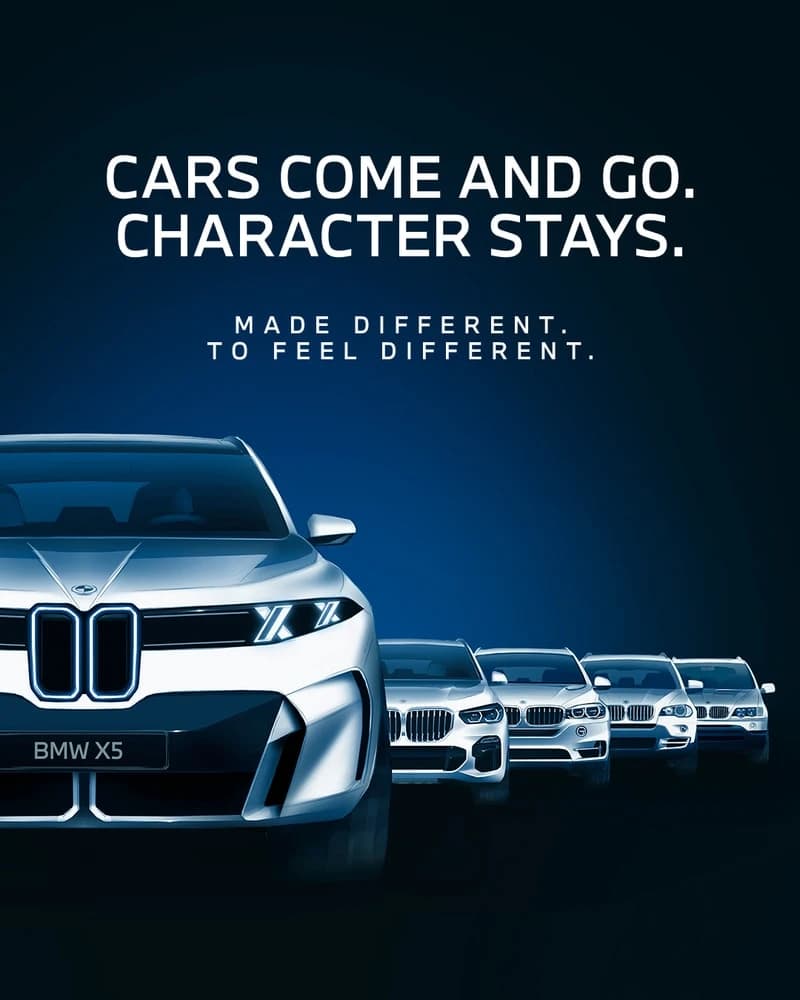
BMW has labelled an anonymous, 1990s-looking silver sedan “BORING” in an official Instagram carousel, before showing a BMW X5 under “CHARACTER”. The contrast belongs to its new international campaign, “Made Different. To Feel Different.” BMW says the campaign launched globally on 29 October 2026, with its official announcement following on 30 October.
The Instagram post carries an AI-content label. BMW does not identify the sedan’s manufacturer or model in the accompanying caption. Its rectangular lights and narrow grille may look familiar to people who remember older Toyotas, but resemblance is not confirmation that BMW photographed and assessed a particular Corolla or Carina. The anonymous car is an advertising device, not a documented comparison-test subject.
What the two images establish
The first image shows a frontal view with rectangular headlights, separate indicators and no manufacturer badge. The second moves to a contemporary BMW SUV and its recognisable grille. The caption makes BMW’s claim that it gives cars a distinctive character. Neither that wording nor the two labels measures an engineering advantage over the older-looking vehicle.
There are no paired crash-test results, consumption figures or reliability records for the two cars. A judgement about visual excitement cannot supply those missing comparisons. Nor does the post establish whether an ordinary older sedan might suit a particular owner’s needs. That would involve identifying the vehicle and examining different evidence from the campaign’s aesthetic contrast.
Some visible comments on the original post reject the comparison and favour the older design. They demonstrate disagreement among people engaging with the post, rather than the opinion of all BMW customers or all Toyota owners. An algorithmically presented selection of comments cannot establish that the campaign has succeeded or failed commercially, and BMW’s announcement does not publish a sales effect from it.
The wider campaign has a defined format
BMW’s official release describes a 120-second main film, accompanied by shorter videos exploring individual subjects. These include design, technology, driving dynamics, quality, safety and the customer-support ecosystem. The anonymous-sedan carousel is therefore one component of a broader brand platform. It is not an announcement of a new vehicle, a price change or a specification update.
Agency partner Jung von Matt developed the campaign, with Hochkant Films involved in video production. A new interpretation of Run-D.M.C.’s “Walk This Way” supplies the musical backdrop. BMW credits Jung von Matt MUSIC with rights clearance and music and audio production. Those details identify who made the communication, rather than independently verifying the advantages it claims for BMW vehicles.
The manufacturer’s design explanation reaches back to the kidney grille in 1933 and the Hofmeister kink at the rear side windows in 1961. It says Neue Klasse reinterprets both through cleaner surfaces and fewer lines. That is BMW’s account of its own design continuity. It does not make the campaign’s choice between understated and more assertive styling an objective rule for car design.
Testing figures need their original context
The release supports the quality message with manufacturer-reported development activity. BMW cites testing in more than 30 countries, an acoustic wind tunnel operating at air speeds up to 250 km/h, and around 100,000 km on the Nürburgring Nordschleife. These describe its stated development work, not a Carboratory audit or a controlled comparison with the sedan shown in the Instagram image.
BMW also mentions almost 10,000 crash tests since 2005. Keeping the start date matters: the number is not presented as the crash-test count for one newly launched car. Its simulation centre is described through 1.2 million calculations per second and a virtual 36 km test track. The campaign combines simulation and physical testing within its quality narrative, without presenting equivalent data for the anonymous vehicle.
Customer support adds another part of the story. BMW cites more than 120,000 service specialists at approximately 4,000 locations, alongside 55 logistics centres. These are company-reported network figures. They do not automatically specify what assistance is included for a particular owner, vehicle or country, and should not be read as identical service terms everywhere a BMW is driven.
Toyota is a resemblance, not a named opponent
The older car’s appearance invites comparisons with Toyota models from the period, but the official post does not name one. Describing the image as a confirmed Corolla or Carina would turn an interpretation into an identification BMW has not supplied. It would also make the marketing comparison look more technically defined than the published material supports.
BMW and Toyota do have a separately documented engineering partnership. Their September 2024 announcement expanded cooperation on a new generation of fuel-cell technology. It described shared powertrain development for vehicles retaining distinct brand identities, while BMW stated a plan for its first series-production fuel-cell vehicle in 2028. That dated announcement provides partnership context, rather than proof of the campaign’s intended target.
The cooperation does not establish that the Instagram carousel marks a dispute between the companies. The verified story is narrower: BMW has used an AI-labelled post, an unnamed older-looking sedan and a contemporary X5 to argue for its own design character. The longer campaign then connects that claim to development, technology and service, whose merits require their own evidence beyond the labels on the images.
Official BMW campaign artwork about design identity and character. Credit: BMW.