A 1997 Ferrari F50 has set a new auction benchmark for the model, selling for approximately €16.74 million including the buyer’s premium at Broad Arrow’s Las Vegas sale. The car, offered as lot 139, had covered the equivalent of only about 171 km. Broad Arrow says the winning bidder was in the room at Wynn Las Vegas on 31 October 2026.
The auction house released its official results on 2 November. Overall sales amounted to approximately €83.06 million, which Broad Arrow describes as the highest total achieved by a collector-car auction in Las Vegas. The city-wide event record and the F50’s model record are separate claims: one measures the whole sale, the other an individual car’s public auction result.
What the F50 result actually measures
Broad Arrow highlighted the car’s very low distance and its accompanying original factory accessories. Those details belong to this particular offering. The release does not assign an individual monetary contribution to the accessories or calculate how much buyers paid for each kilometre the car had avoided covering.
The published figure is a final result including the buyer’s premium, rather than simply the accepted hammer bid. That distinction matters when comparing it with another auction listing or a reported sale that uses a different definition of price. The record also concerns auction transactions; it does not document undisclosed private deals or provide a valuation for every surviving F50.
Euro amounts here are approximate conversions using the European Central Bank reference rate dated 30 October 2026, the last business day before the auction. They are rounded for readability. They should not be read as euro settlement invoices, and the conversion does not establish a European landed cost for the vehicle. The same basis is used for each result discussed below.
Ferrari’s own description of the F50
Ferrari’s historical model page provides useful technical context for the car behind the record. It identifies a naturally aspirated V12 and a carbon-fibre monocoque, with composite construction among the elements it connects to Formula 1 technology. These are manufacturer specifications for the model, rather than findings from a fresh inspection of the Las Vegas lot.
The rear, longitudinally mounted engine displaces 4,698.5 cc. Ferrari lists maximum output at 382 kW, or 520 metric horsepower, at 8,500 rpm, with 471 Nm delivered at 6,500 rpm. Five valves per cylinder and dry-sump lubrication also appear in the factory specification. The engine uses Bosch Motronic M2.7 injection, and the transmission provides six forward ratios plus reverse.
Ferrari contrasts the F50’s naturally aspirated V12 with the turbocharged V8 approach of its preceding supercars. Its account also points to the absence of power steering, brake assistance and ABS. Those details describe a particular engineering layout; they are not evidence that a bidder paid a measurable premium for any one component at this auction.
Independent push-rod suspension is specified at both ends, alongside rack-and-pinion steering. Ferrari quotes a top speed of 325 km/h. That is a factory figure, not a speed achieved or verified during the sale. Nothing in the auction results turns the car’s small recorded distance into a recent performance test.
Pininfarina’s body design includes rounded air openings, paired circular rear lamps and a prominent rear wing. Ferrari explains the shape through the aerodynamic requirements of the project, while identifying the dark side line and rear lights as links to earlier cars. The historical account gives the F50 a technical setting without requiring an invented explanation of the winning bidder’s motives.
Daytona SP3 finished close behind
A 2025 Ferrari Daytona SP3 was the second-largest result, at approximately €16.60 million. On the unrounded conversions, it finished about €148,000 behind the F50. Broad Arrow’s record claim is specifically for a non-charity SP3: dropping that qualification would change the category and overstate what the result establishes.
The SP3 came from its original owner and had covered about 130 km when catalogued. Broad Arrow describes it as one of 600 examples, finished in Tailor Made Verde Francesca with Nero Alcantara and Mustard Aunde Jeans inside. Bidding involved people in the room and on the telephone. The published account does not identify the buyer or establish a future resale plan.
A 2014 LaFerrari took third place at approximately €7.88 million, another model auction record according to the house. Together, the F50, SP3 and LaFerrari accounted for roughly 49.6% of the entire sale total. That percentage is calculated from the announced final prices, and illustrates the concentration of value in the three leading lots rather than the average performance of every car offered.
The sale still had 20 unsold lots
Broad Arrow reported 64 sales from 84 lots offered, a rounded sell-through rate of 76%. Subtracting those figures leaves 20 unsold lots. The record revenue therefore coexisted with an offering that did not sell in full; the two measures describe different aspects of the same event.
The house also announced ten model auction records and a 63% rise in registered bidders compared with 2025. It said 35% were bidding with Broad Arrow for the first time. These are participation figures for the auction house’s event, rather than a survey of the whole collector-car market. They cannot establish how the next F50, with its own condition and documentation, will be priced.
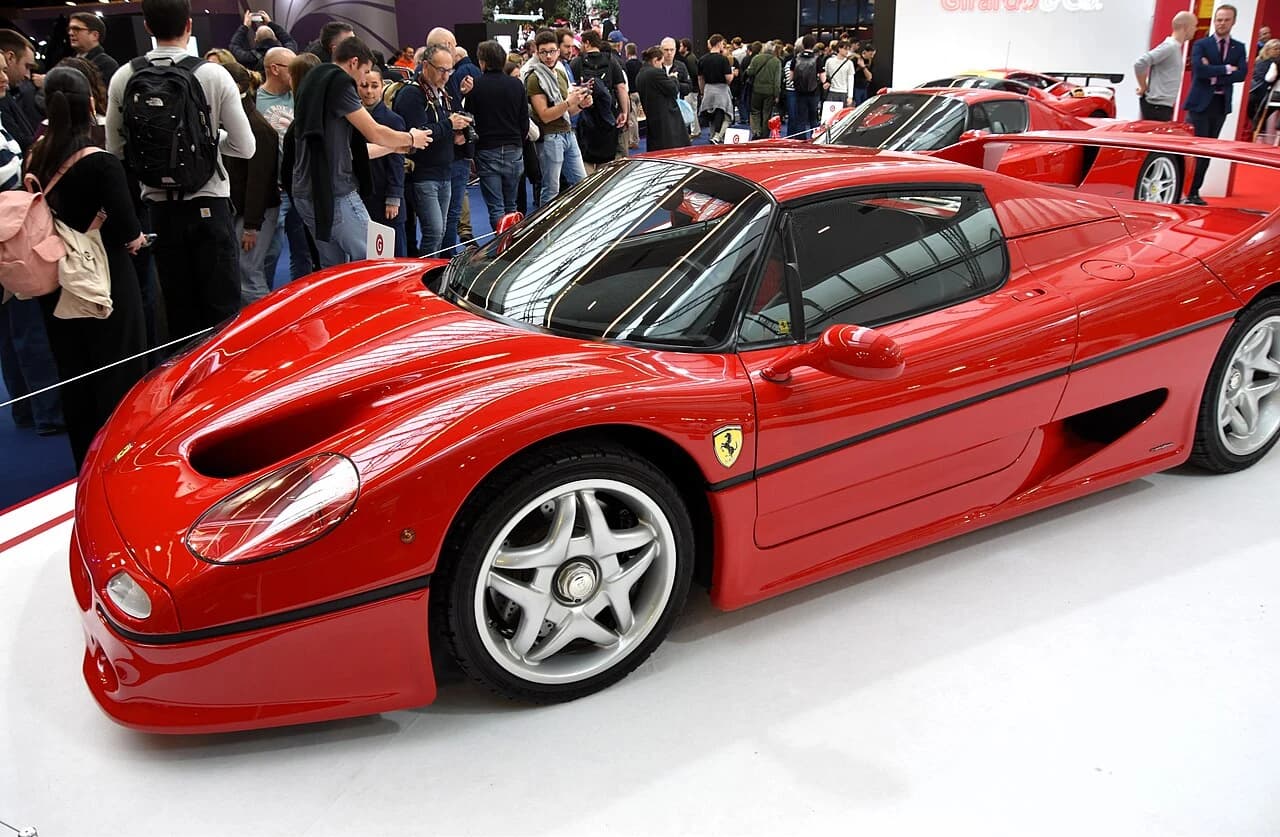
Illustrative photograph of another Ferrari F50, not the Las Vegas auction car. Photo: Charles / Wikimedia Commons, CC0 1.0. WebP.