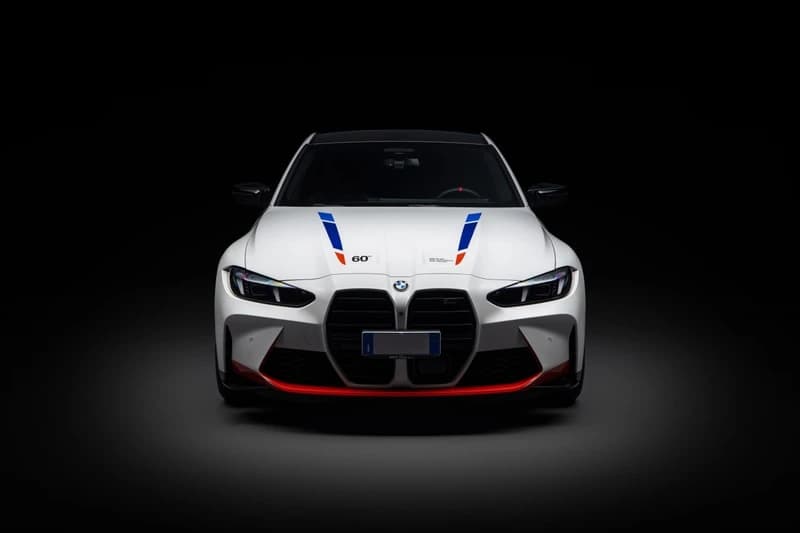
BMW Italy has created a single M3 to honour Alex Zanardi on what would have been his 60th birthday. Named “Tribute to Alex Zanardi”, the car combines BMW M colours with the pineapple that served as the racing driver and Paralympic champion’s personal good-luck symbol. Design studio BorromeoDeSilva developed its visual treatment, with BMW announcing the project on 30 October 2026.
Zanardi was born in Bologna on 23 October 1966. He died on 1 May 2026, aged 59, as BMW confirmed in a statement citing his family. The tribute therefore marks the anniversary of his birth rather than a birthday he was able to celebrate. It also arrives in the year marking four decades since the original M3 entered production.
The graphics have a personal reference
The project uses the current BMW M3 as its basis. BorromeoDeSilva reinterpreted the M division’s colours with references to the liveries of BMW competition cars. Official photographs show coloured accents across the front and a graphic treatment continuing along the lower body. Anniversary markings and the pineapple identify the specific person behind the project’s theme.
BMW describes the fruit as Zanardi’s longstanding lucky charm. Here it belongs to the car’s commemorative composition, rather than being introduced as a new emblem for the whole M range. Its appearance on the body and within the cabin connects the separate areas of the design without suggesting that the same package is being added to ordinary customer configuration lists.
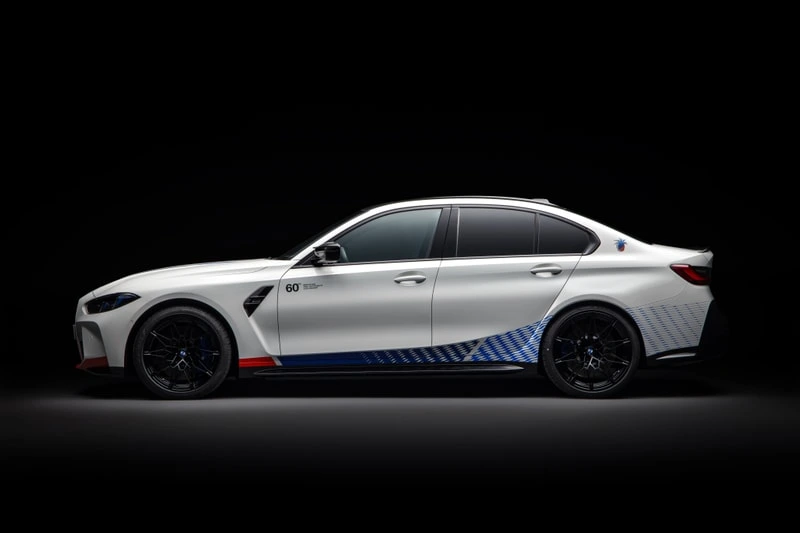
The side view shows the continuity of BorromeoDeSilva’s commemorative graphics. Photo: BMW.
BMW Italy also credits Alcantara and Befuel with helping turn the design into a finished vehicle. The announcement identifies BorromeoDeSilva’s styling role and the partners’ contribution to its execution. It does not announce an orderable limited-production series, a separately priced trim package or a retail allocation for the one-off car.
Alcantara and an E30 reference inside
The central seat sections use anthracite Alcantara, perforated by laser to reveal an iridescent contrasting backing. BMW describes a gradient running from blue to red, drawing on M colours. Plain Alcantara bands establish a transverse pattern extending across the seats and door panels. The interior therefore carries its own material interpretation of the exterior’s colour theme.
The official photographs also show pineapple motifs on the head restraints and a commemorative element on the centre console. BMW explicitly links the balance of cabin materials and colours to the M3 E30 Sport Evolution. That is a design reference, rather than an announcement that the historic model’s engine or other mechanical components have been installed in this current M3.
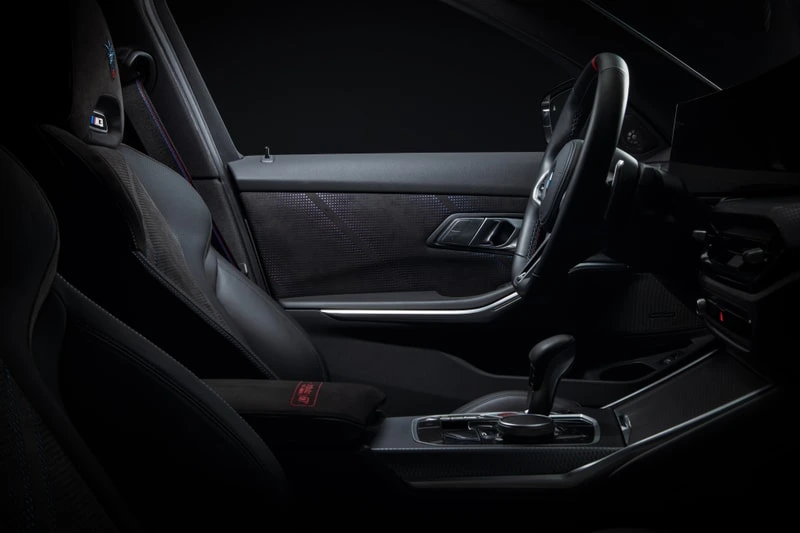
The cabin references E30 Sport Evolution materials and colours. Photo: BMW.
BMW M’s history places the Sport Evolution in 1990, as the final development of the first M3. Its four-cylinder engine grew to 2.5 litres and produced 238 metric horsepower, with 600 cars built. Those figures belong to the E30 reference vehicle. They should not be read as specifications for the 2026 tribute car.
The original M3 was shown in 1985 and entered production in 1986, with its development tied to touring-car homologation. This explains the second anniversary accompanying the project. BMW’s tribute announcement supplies no distinct power output, acceleration result or selling price for the one-off. Its documented changes concern the commemorative design and cabin treatment, rather than a newly announced performance upgrade.
Zanardi’s BMW relationship was built through racing
Before that partnership, Zanardi had secured consecutive CART titles in 1997 and 1998. The FIA records 15 victories in the American series and 41 Formula 1 appearances, following his F1 debut in 1991. These achievements preceded the touring-car chapter that would connect him with BMW for more than two decades.
The 2001 accident at the Lausitzring resulted in the loss of both his legs. Zanardi returned to racing with adapted controls, joining BMW’s European touring-car programme in 2003. He competed in the WTCC between 2005 and 2009, recording four victories according to BMW. His Oschersleben win in 2005 is among the comeback milestones highlighted by the FIA.
The collaboration later extended into GT and endurance competition. BMW lists the Z4 GT3 at Spa-Francorchamps in 2015, a win in the final Italian GT round with the M6 GT3 in 2016, and a DTM guest appearance in 2018. In 2019, he raced the M8 GTE at Daytona. The M3 tribute connects to that long relationship without being described as a replica of one particular racing car.
The story continues beyond motorsport
The International Paralympic Committee records four gold medals and two silvers across London 2012 and Rio 2016. Zanardi’s two individual London victories came at Brands Hatch, where he had previously competed as a racing driver. In Rio, he won the time trial and took another gold with Italy’s mixed relay team.
Those results are a separate sporting achievement from his motor-racing titles, and both careers inform BMW Italy’s commemoration. The company also places the project alongside SpecialMente, its social-responsibility programme. Zanardi’s son Niccolò remains involved as an ambassador and BMW Driving Experience instructor, including work with courses for people with disabilities.
BMW says the driving school has an M2 equipped with special controls for that activity. This is distinct from the tribute M3: the announcement does not say the one-off uses the school car’s controls. A permanent commemorative panel was also unveiled at BMW Italy’s San Donato Milanese headquarters, giving the event a lasting element beyond the personalised vehicle.
Photos: BMW.