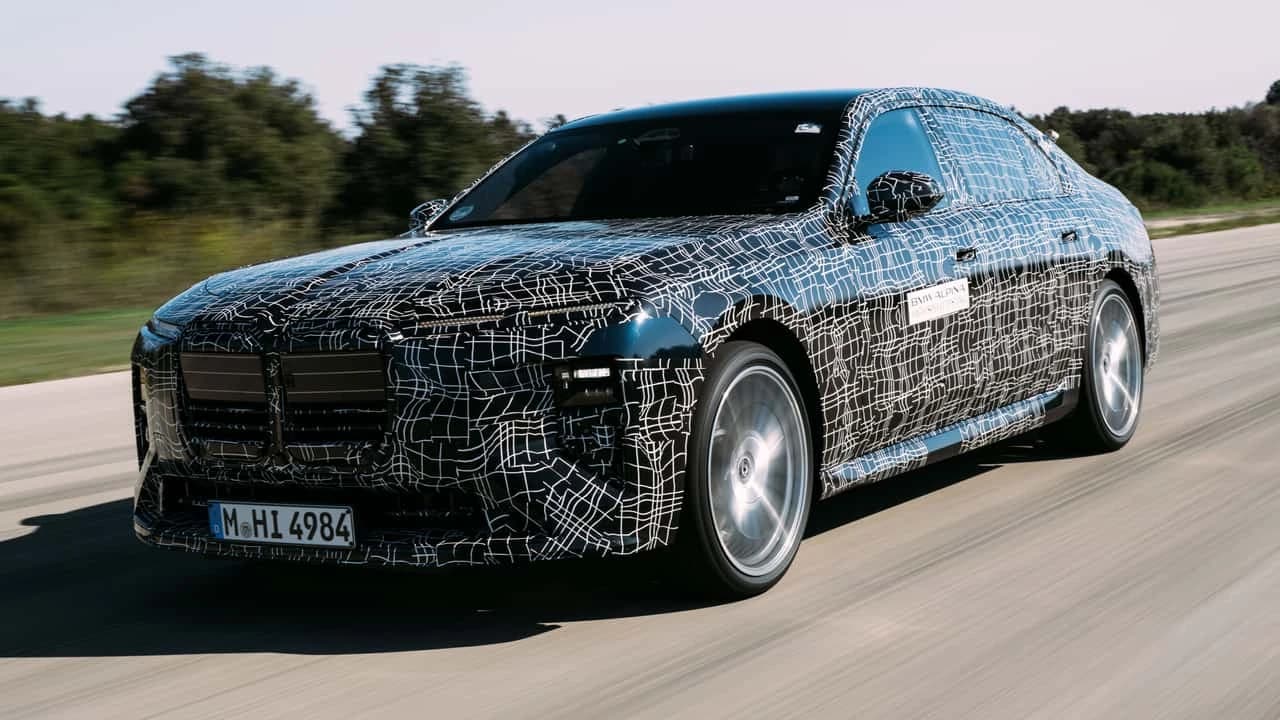
BMW ALPINA has taken its camouflaged new production-model prototype beyond 300 km/h at Nardò in southern Italy. BMW’s announcement on 3 November 2026 confirms a V8 engine and outlines work on the powertrain, suspension, aerodynamics and tyres. It does not disclose the finished car’s ultimate top speed, rated output or acceleration figures.
The model belongs to the brand’s new chapter within BMW Group. An official brand presentation published in August says the first new model will be inspired by the BMW 7 Series and launched in 2027. The Italian test supplies a clearer account of its engineering priorities, without yet becoming a full production specification or a market-specific sales announcement.
The speed is demonstrated, the maximum remains undisclosed
BMW says its accompanying film shows the car accelerating past the 300 km/h threshold. That is a specific statement about the development footage. It is not a published ceiling for the production car, nor evidence that BMW has established a new outright luxury-saloon speed record.
Oliver Viellechner, Vice President of BMW ALPINA, describes the objective as how naturally and confidently the car behaves at speed, rather than the peak number alone. The emphasis is long-distance composure combined with performance. Those are manufacturer development aims, not findings from an independent Carboratory drive of the prototype.
The venue explains the type of work being shown. BMW describes Nardò’s high-speed circuit as approximately 12.6 km long. Operator Porsche Engineering identifies a circular layout with a diameter of about 4 km, using lanes with different banking. It is a facility designed around sustained high-speed testing under controlled proving-ground conditions.
Nardò also has a separate handling track. Porsche Engineering lists that course at 6,222 m with 16 corners. The BMW announcement concerns the high-speed ring, and supplies no lap time for the handling circuit. A sustained-speed demonstration and a handling-course benchmark would measure different aspects of the vehicle.
A V8 calibrated for progressive response
The engine receives specific management calibration and accelerator mapping. BMW says these changes are intended to provide prompt but smooth delivery, avoiding an aggressive character. It also describes strong torque availability over a broad rev range, without supplying a final torque rating in Nm.
Transmission tuning has been adapted to the higher maximum engine speed and increased output of the installation. BMW has not published the numerical power rating in this release. Displacement, a zero-to-100 km/h time and the definitive top speed are likewise absent, so specifications from another BMW V8 model cannot be adopted as substitutes.
The distinction matters when reading numbers visible during prototype testing. A momentary instrument display can reflect the conditions at that point in a run; it is not automatically the car’s certified maximum output. A production data sheet is needed before comparing the newcomer’s engine ratings with earlier ALPINA saloons or current rivals.
Twenty spokes describe the wheel design
BMW specifically identifies 20-spoke alloy wheels. That is a count of spokes, rather than a wheel-diameter measurement. The company says the wheels were developed together with tyres tailored to the car, treating each assembly as a matched part of the chassis package.
An additional foam layer is a feature of the tyres. BMW attributes benefits in precision, ride comfort and high-speed operation to the design, but publishes no comparison that isolates the layer’s effect. The release also does not provide a complete tyre-size specification. Those details should be taken from the eventual production documentation rather than inferred from the wheel description.
Suspension development follows the same combination of dynamics and comfort, accompanied by aerodynamic optimisation of the body. The announcement does not identify a specific damper technology or give a drag coefficient. It establishes the areas being developed without quantifying every engineering result.
Four oval exhaust outlets provide another recognisable ALPINA detail. BMW describes the system’s sound as deep and full, linking it to the V8’s character. That is the manufacturer’s account of the exhaust, without an independent noise measurement or a confirmation that every future market version will have an identical specification.
A new brand structure around familiar cues
BMW Group relaunched ALPINA as a distinct marque within its portfolio on 1 January 2026. Its August brand presentation says vehicles will be built in selected BMW Group plants prepared for the marque’s requirements. It does not name the factory for the camouflaged car shown at Nardò.
The revised identity includes lettering influenced by the asymmetric wordmark of the 1970s and an emblem retaining stylised individual throttle bodies and a crankshaft. Traditional colours, multi-spoke wheels and extensive material personalisation are part of the stated continuity. These are brand-wide intentions rather than a complete options list for the first saloon.
The Vision BMW ALPINA shown at Villa d’Este in 2026 expressed the design direction as a study. The camouflaged Nardò vehicle is the production project now undergoing development. They should not be treated as the same body style or as proof that every feature of the study will reach the saloon.
For a prospective buyer, the next decisive information is the finished car’s specification and market offer: final name, price, available configurations and ordering timetable. The 2027 launch plan is confirmed in BMW’s brand communication, while the high-speed release adds engineering detail. It does not yet provide those country-specific commercial terms.
Photo: BMW.