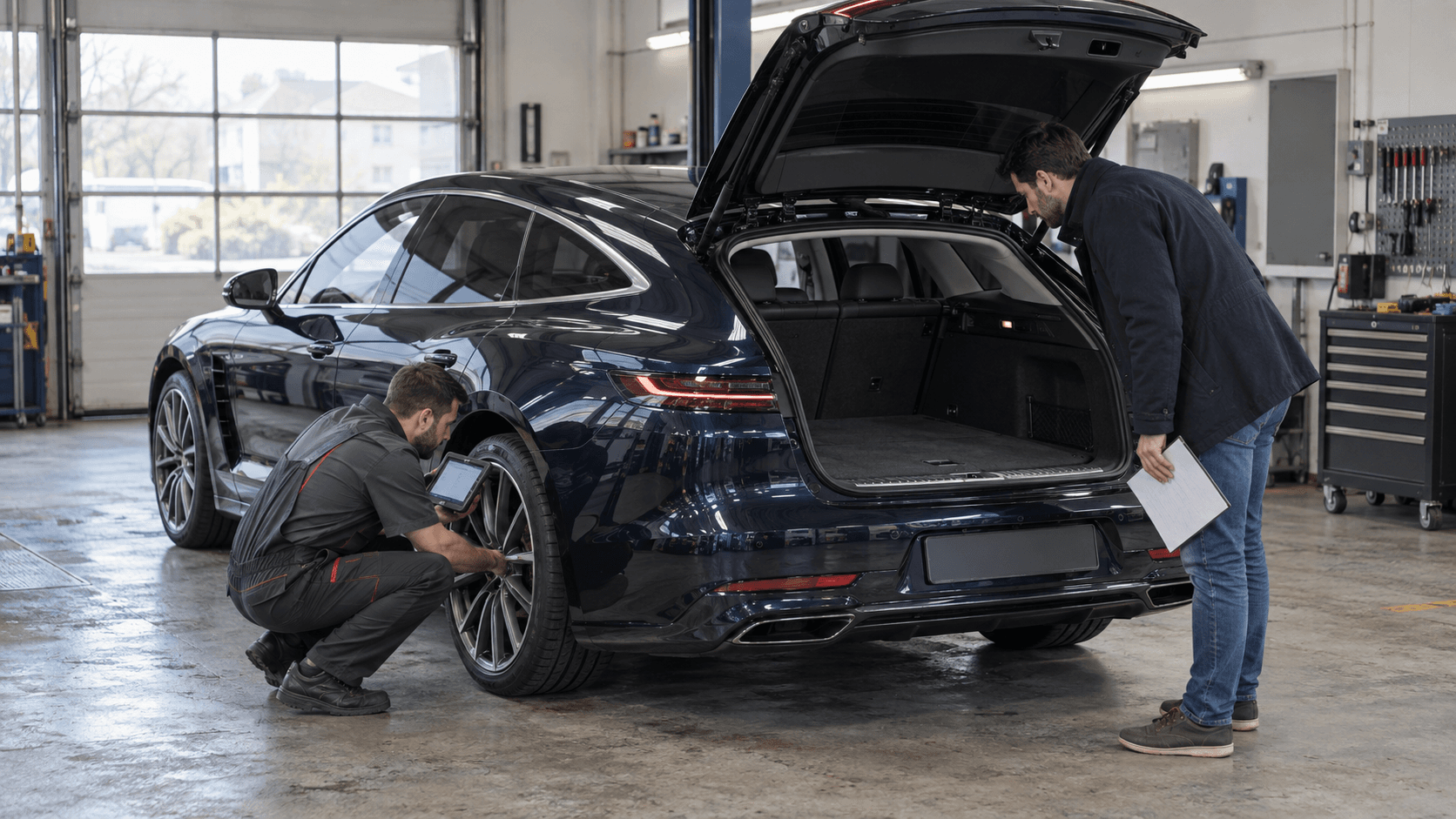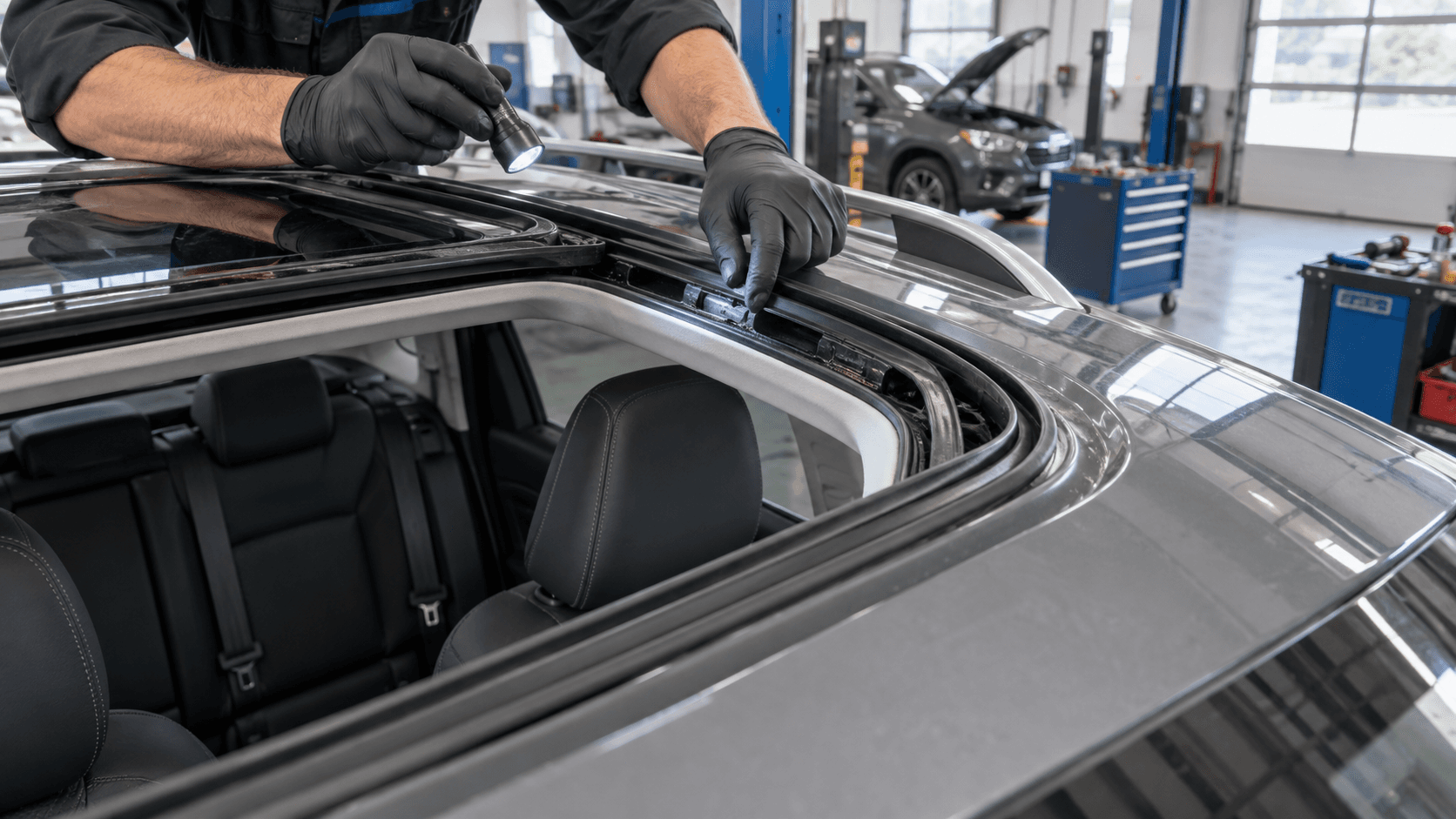
Illustrative image; the car does not represent a specific model or brand.
Used BMW X1 in 2026: running costs and what to check on diesel, xDrive, automatic and PHEV
The short answer
A used BMW X1 can be a practical choice, but running cost is not set by the year in the advert or by the sDrive/xDrive badge. First identify the generation — E84, F48 or U11 — then the engine, gearbox, drive and equipment from the VIN. The three generations use different architectures and technical systems, and a job that applies to one X1 must not be transferred automatically to another.
On a diesel example, check the DPF, EGR, injection, turbocharger and journey history. On petrol, start the engine from cold and inspect ignition, cooling, the turbo and documented oil consumption. The automatic gearbox and xDrive must be tested cold and hot, and for an X1 xDrive25e you add a charging test and a high-voltage battery report.
There is no correct annual price for every car. Before a deposit, ask for written quotes for the due service, tyres, brakes and every fault found. The relevant cost is that of the inspected car, with the VIN and the real part sizes, not a forum average.
E84, F48 or U11: the differences that change the quote
| Generation | Reference period | Architecture and versions | What can change the decision |
|---|---|---|---|
| E84 | launched in 2009 | sDrive with rear-wheel drive, xDrive with all-wheel drive; petrol and diesel | age, corrosion, timing drive and ancillaries, automatic, xDrive, old repairs |
| F48 | launched in 2015, facelift in 2019 | transverse engine, sDrive with front-wheel drive, xDrive; petrol, diesel and xDrive25e PHEV after the facelift | exact engine and gearbox history, emissions equipment, all-wheel drive, PHEV battery |
| U11 | launched in 2022 | front-wheel drive or xDrive, seven-speed dual-clutch Steptronic on the launch combustion range; mild hybrid, PHEV and iX1 | 48 V, PHEV, electronics, ADAS, software, large wheels and digital history |
BMW documentation from 2009 shows that the first X1 offered sDrive with rear-wheel drive and xDrive with variable torque split between axles. For F48, BMW specification sheets valid from November 2015 already describe another generation. U11 was presented in June 2022, with production announced at Regensburg and with combustion, plug-in hybrid and electric versions on the same line.
The first-registration year does not identify the car on its own. A vehicle registered at a generation change can belong to the previous model, and an imported car can have a different specification from the Romanian range of the same year. Ask for VIN decoding, the options list and the build date.
1. How to calculate running costs before you buy
Split the quote into four, so you do not mix a normal service with a major repair:
- Jobs that are due: engine oil, filters, brake fluid, spark plugs on petrol and the fuel filter on diesel, if they are due for that specific car.
- Wear parts: tyres, discs, pads, bushes, dampers, wheel bearings and the 12 V battery.
- Systems specific to the specification: the exact gearbox, xDrive, diesel emissions equipment, 48 V or the plug-in hybrid system.
- Faults found: leaks, errors, headlights, cameras, sensors, climate control, sunroof or body repairs.
BMW Romania states that Service Inclusive can cover oil, the vehicle inspection, applicable filters, spark plugs and brake fluid. The list does not mean every used X1 still has an active pack, nor that brakes, tyres or repairs are included automatically. Check remaining term, mileage and operations by VIN.
Ask for two quotes for the technical inspection: one from a workshop that works often on that generation and, for software issues, campaigns or network history, one from a BMW partner. Each quote must show the part, the manufacturer, labour, VAT and whether programming or calibration is needed.
Then compare two cars with the formula:
purchase price + work required immediately + jobs due in the next 12 months + insurance and taxes.
A cheaper car does not stay cheaper automatically if it has four tyres at the limit, worn brakes and a gearbox with no paperwork.
2. Diesel: check previous use, not only consumption
An X1 diesel makes sense for long journeys, extra-urban commuting and sufficient mileage. For short, repeated trips, you need to check whether the emissions system worked in suitable conditions. Do not buy a diesel only for the consumption shown on the dash.
At inspection:
- ask for the engine to be cold before the first start;
- watch for smoke, vibration, noises and injection corrections;
- read DPF load, differential pressure and any regeneration data available in diagnostics;
- check EGR, the turbocharger, intake pipes and the SCR/AdBlue system, if fitted;
- inspect the thermostat and operating temperature, because an engine that stays cold can affect regeneration;
- look for oil, diesel and coolant above the engine and under the undertray;
- compare invoices, mileage and the declared type of journeys.
E84, F48 and U11 do not share the same engine family or the same emissions installation. Names such as 18d, 20d or 23d indicate performance levels, not a displacement you can read off directly. Confirm the engine code and emissions standard from the documents and the VIN.
An invoice for “DPF cleaning” must come with an explanation of the cause. Cleaning does not repair a faulty injector, thermostat or sensor. The guide on DPF, EGR and AdBlue on a used diesel shows which parameters a workshop should interpret.
3. Petrol: a cold start and cooling say more than a warm idle
A petrol X1 can suit town use and low annual mileage better, but it is not free of costly parts. Injection, turbo, ignition, timing drive and cooling differ by engine and generation.
Do not let the seller warm the car before you arrive. At start-up, watch how long it takes to fire, idle, misfires, smoke and noises. After the test drive, check temperature, the fan, the water pump, the thermostat and coolant traces. Ask for invoices for oil, spark plugs, coils and any work on the timing drive or turbo.
If the seller says the engine uses oil, note the quantity and the distance between top-ups. “It is normal for BMW” is not a measurement. The workshop must check for leaks and decide whether a further test is needed.
On U11, some versions use a 48 V mild-hybrid system. BMW announced for the launch range that the 48 V electric motor is integrated into the dual-clutch Steptronic on electrified powertrains. The 48 V battery and its electronics are diagnosed separately from the ordinary 12 V battery.
4. The automatic gearbox: not every X1 has the same transmission
The first X1 could have a manual or different automatics by engine and year. F48 in turn used several configurations, and xDrive25e has a transmission specific to the hybrid system. For U11, BMW communicated at launch a seven-speed dual-clutch Steptronic for combustion powertrains. The word “automatic” in the advert is not enough to order oil or estimate a repair.
Do the test in this order:
- select R and D with the car cold and your foot on the brake;
- move slowly forwards and backwards in a car park;
- pull away smoothly on a ramp;
- simulate heavy traffic without hard acceleration;
- accelerate progressively and watch the shifts;
- repeat the manoeuvres after warm-up;
- read faults and adaptation values with a BMW-compatible tester.
Delayed engagement, knocks, slip, vibration or warning messages need diagnosis. The symptom alone does not say whether the problem is in the clutches, torque converter, mechatronics, dual-mass flywheel, mounts or another part. Ask for invoices with date, mileage, fluid and parts used. The checklist for a used automatic gearbox complements the test.
5. sDrive and xDrive do not mean the same thing on every generation
On E84, sDrive means rear-wheel drive. On F48 and U11, sDrive versions are front-wheel drive. For xDrive, the parts and how the system works differ by generation and powertrain. Do not ask for a generic quote for “X1 xDrive”.
Before the test, note the homologated wheel sizes. Check whether the tyres on each axle have compatible size, load index and wear, and measure the tread including the inner edge. On the move, watch vibration under acceleration, rumble that changes with speed and binding in tight corners. On the lift, inspect driveshafts, gaiters, shafts, differentials, mountings and leaks.
xDrive can help pull-away on slippery surfaces, but it does not fix unsuitable tyres and does not shorten braking distance by itself. If you use the car almost only on tarmac and in town, a well-maintained sDrive can have a technical cost that is easier to estimate. For the all-wheel-drive inspection, also use the used 4x4 guide.
6. X1 xDrive25e: one name, two different PHEV generations
F48 xDrive25e entered production in 2020. In BMW Romania documentation, the system has a 1.5-litre petrol engine driving the front axle through a six-speed Steptronic and an electric motor for the rear axle. System output communicated at launch was 220 hp, the battery had 9.7 kWh gross, and declared electric range reached 57 km in the cycle used then.
U11 xDrive25e is another system. BMW announced for the 2022 version a system output of 245 hp, a seven-speed dual-clutch transmission and a WLTP electric range of 77–92 km. Do not use these figures for F48 and do not compare the range shown in two adverts without accounting for temperature, route, climate control and wheel size.
On any X1 PHEV:
- identify the generation and market specification from the VIN;
- ask for separate history for the combustion engine and the high-voltage system;
- charge the car with its own cable from a low level to the agreed percentage;
- test the port, plug lock and charging without interruptions;
- ask for a report on the high-voltage battery, charger, inverter and cooling;
- drive electrically and watch the transition to the combustion engine;
- check discs and calipers, because regeneration does not eliminate mechanical braking;
- confirm remaining warranty by VIN and country of origin.
A PHEV is hard to justify if you cannot charge it regularly. In that case you use the combustion engine more often and carry the battery without exploiting the main advantage. Also read the guide on a used plug-in hybrid.
7. Suspension, brakes and wheels can change the first year of ownership
An X1 with large wheels, a sport pack and xDrive does not necessarily have the same tyres and brakes as a base version. Note the sizes on the car and ask for a price for the real specification. A quote calculated with 17-inch tyres does not help if the car has 19 or 20 inches.
On the road, look for knocks at low speed, a misaligned steering wheel, vibration under braking and noises that change in corners. On the lift, check arms, bushes, dampers, springs, wheel bearings and the steering rack. Measure the discs and tyre tread; “they will last another season” cannot go into a budget.
On a U11 with ADAS, a knock to a wheel or the front bumper can involve geometry, sensors and calibration. Ask for repair invoices and the calibration report, not only photos after painting.
8. The sunroof, headlights, cameras and digital functions must be tested
Two BMW X1s from the same year can have very different equipment and costs. Check both keys, comfort access, instruments, the screen, iDrive, Bluetooth, phone integration, climate control, seat heating, the tailgate, the camera, sensors, adaptive cruise and the headlights. Do not treat an option as working only because it appears on the VIN-decoded list.
On the panoramic roof, look for water or dried traces on the headliner, pillars, carpets and under the boot floor. On headlights, check mountings, persistent condensation, colour differences and faults. After a windscreen, bumper, camera or radar replacement, ask for proof of calibration.
U11 uses BMW Curved Display and BMW Operating System 8 in the launch specification. Some functions depend on hardware, an account, a subscription, the market or connected services. Test them with your phone and check whether the car can be removed from the previous owner’s account and added to the buyer’s account.
Euro NCAP assessed the BMW X1 U11 in 2022. The passenger compartment remained stable in the offset frontal test, but driver chest protection was rated weak in that test, and rear-passenger protection was rated marginal in the full-width frontal impact. A laboratory result does not certify a repaired example: check airbags, seatbelts, structure and assistance-system calibration.
9. VIN, history, RAR Auto-Pass and recalls
Compare the VIN on the body with the registration certificate, the logbook, invoices and diagnostics. Ask for documents from the country of origin, older photographs and invoices with mileage. RAR Auto-Pass is useful for mileage indications and information available in Romanian databases, but it does not replace external history, paint measurement or a lift inspection.
BMW Romania offers recall checks by VIN and states that work linked to a technical action or recall is covered by BMW. The check must be done with the car’s serial number before a deposit. A general online list of campaigns does not show whether that example was affected or repaired.
Ask a brand partner to confirm open and closed campaigns in writing. Do not confuse the absence of a result in a public tool with a complete history. For an imported car, also check the official database in the country of origin, if one exists.
10. The 90-minute buying test
A serious viewing can be ordered like this:
- 15 minutes for paperwork: VIN, generation, engine, gearbox, drive, owner, import and invoices.
- 15 minutes from cold: start-up, fluids, leaks, warning lights, noises and batteries.
- 25 minutes on the road: town, manoeuvres, a ramp, braking, corners and a stretch at constant speed.
- 20 minutes on the lift: body, undertrays, suspension, drivetrain, brakes, tyres and leaks.
- 15 minutes for diagnosis and a quote: all modules, not only the engine; present and stored faults; work ordered by urgency.
Do not negotiate before the workshop identifies the cause. A vibration can come from a wheel, driveshaft, mount or transmission, and the cost difference is large. If the seller refuses a cold start, the lift, diagnostics or a VIN check, walk away from that example.
Compare BMW X1 listings only after you have established generation and powertrain. For U11, the dedicated BMW X1 2023 guide explains the differences from F48. As a reference for a nearby class, you can also compare a used Mercedes-Benz GLA.
Checklist before you buy a used BMW X1
- The VIN is identical on the body, in the registration certificate, logbook, invoices and diagnostics.
- Generation E84, F48 or U11 and the build date are confirmed.
- Engine, power, emissions standard, gearbox and drive are identified from the VIN.
- The engine is fully cold at the first start.
- There is no unexplained smoke, misfire, noise or warning light.
- Cooling is stable and there are no traces of oil, diesel or coolant.
- On diesel, DPF, EGR, injection, turbo and SCR/AdBlue have been read, as applicable.
- On petrol, ignition, turbo, the applicable timing drive and oil history have been checked.
- The 48 V system has been tested if the car is a mild hybrid.
- The gearbox has been tested in R, D, on a ramp, in slow traffic and after warm-up.
- Transmission history has invoices and specifications, not only statements.
- xDrive does not produce vibration, binding or noises.
- Driveshafts, shafts, differentials and leaks have been inspected on the lift.
- Wheels and tyres have homologated sizes and compatible wear.
- Brakes, suspension, steering and geometry have been checked.
- Paint thickness and body joints have been measured.
- Sills, floor and mounting points have no suspicious structural repairs.
- Airbags, seatbelts and head restraints are present and without hidden faults.
- Headlights, camera, radar and sensors work and are calibrated.
- iDrive, climate control, tailgate and sunroof have been tested.
- There is no water under the carpets or under the boot floor.
- Both keys are handed over and working.
- On xDrive25e, charging has been tested with the car’s cable.
- On xDrive25e there is a report for the high-voltage battery.
- RAR Auto-Pass, external history and invoices confirm one another.
- Recalls and technical actions have been checked by VIN.
- The workshop has issued quotes for immediate and due work.
- The budget is not consumed entirely by the purchase price.
Frequently asked questions
How much does it cost to maintain a used BMW X1?
There is no annual sum valid for every generation. Cost depends on engine, gearbox, xDrive, wheels, PHEV or 48 V, due jobs and the car’s faults. Ask for VIN-based quotes for service, brakes, tyres, transmission and the errors found before you pay a deposit.
Which BMW X1 is more suitable: E84, F48 or U11?
E84 is older and needs a careful check of accumulated wear. F48 offers more space and a varied engine range, and after the facelift there is also a PHEV. U11 adds digital systems, 48 V, a PHEV with more range and the iX1. The example with history and a good inspection is preferable to a newer generation repaired badly.
Is a BMW X1 diesel suitable for town?
It is not the natural choice for very short, repeated trips. Diesel makes sense on a long extra-urban commute. Check DPF, EGR, injection, operating temperature and previous use, not only the consumption on the dash.
Is the automatic gearbox on the BMW X1 reliable?
The question must be tied to generation, engine and the transmission code. The X1 used several gearboxes. Test the car cold and hot, in R and D, at low speeds and on a ramp, then read faults and adaptations with a compatible tester.
Is xDrive worth it on a used X1?
Yes, if you need traction on low-grip roads and the system passes inspection. For town and tarmac, sDrive can reduce complexity. Whatever the version, suitable tyres and good brakes remain decisive.
Is a BMW X1 xDrive25e worth it if I live in a block of flats?
Only if you have regular, reliable access to charging. Otherwise you use the petrol engine more often and carry the battery mass. Check generation, battery, port, cable, charger and remaining warranty by VIN.
Is BMW network history enough?
No. Compare it with invoices, RAR Auto-Pass, documents and databases from the country of origin, diagnostics and the physical inspection. A recorded service does not prove the current state of brakes, tyres, body or the PHEV battery.
How do I check recalls for a BMW X1?
Enter the VIN in the official BMW tool and ask a brand partner for written confirmation of open or completed campaigns. Recalls are checked on the car, not only by model and year.
Technical sources
- BMW Group Romania: first-generation BMW X1, engines, transmissions and xDrive
- BMW Group: F48 generation specifications at the 2015 launch
- BMW Group Romania: X1 F48 xDrive25e, battery, transmission and charging
- BMW Group: U11 generation, transmissions, 48 V, PHEV and digital systems
- BMW Romania: Service Inclusive and recall checks
- BMW Romania: VIN recall-check tool
- Euro NCAP: 2022 BMW X1 U11 assessment