BMW plans to add navigation-guided urban manoeuvres to its SAE Level 2 driver assistance from 2027, beginning in Germany. Announced on 2 November 2026, the extension covers help with turns, city lane changes, priority situations and roundabouts. It does not remove the driver's responsibility to watch the road or intervene when necessary.
There is a further qualification before customers receive the functions. BMW says an independent technical service has completed the required real-traffic tests, but official confirmation of type approval is still expected in early 2027. The manufacturer has not announced the precise German rollout date, prices for the new capabilities or a timetable for individual countries beyond Germany.
Following a route into the city
The proposed functions depend on active route guidance through BMW Maps. Rather than simply maintaining a lane, the assistance will support manoeuvres connected with the chosen route: turning, moving between urban lanes, negotiating priority situations and travelling through roundabouts. BMW describes support for these scenarios, rather than unrestricted operation on every city street.
Combined with the Motorway and City Assistant, the extension is intended to connect motorway, rural-road and urban assistance along a navigation route. Availability will still vary by country. A route shown on the navigation screen should therefore not be taken as proof that every part of the journey is covered by the driving assistance.
Stopping at red traffic lights and moving away when they turn green are not entirely new promises for 2027. BMW says the current City Assistant can already perform automated stopping and starting at lights, for example in Germany. The next stage adds other urban manoeuvres and a closer relationship between the navigation route and vehicle assistance.
What Level 2 means for the person driving
In the release's own questions and answers, BMW explicitly rejects the idea that a car with this system will drive autonomously through cities. The driver must remain attentive, monitor traffic and be able to intervene. The vehicle continuously checks attention, and the functions are available during driving only when the system detects an attentive driver.
NHTSA's explanation of assistance levels provides useful context: Level 2 combines continuous steering assistance with acceleration and braking assistance while the person remains fully engaged. That classification describes the division of the driving task. It is not an announcement that the BMW package has received US approval, or that the German launch applies to North American cars.
The difference matters when reading names such as City Assistant. They identify a product's intended environment, but do not grant permission to stop supervising it. BMW Symbiotic Drive likewise describes cooperation with the driver, rather than the driver handing responsibility to an automated chauffeur. The announced urban capability remains within the Level 2 category.
The approval milestone has limits
BMW identifies updated UN Regulation No. 171, DCAS Series 2, as the basis for approval. According to the company, this framework will allow system-initiated manoeuvres in urban settings from 2027. Its announcement separates the technical testing milestone from the official confirmation that is still due early next year.
An independent technical service is said to have successfully completed the necessary tests in real traffic. BMW does not identify that service in this release or supply its complete test report. The statement can support reporting that the required testing has finished, but it should not be read as an independent road test by Carboratory or as an already issued approval for the expanded package.
Hardware fitted before software activation
The necessary technical equipment is standard in the new BMW iX3 and iX4, and across the new X5, 3 Series and 7 Series model variants cited by BMW. The reference concerns those new models. It does not promise that every earlier vehicle carrying one of those model names can acquire the functions through a download.
For compatible cars, the required software will be installed over the air. Customers will be able to activate available functions after purchasing the vehicle. This separates the presence of equipment from the point when a capability becomes usable. Standard hardware alone establishes neither a free feature nor availability in a particular country.
The enhanced urban functions form part of the Motorway and City Assistant. BMW has not provided the commercial terms of activation in this announcement. Buyers therefore still need the specification and local offer for their particular car, rather than assuming that a hardware statement includes the entire future software package.
Cooperating with the assistance
BMW says Symbiotic Drive allows drivers to influence assisted driving through steering, braking and acceleration. The aim is to combine human inputs with system support. The release does not establish that every possible driver intervention preserves every assistance feature regardless of circumstances, so that broader claim should not be inferred.
The company also describes how Lane Keeping Assist considers steering behaviour and gaze direction when identifying intention. It links warnings and steering intervention to unintentional lane departure or a detected imminent collision. These are explanations of the system's intended operation, not independently measured accident-reduction results.
BMW Panoramic Vision presents situation-specific assistance information in the driver's field of view. On the central display, BMW Maps with Driver Assistance combines route guidance, detected surroundings and assistance status in one 3D view. Further countries are scheduled to follow Germany gradually; their dates and the exact 2027 German introduction remain to be announced.
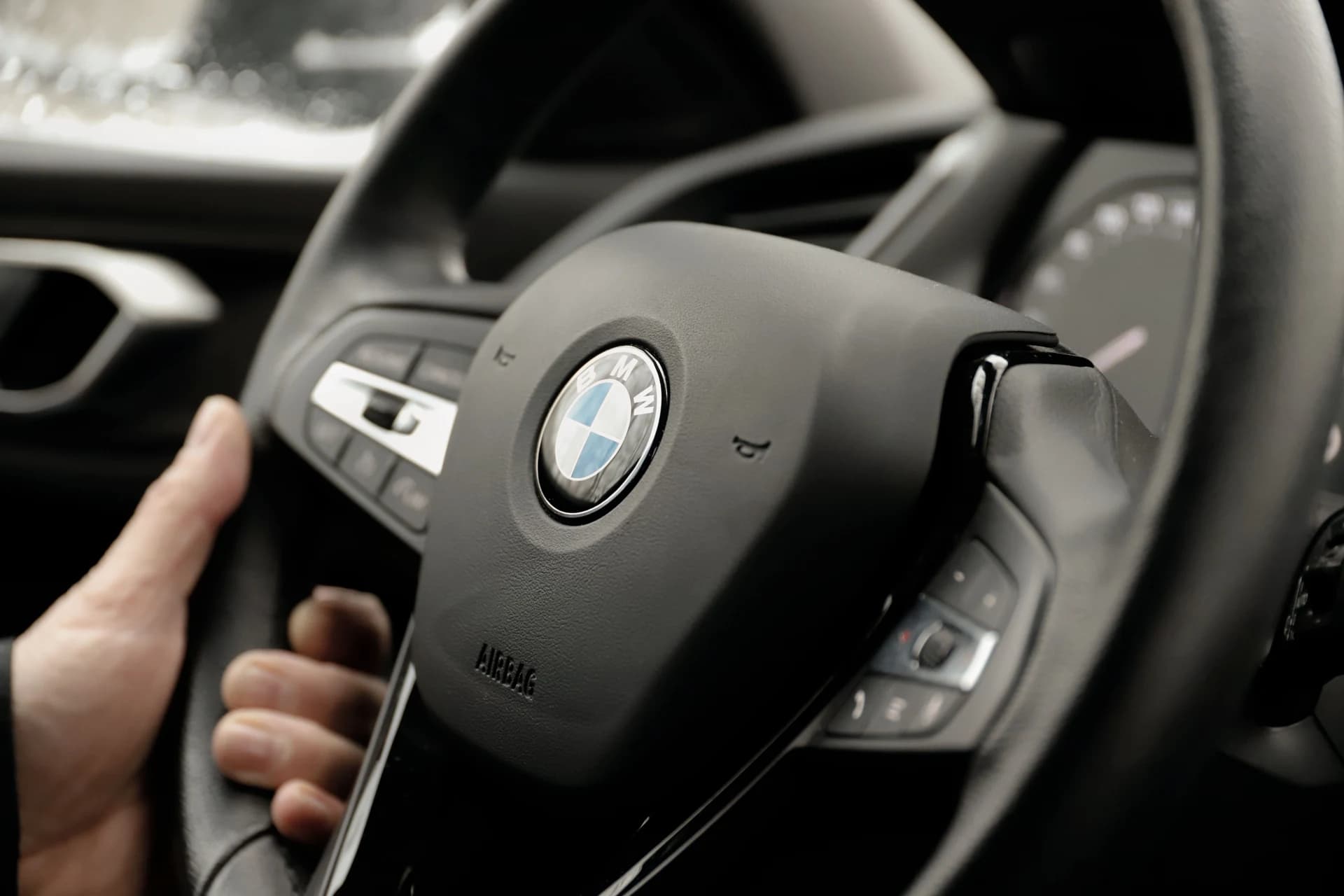
Illustrative photograph of a steering wheel in an earlier BMW; it does not show the new interface or testing of the 2027 urban functions. Pexels · Pexels License.