China's lead in electric-car charging is visible in the size of its network as well as in headline charging speeds. At the end of 2025, it accounted for more than 65 per cent of the world's public charging points, according to the International Energy Agency's Global EV Outlook 2026. The global total exceeded seven million after almost 1.8 million additions during the year.
Those figures describe infrastructure already counted for 2025, not a completed 2026 rollout. Alongside them, manufacturers are promoting much shorter charging stops: BYD's European Denza Z9GT material cites nine minutes from 10 to 97 per cent. Understanding the gap between a network statistic and a vehicle-specific claim is essential when deciding whether an EV suits a particular journey.
Count the points, then consider the power
IEA puts global public charging-point growth above 33 per cent in 2025, broadly matching growth in the electric light-duty vehicle fleet. A charging point is not the same as a whole location with multiple bays. Comparing a country reporting sites with another reporting individual points can therefore produce a misleading impression of coverage.
The agency estimates roughly 11 electric light-duty vehicles per public point worldwide. It also examines installed public charging capacity relative to the fleet, which averaged 4.5 kW per vehicle at the end of 2025. This is an infrastructure ratio, not the charging power that an individual driver should expect at a plug.
For that calculation, the IEA assigns representative power levels to equipment categories. It notes that national statistics using more granular information may differ. Both metrics are useful for describing network development, but neither establishes the availability or performance of the charger needed for a specific trip.
China supplied most of the growth
China's public network expanded from almost 3.4 million points at the end of 2024 to more than 4.7 million at the end of 2025. The country represented over 75 per cent of global additions during that period. Its ratio stood at ten electric light-duty vehicles per public charging point.
Fast and ultra-fast points in China increased by 40 per cent, from 1.5 million to 2.2 million. Public charging capacity per electric light-duty vehicle was close to 6 kW. That combination shows why the discussion is broader than the peak output of one new charger: China is expanding a large network while changing its power mix.
Europe's public charging-point stock rose by about 20 per cent in 2025. Within the EU, Denmark, Estonia, Latvia, Lithuania and Romania each recorded growth above 50 per cent, according to the IEA. A high percentage increase does not, by itself, establish uniform geographical coverage or tell a driver how many working points are on a chosen route.
Regional comparisons need private charging too
The Netherlands had Europe's largest public-point stock at the end of 2025, at 210,000, followed by Germany with 196,000 and France with 185,000. The EU averaged around 11 electric vehicles per public point, close to the world ratio, but public charging capacity was about 3 kW per electric light-duty vehicle, below the global average.
The US recorded 33 electric light-duty vehicles per public charging point and just over 1.5 kW of public capacity per vehicle. The IEA also highlights greater access to home charging there. That matters: a public-network comparison cannot fully describe ownership convenience without considering where vehicles are normally charged.
Globally, private charging points were estimated to exceed 43 million in 2025. For drivers able to use it, home charging remains attractive because of convenience and relative affordability. More powerful motorway equipment addresses a different need from reliable overnight access at an apartment or house.
Read the Denza charging claim carefully
BYD's European launch documentation dated 8 April 2026 states that FLASH Charging can take the Denza Z9GT from 10 to 70 per cent in five minutes and from 10 to 97 per cent in nine. It also claims 20 to 97 per cent in 12 minutes at −30°C. These are manufacturer figures, not Carboratory test results.
The same document qualifies the figure of up to 1,500 kW through one connector as applying to the Chinese market. That condition must stay attached to the power claim when discussing Europe. It should not be converted into an assertion that every European charging location or vehicle configuration can deliver that peak.
Charging intervals also matter. A 10–97 per cent claim is different from a 10–80 per cent test, and 97 per cent is not 100 per cent. Comparing times without retaining the starting charge, ending charge, temperature and relevant equipment can make unlike sessions appear directly comparable.
The vehicle and its battery must be compatible with the charging system to obtain the advertised result. Merely connecting an unrelated EV to a higher-rated charger does not give it the Denza's claimed charging capability. Nor does a fast energy-transfer phase establish the total time spent arriving, finding a free point and starting payment.
Convenience extends beyond the battery
The EU's AFIR framework addresses price transparency, payment without a subscription and access to information about charging availability as well as infrastructure deployment. The Council's explanation makes those usability measures part of the same programme as expanding capacity. It does not amount to a declaration that every European charger already provides a faultless experience.
For a prospective owner, the practical assessment therefore has several separate parts: everyday charging access, suitable points on regular longer journeys, vehicle compatibility and the operator's tariff. China's network statistics and BYD's technology claims provide evidence of development, but a buying decision still depends on the infrastructure the driver can actually use.
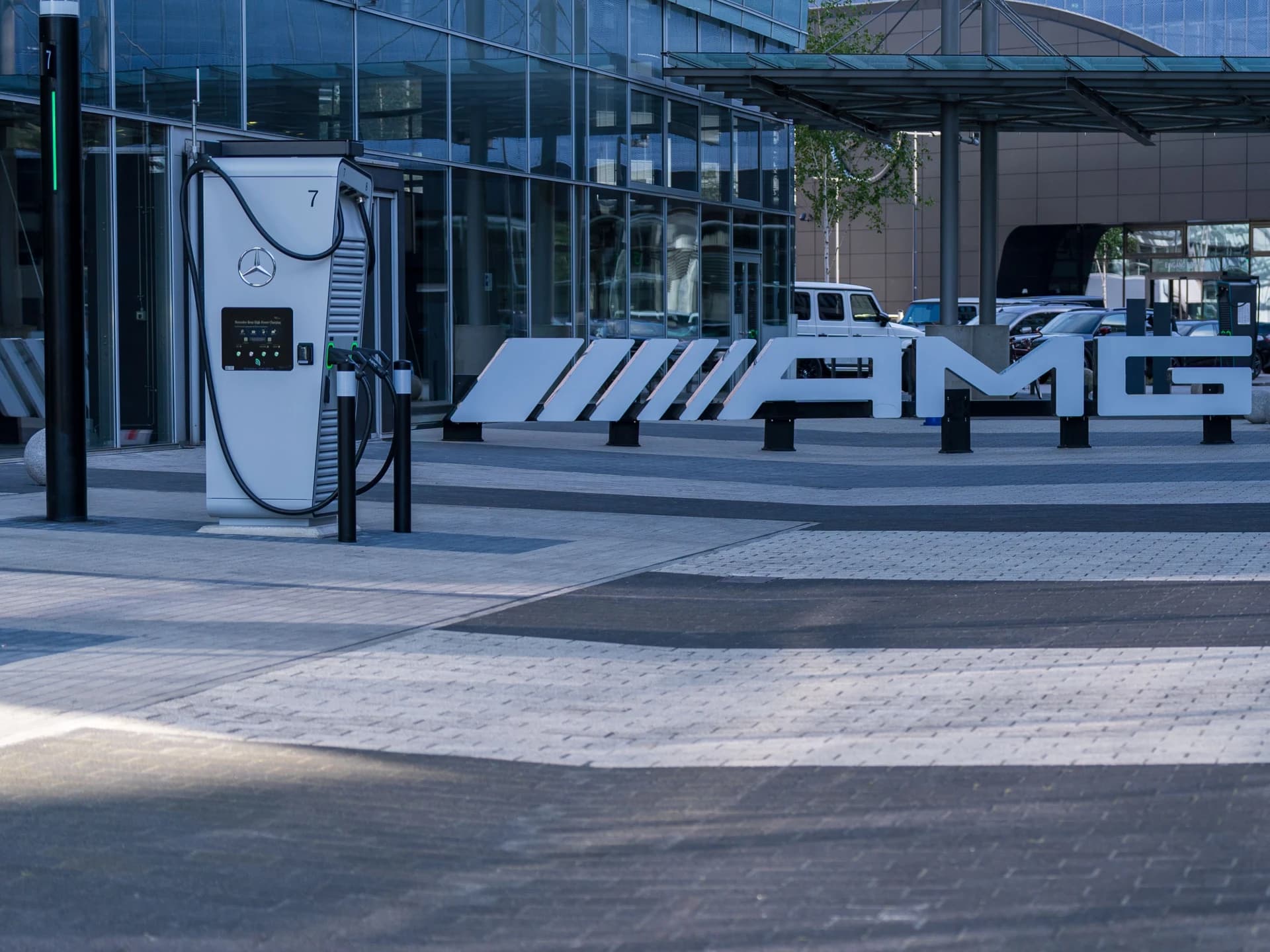
Illustrative Mercedes-Benz charging station; this is not FLASH Charging equipment or a Denza charging test. Mohamed B. / Pexels · Pexels License.