BMW’s electric-car customers are helping the company retain high-emitting performance models in Australia, according to its local chief executive. The connection is a regulatory one: battery-electric cars improve the supplier’s fleet emissions position, giving it more room to offer combustion models alongside them. It does not mean the V8 itself emits less because another driver chooses an EV.
Vikram Pawah, chief executive of BMW Group Australia, described that balance in an interview with Carsales. He said BMW intended to preserve a choice of powertrains and had not needed to remove models because of Australia’s New Vehicle Efficiency Standard, or NVES. His comments concern the Australian business; they are not a worldwide guarantee for every future eight-cylinder model.
Nearly one in five Australian BMWs was electric
BMW Australia’s own 2025 sales announcement provides a useful check on the scale involved. The brand reported 26,842 vehicles sold, including 5,187 fully electric cars. That works out to approximately 19.3% of its annual total. The denominator is BMW-brand sales in Australia, rather than all cars sold nationally or the wider BMW Group’s global deliveries.
The distinction between annual sales and the regulatory fleet also matters. The first mandatory NVES performance period began on 1 July 2025. A full calendar year of retail sales cannot simply be substituted for the eligible vehicles recorded for that period. The electric share supports Pawah’s explanation, but does not reveal BMW’s exact compliance balance or establish how many additional V8s it can supply.
There is therefore no defensible one-for-one exchange rate between electric cars and performance cars in these figures. A calculation would need the relevant vehicle population, each model’s recorded emissions and its applicable target. Neither the sales percentage nor the interview supplies that complete dataset.
A fleet requirement allows a mixed showroom
The Australian government’s NVES framework sets carbon-dioxide requirements for suppliers of covered new passenger cars and light commercial vehicles. The legislation took effect on 1 January 2025, with mandatory vehicle coverage starting on 1 July. Its purpose is to improve the emissions performance of the vehicles entering the market, rather than to prescribe a single engine type for every buyer.
The regulator uses information entered on the Register of Approved Vehicles. Its guidance identifies vehicle type, CO₂ emissions, mass in running order and rated towing capacity as relevant data. Targets are adjusted under the scheme’s rules, including for vehicle mass. Reducing the system to one universal grams-per-kilometre ceiling would miss that structure.
For BMW, the commercial implication is that different products can contribute differently to the final result. Battery-electric cars have no exhaust CO₂ output, while petrol models contribute their recorded emissions. A manufacturer can preserve a broader range if the overall position meets the requirements. Individual combustion cars still need to satisfy the other rules that apply to their approval and sale.
Credits provide another compliance route
NVES expresses the supplier’s initial position as an interim emissions value. A figure below zero means the supplier has beaten its requirement and receives units; zero means it has met the requirement. A positive figure needs to be addressed before the final position is settled. These are regulatory calculations across a covered fleet, not labels applied to a buyer’s personal environmental footprint.
Units can also be traded between regulated entities through the system’s registry. The regulator describes a closed market, with commercial terms agreed by the participants. It does not set the price of a unit or record the consideration paid for a trade. That mechanism gives suppliers another route to compliance, but says nothing by itself about BMW having bought or sold particular units.
Pawah’s argument is consequently about retaining flexibility through BMW’s product mix. It should not be read as an announced discount for V8 customers, an exemption for BMW M, or evidence that the Australian regulator has approved the brand’s strategy indefinitely. Annual requirements and the vehicles supplied remain decisive.
An electrified V8 is already a production solution
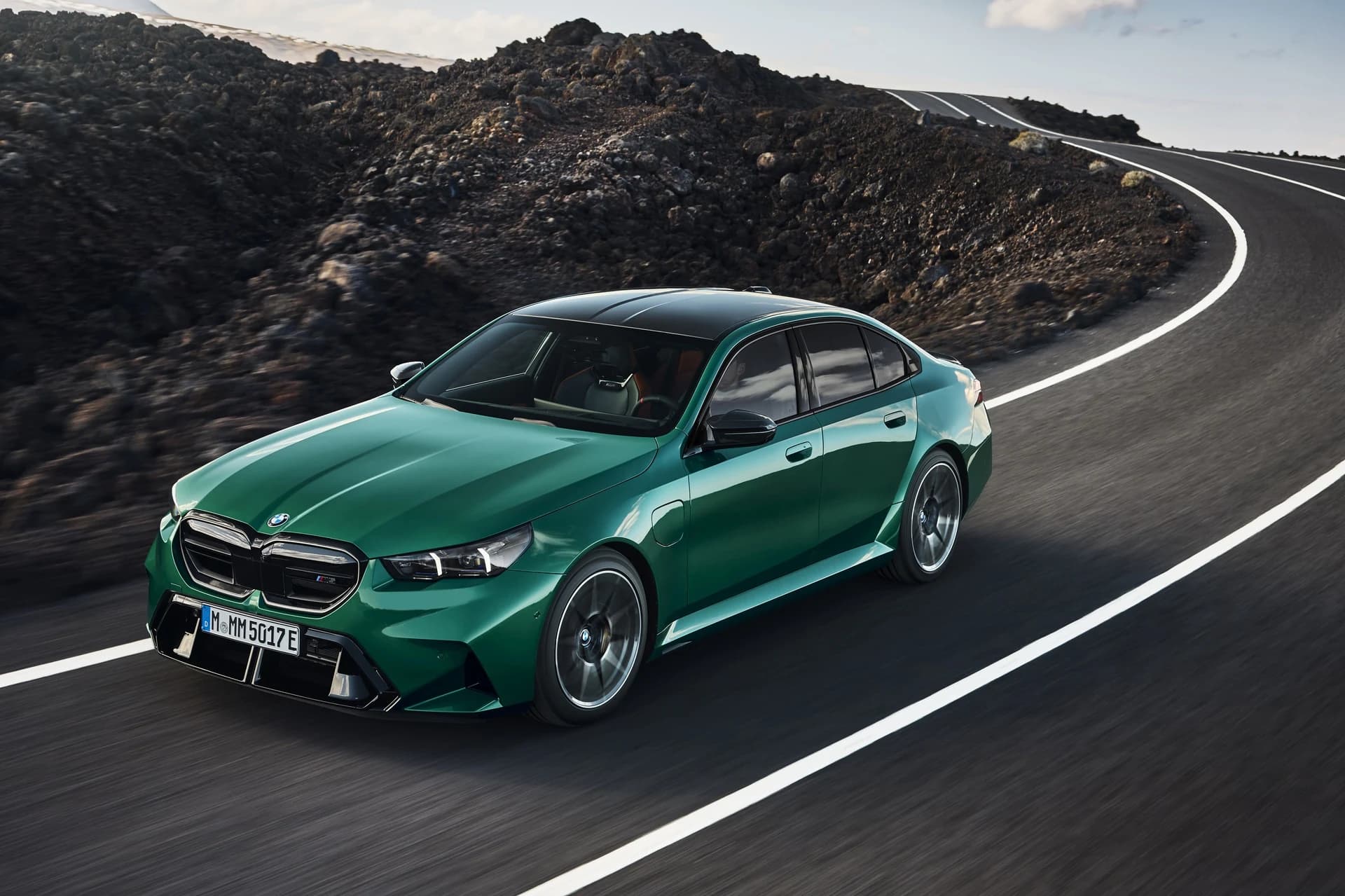
The M5 illustrates why a simple electric-versus-combustion split can obscure the actual range. BMW’s June 2024 launch information describes a plug-in hybrid combining a 4.4-litre V8 and an electric motor. The manufacturer quoted total system output of 535 kW and torque of 1,000 Nm. Those are official specifications, not Carboratory test results.
A plug-in hybrid is not a battery-electric car. It can use externally supplied electricity, but retains its petrol engine and its associated fuel use. Equally, “electrified” sales can include both BEVs and plug-in hybrids, so that broader term should not be used interchangeably with fully electric sales when interpreting BMW’s figures.
The official M5 photograph accompanying this article shows an existing product from that launch. It is not a preview of a newly confirmed Australian model or proof that a future X5 variant will be offered locally. Product announcements need to be assessed separately from statements about portfolio strategy.
Global figures tell a different, complementary story
In its financial-year 2025 reporting, BMW Group recorded 442,056 fully electric deliveries worldwide, representing 17.9% of the group total. Including plug-in hybrids, electrified deliveries reached 642,071. Those figures cover the group’s businesses and cannot be compared directly with the Australian BMW-brand percentage as though they measured the same population.
For buyers outside Australia, the immediate consequence is limited. Pawah has explained why local EV demand can support continued powertrain choice under NVES. He has not announced European availability, a future V8 production end date or a price change. The next concrete evidence for any particular car will be its market-specific launch announcement and specification, rather than the existence of a favourable fleet mix alone.
Photo: BMW AG, official BMW M5 press photography released in June 2024.