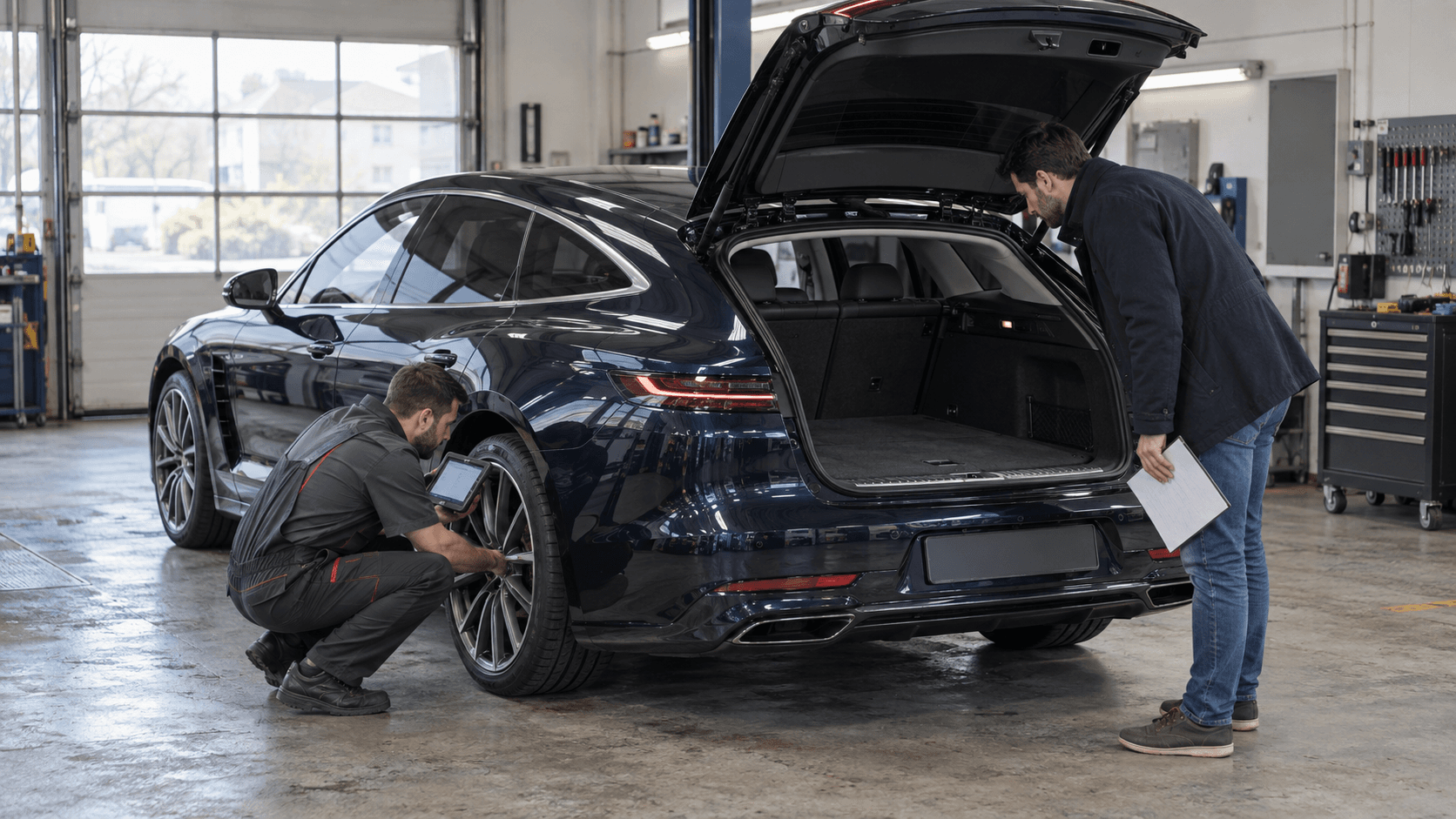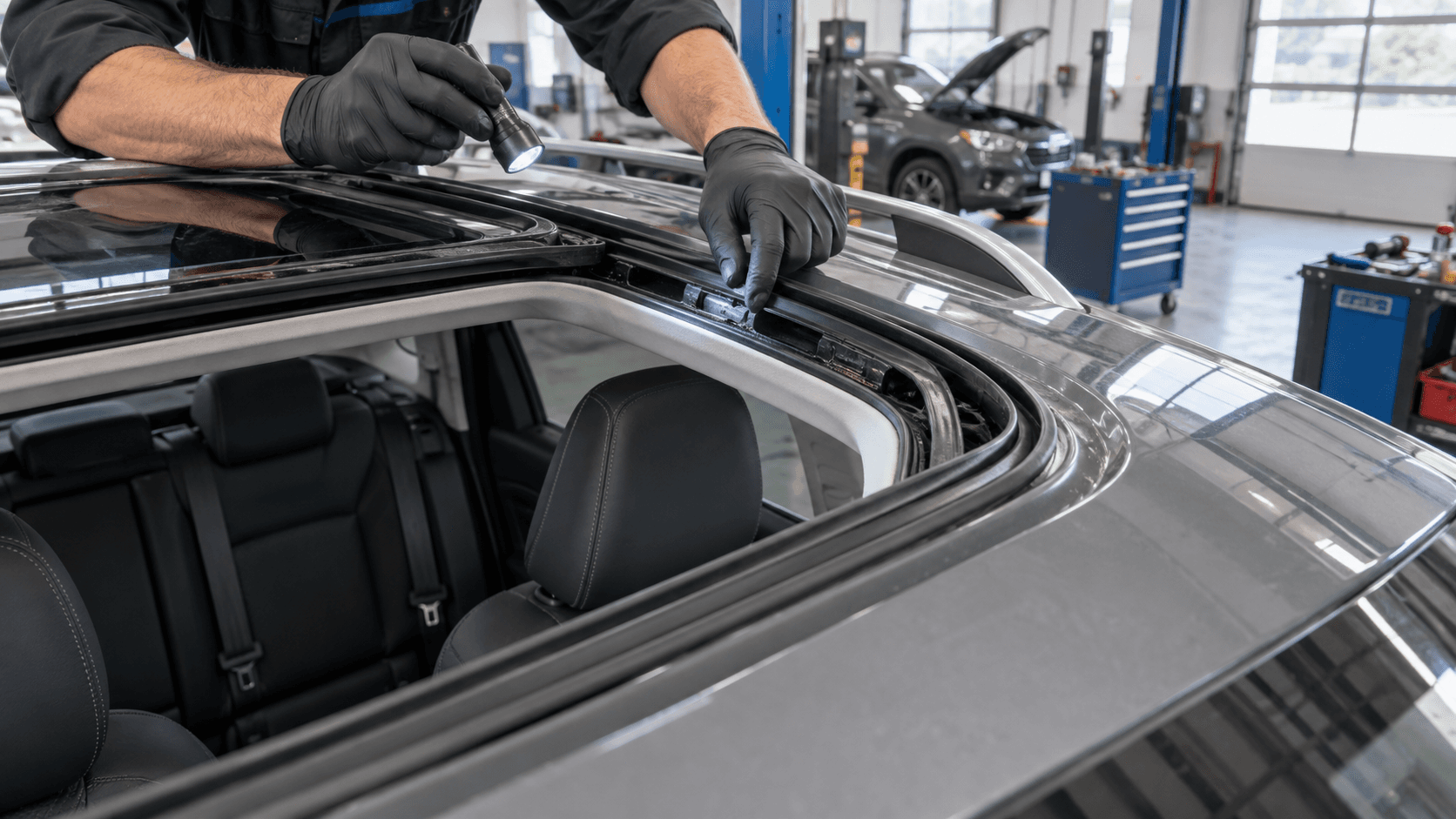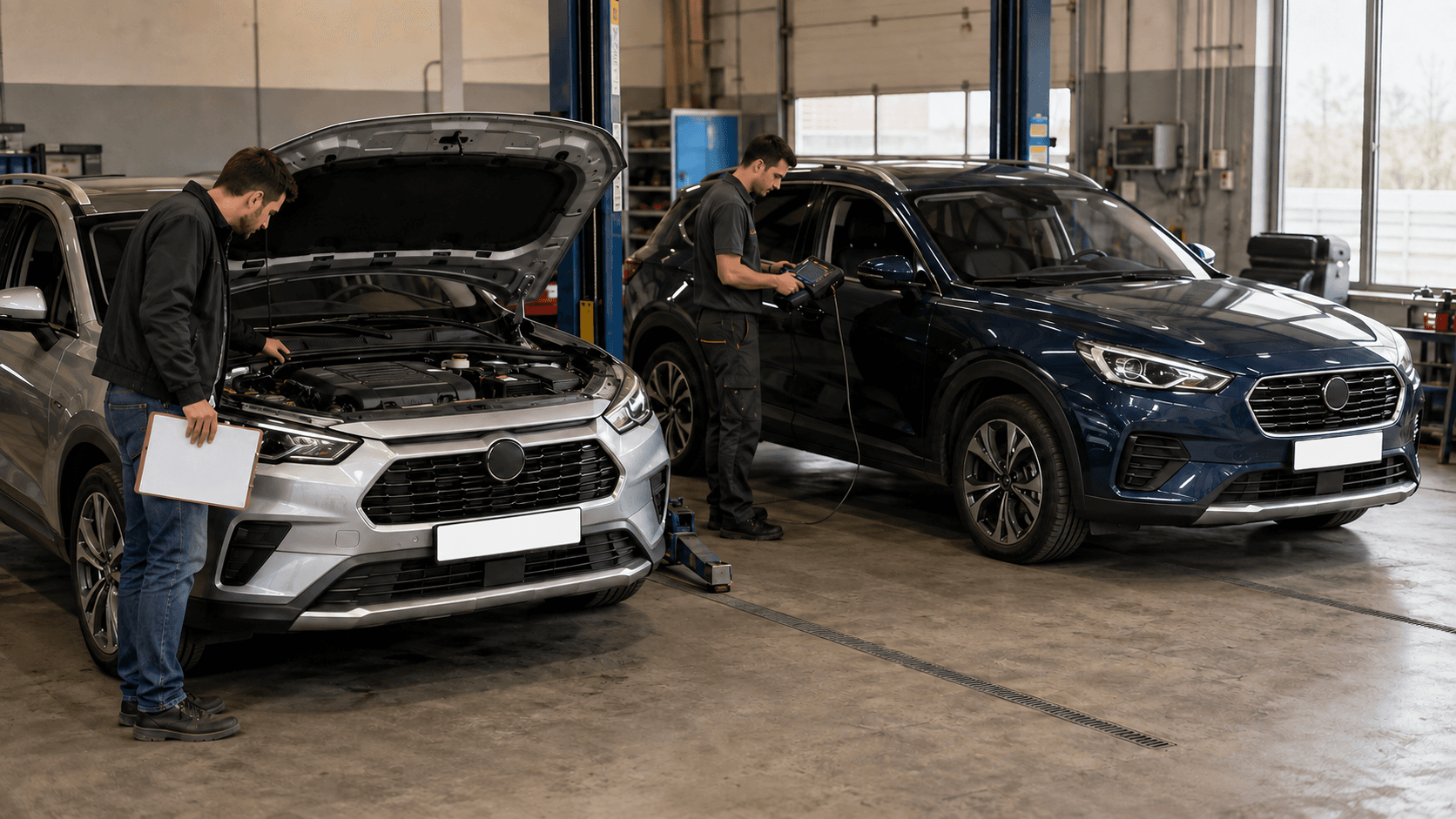
Illustrative image; the cars do not represent specific examples or brands.
Used Mercedes-Benz GLA in 2026: running costs and what to check on diesel, DCT, 4MATIC and PHEV
Short answer
A used Mercedes-Benz GLA is worth considering if you want a compact crossover, but it must be bought by generation, engine, gearbox and history, not by the badge. On the first-generation X156, check age, the diesel, the 7G-DCT gearbox and the 4MATIC drivetrain carefully. On the H247 generation, add 8G-DCT on certain diesels, MBUX and ADAS systems, 48 V electrification after the facelift, and the battery plus charging on the GLA 250 e.
There is no universal annual cost for maintaining a GLA. The quote changes with VIN, wheel size, drivetrain, engine and equipment. Before a deposit, ask for written prices for the immediate service, brakes, tyres, transmission, emissions systems and every fault found on diagnosis. A cheaper example with four worn tyres, a gearbox with no history and a faulty headlamp can cost more in the first year than one with a higher asking price.
Quick generation comparison
| Used version you will meet | What must be identified | The check that can change the purchase |
|---|---|---|
| X156, before or after the 2017 facelift | the exact engine, manual or 7G-DCT, front-wheel drive or 4MATIC | cold start, diesel emissions kit, gearbox, drivetrain and old damage |
| H247, the model launched in 2020 | petrol, diesel or GLA 250 e; 7G-DCT or 8G-DCT depending on configuration | electronics, ADAS, gearbox, cooling and the digital service history |
| H247 facelift, from 2023 | 48 V mild-hybrid petrol, diesel, PHEV and the exact equipment | the 48 V battery, PHEV charging, cameras and digital kit |
| the new GLA presented in 2026 | electric or forthcoming hybrid, a different platform and systems | do not confuse it with H247 just because the advert says “new GLA” |
Mercedes-Benz presented H247 in December 2019 and announced European market entry in spring 2020. Official documentation for this generation indicates 4,410 mm length, 1,834 mm width, 1,611 mm height and a boot of 435–1,430 litres. The figures do not automatically describe the first generation, the plug-in hybrid version or the new electric model presented in 2026.
1. X156 or H247: establish the generation before you ask for prices
The GLA X156 was built on the compact Mercedes architecture of the same period as the A-Class. In stance and space it is closer to a raised compact than to a GLC or GLE. Cars registered in 2017 can be before or after the facelift, so the year on the registration document is not enough. Check the build date, chassis series, equipment codes, headlights, bumpers and the multimedia system.
H247 is taller and has a different interior, a different assistance generation and MBUX. Euro NCAP notes that the GLA H247 uses a large part of the B-Class structure assessed in 2019 and that additional tests were carried out where necessary. The rating is now marked as expired; it does not prove the condition of the airbags, belts or sensors of a repaired car.
In July 2026, Mercedes-Benz presented a new GLA generation, electric first, with a hybrid version announced for 2027. Do not apply those specifications to a used H247. An advert published in 2026 can call both an H247 facelift and the newly launched model “new”. The VIN and real photographs resolve the confusion.
2. Diesel: previous routes matter more than the consumption in the advert
A diesel GLA can make sense for a long commute, national roads and the motorway. For repeated short urban trips, the particulate filter and emissions systems must be assessed before purchase. The same commercial name can hide different engines, outputs and emissions installations between X156, H247 and the facelift.
At inspection:
- insist that the engine is completely cold on arrival;
- read present, stored and recently cleared faults;
- check DPF parameters and the regeneration history available on diagnosis;
- inspect EGR, the turbocharger, injection and the SCR/AdBlue system, where fitted;
- watch whether the engine reaches and stays at normal temperature;
- look for oil, diesel and coolant traces above and below the undertray;
- compare invoices with mileage and the intervals that apply to the exact engine.
Do not accept “the DPF has been cleaned” as a diagnosis. Ask for the invoice, the method and the reason the filter loaded up. A forced regeneration does not repair a faulty thermostat, a problematic injector or unsuitable use. The guide on DPF, EGR and AdBlue on a used diesel explains the parameters a workshop should interpret.
3. Petrol: check cold starting, cooling and the oil history
A petrol GLA can be more suitable for low annual mileage and many urban routes, but it is not automatically a simple or cheap car. Turbo engines, injection, cooling and electronics differ between generations. On the H247 facelift, Mercedes-Benz introduced 48 V electrification for the petrol range, with a belt-driven starter-generator and seven- or eight-speed DCT transmissions, depending on version.
Start the engine cold and watch noises, idle, misfires and warning lights. After warm-up, check temperature, the fan, the water pump, the thermostat and any coolant traces. Ask for invoices for oil, spark plugs, coils and repairs. If the owner reports frequent oil top-ups, note the distance and quantity; “they all use oil” is not a measurement.
On a mild hybrid, the 48 V battery, starter-generator and voltage converter must be read separately on diagnosis. A new 12 V battery does not certify the 48 V system. Confirm the equipment from the VIN, because not every petrol GLA in an advert is a mild hybrid.
4. 7G-DCT and 8G-DCT: two names, more configurations
Many X156 examples have 7G-DCT, a dual-clutch automatic. On H247, 7G-DCT and 8G-DCT appear depending on engine, and AMG versions have their own configurations. The generic word “automatic” in the advert does not say which gearbox is fitted and which operations apply to it.
Run the test in this order:
- select R and D from cold, with a foot on the brake;
- crawl slowly forwards and backwards in a car park;
- repeat a smooth hill start;
- simulate slow traffic without sudden throttle;
- watch shifts under progressive acceleration;
- check a downshift in a safe area;
- repeat the manoeuvres after the transmission has warmed up;
- read faults and adaptation values with Mercedes-compatible equipment.
A long delay into gear, vibration, slip, bangs or warning messages need diagnosis. The cause can be in the clutches, mechatronics, dual-mass flywheel, mounts or another component; a road test alone does not identify the part. For the oil history, ask for an invoice with the date, mileage, fluid specification and parts used. The used automatic gearbox checklist completes the test.
5. 4MATIC: the badge does not confirm the drivetrain’s condition
GLA can have front-wheel drive or 4MATIC. Confirm the configuration from the VIN; a badge can be added, and advert photographs do not show the condition of the differential, shafts and the coupling to the rear axle.
Check the homologated wheel sizes, the tyre brand and model on each axle, tread depth and circumference differences. On the test, watch vibration under acceleration, noises at constant speed and binding in tight turns. On a lift, inspect the driveshafts, gaiters, shafts, mounts, final drives and leaks.
4MATIC helps traction, but it does not automatically shorten braking on ice and does not compensate for unsuitable tyres. For urban use, a front-wheel-drive version with a good history can be more logical than a neglected 4MATIC. Also use the guide on 4x4 drivetrains on a used car.
6. GLA 250 e: test the battery and charging, not the range on the dash
The GLA 250 e is the plug-in hybrid version of the H247 generation. At the 2020 launch, Mercedes-Benz communicated 218 hp system power, a 15.6 kWh total battery and 53–61 km of electric WLTP range. For the facelift presented in 2023, official documentation indicates 218 hp, higher electric power, optional AC charging of up to 11 kW and optional DC charging of up to 22 kW.
Do not compare every brochure battery figure directly without checking whether it represents gross energy, usable energy or another convention. Nor is the range shown after the seller’s route a health test. Temperature, speed, climate control and recent history can change the estimate.
At viewing:
- identify the model year and version from the VIN;
- ask for the history of the combustion engine and the high-voltage system;
- charge the car with its own cable from a low level to the agreed percentage;
- test the port, plug locking, AC and DC charging only if the car has the equipment;
- ask for a report on the high-voltage battery, charger, inverter and cooling;
- drive in electric mode and watch the changeover to the combustion engine;
- check regenerative braking together with the discs and calipers;
- confirm remaining warranty from the VIN and the market of origin.
A PHEV makes sense if you can charge it regularly. Otherwise you carry the battery mass and use the combustion engine more often. Also read the dedicated guide to used plug-in hybrid cars.
7. Suspension, brakes and wheels set a large part of the bill
GLA does not automatically use the same brakes, wheels and tyres on every version. AMG Line packs and AMG models can have different sizes and components from a GLA 180 d. Note the equipment codes and ask for prices for the actual car.
On a lift, check the arms, bushes, joints, dampers, springs, bearings and steering rack. On the road, look for knocks at low speed, a misaligned steering wheel, a car that pulls, vibration under braking and noises that change in corners. Measure tyre wear on the inner shoulder as well; the visible face in a photograph can look fine while the inner edge is worn.
Ask for two quotes: one for components that are mandatory immediately and one for work likely in the first year. Four tyres, discs and pads on both axles plus a straightened wheel can change the choice between two cars with similar prices.
8. MBUX, headlights, the sunroof and ADAS must be tried separately
Two GLAs from the same year can have very different equipment. Do not treat a feature as working just because it appears in the advert or in a menu. Test both keys, keyless entry, the instruments, the screen, the controls, Bluetooth, phone integration, every climate zone, the camera, sensors, adaptive cruise, lane keeping, headlights, the tailgate and the sunroof.
On a panoramic roof, look for water traces on the headlining, pillars, carpets and under the boot floor. On headlights, watch persistent condensation, colour differences and faults. After a windscreen, bumper, camera, radar or suspension-part change, assistance systems may need calibration; ask for the invoice and report.
Some digital functions can depend on an account, a subscription, the market of origin or unit compatibility. Test them with your own phone before payment. A screen that lights up does not prove that navigation, the camera and connected services work.
9. Digital history, RAR Auto-Pass and recalls are checked together
Mercedes-Benz Romania explains that the brand uses Service A and Service B, and that the work differs by interval, car type and equipment. The page also shows that the digital report can keep work carried out in the Mercedes-Benz network. Ask a service partner for a complete history and compare it with physical invoices; a missing entry does not automatically prove the car was not maintained in another workshop.
RAR Auto-Pass costs 42 lei and contains verifiable information, focused on the mileage reading. The certificate does not replace history from the country of origin, diagnosis, paint-thickness measurement or a lift inspection. For an imported car, ask for foreign paperwork and inspections, older photographs and repair documents.
Mercedes-Benz Romania offers VIN checks for three categories of recall: diesel software update, refrigerant and Takata airbags. The public tool should not be read as a complete list of every possible technical action. Ask a brand partner to check the serial number and confirm open or completed work in writing.
10. How to calculate running costs before a deposit
Do not start from a generic annual cost found online. Build the budget for the inspected VIN:
- immediate service: oil, filters, fluids, spark plugs or operations that have reached term;
- engine and emissions: defects found in cooling, injection, turbo, DPF, EGR or AdBlue;
- gearbox and 4MATIC: fluids, leaks, adaptations and diagnosed repairs;
- brakes and tyres: the real sizes, not the price of a base GLA;
- suspension and steering: parts, geometry and labour;
- electrics and ADAS: batteries, sensors, headlights, cameras and calibrations;
- PHEV or 48 V: the battery test, charging and auxiliary components;
- paperwork and use: insurance, tax, registration and the cost of an independent inspection.
Ask for quotes with parts, labour and VAT. Separate the work into “mandatory before you drive”, “likely in the first year” and “cosmetic”. Negotiation only makes sense after the workshop has established the cause of the fault. A cleared warning light or a jerking gearbox is not correctly valued from the cheapest part found on the internet.
Compare Mercedes-Benz GLA listings by generation, engine, gearbox, drivetrain, equipment and history. For an X156 registered in 2017, also use the dedicated GLA 2017 guide. If the car comes from another EU state, continue with checks for an imported car.
Checklist before you buy a used Mercedes-Benz GLA
- The VIN is identical on the body, in the CIV, registration document, invoices and diagnosis.
- Generation X156 or H247 and the facelift are confirmed.
- Engine, power, emissions standard, gearbox and drivetrain are identified from the VIN.
- The engine is completely cold at first start.
- There is no unexplained smoke, misfire, noise or warning light.
- Cooling stays stable and there are no coolant or oil traces.
- On diesel, DPF, EGR, injection, turbo and SCR/AdBlue have been read as applicable.
- On petrol, ignition, turbo, cooling and the oil history have been checked.
- The 48 V system has been tested if the car is a mild hybrid.
- The gearbox has been tried in R, D, on a hill, in slow traffic and after warm-up.
- The transmission history has invoices, not only a verbal statement.
- 4MATIC does not produce vibration, binding or noises.
- Driveshafts, shafts, final drives and leaks have been inspected on a lift.
- Wheels and tyres have homologated sizes and compatible wear.
- Brakes, suspension, steering and geometry have been checked.
- Paint thickness and body joints have been measured.
- The floor, sills and mounting points have no suspicious structural repairs.
- Airbags, belts and head restraints are present and without hidden faults.
- Headlights, cameras, radar and sensors work and are calibrated.
- MBUX, controls, climate, tailgate and sunroof have been tested.
- There is no water under the carpets or under the boot floor.
- Both keys and the accessories listed in the offer are handed over.
- On GLA 250 e, charging has been tested with the car’s cable.
- On GLA 250 e there is a report for the high-voltage battery.
- RAR Auto-Pass, the digital history and invoices corroborate each other.
- Recalls and technical actions have been checked by VIN.
- The workshop has issued a written list of defects and quotes.
- The budget remains sufficient after the service and immediate work.
Frequently asked questions
Which Mercedes-Benz GLA generation is more suitable used?
X156 is usually more accessible, but age, accumulated repairs and gearbox history weigh heavily. H247 offers more space, MBUX and newer assistance systems, but adds electronics and, depending on version, a PHEV or 48 V. The example with better documents and inspection is a safer choice than the generation preferred in the abstract.
GLA diesel or petrol for town?
Petrol fits short journeys and low mileage better. Diesel makes sense on longer distances and enough extra-urban use for the emissions systems. The decision should be taken from your routes and the condition of the actual engine, not from the consumption claimed in the advert.
Is the 7G-DCT gearbox on the Mercedes GLA reliable?
There is no useful verdict without the car’s history and a test. Check R/D selection, pull-away, slow running, a hill, acceleration and hot operation. Diagnosis and invoices must explain jerks, delays or previous work.
Is 4MATIC worth it on a used GLA?
Yes, if you drive on low-grip roads and the drivetrain passes inspection. For town and tarmac, front-wheel drive can reduce complexity. Regardless of system, suitable tyres and good brakes remain mandatory.
Is the GLA 250 e worth it if I live in a block of flats?
Only if you have a safe, regular charging solution. Without charging, you use the combustion engine more often and carry the hybrid system’s mass. Test the battery, port, cable and charger before purchase.
How much does it cost to maintain a used Mercedes GLA?
The cost depends on generation, engine, DCT, 4MATIC, wheels, equipment and the car’s faults. Ask for VIN-based quotes for service, brakes, tyres, transmission and the faults found. Do not spend the whole budget on the purchase price.
Is the Mercedes-Benz digital history enough?
No. Compare it with invoices, RAR Auto-Pass, documents from the country of origin, diagnosis and a physical inspection. Work done outside the network can be missing, and an entry in the system does not prove the current condition of the part.
Technical sources
- Mercedes-Benz: H247 generation launch, dimensions and boot
- Mercedes-Benz: H247 facelift, mild-hybrid engines, DCT and GLA 250 e
- Mercedes-Benz: GLA 250 e data at the 2020 launch
- Mercedes-Benz: new electric and hybrid GLA generation presented in 2026
- Mercedes-Benz Romania: Service A/B and the digital service report
- Mercedes-Benz Romania: VIN recall check
- Euro NCAP: Mercedes-Benz GLA H247 assessment
- Romanian Automotive Register: RAR Auto-Pass certificate