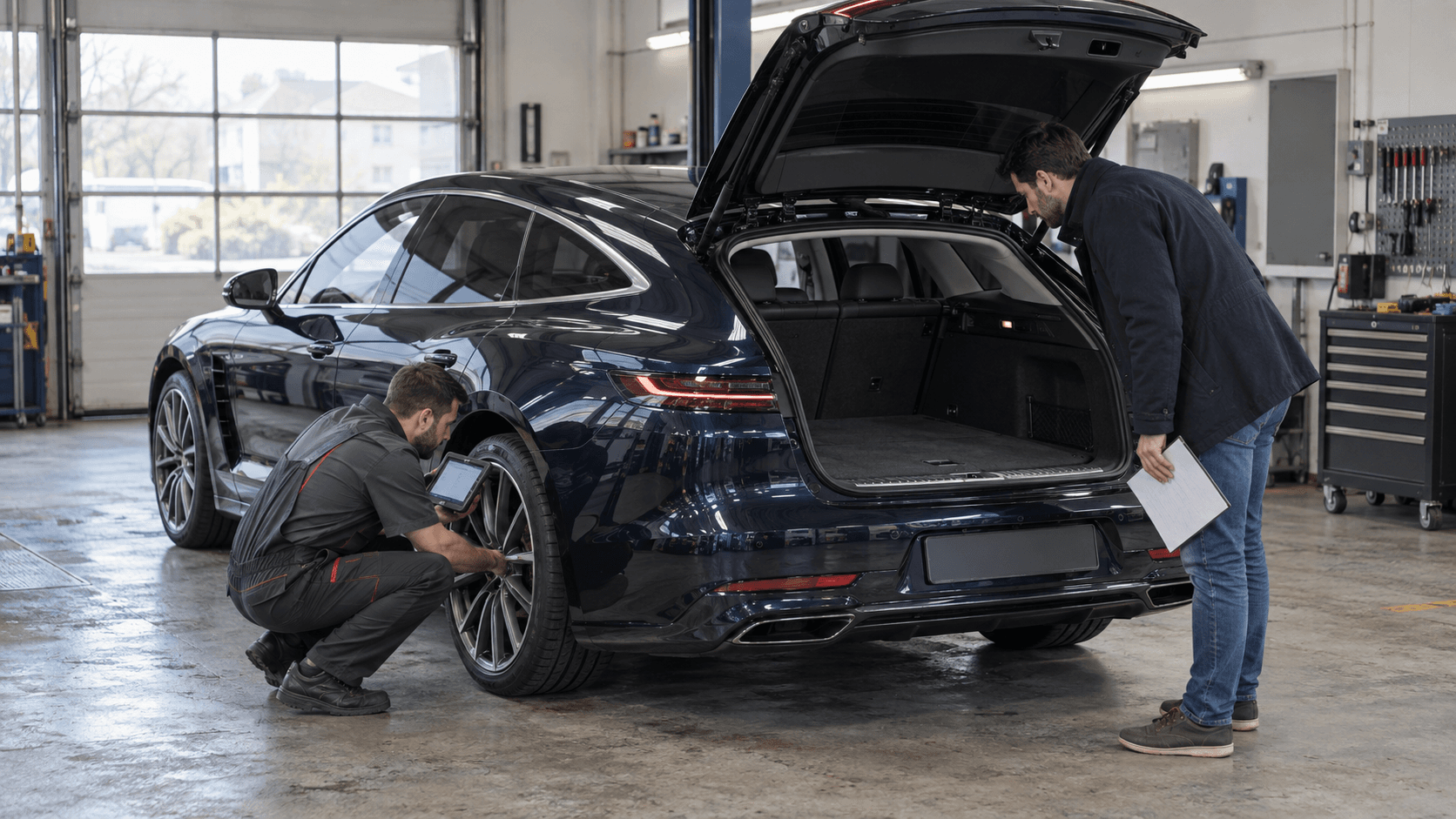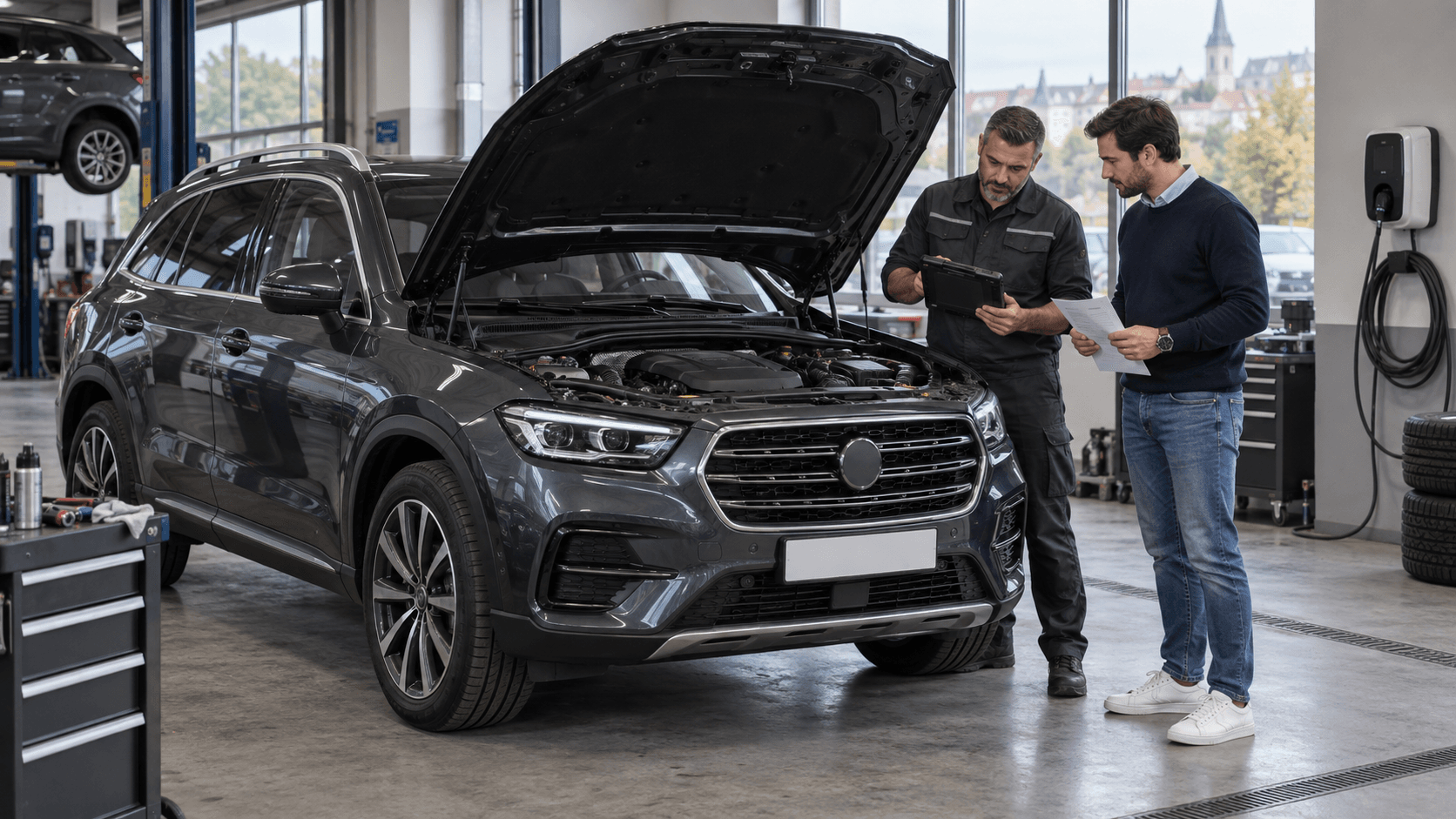
Illustrative image; the car does not represent a specific model or brand.
Used Mercedes-Benz GLC in 2026: what to check on diesel, 9G-TRONIC, 4MATIC, PHEV and AIRMATIC
Short answer
A used Mercedes-Benz GLC can be a comfortable family car, but the GLC name covers two generations and very different technical systems. The X253, launched in 2015 and updated in 2019, can have diesel, petrol or plug-in hybrid, a 7G-TRONIC or 9G-TRONIC gearbox, and coil springs or AIR BODY CONTROL. The X254, which arrived in 2022, uses electrified four-cylinder engines: 48 V mild hybrid or PHEV with a much larger battery.
Before a deposit, identify generation, engine, gearbox, drivetrain and suspension from the VIN. On diesel, the DPF, EGR and SCR/AdBlue system, where fitted, must be read. On 9G-TRONIC, a cold and hot test matters, plus service history that matches that gearbox. On 4MATIC, check all four tyres and the drivetrain on a lift. On PHEV, test the combustion engine, battery, charging, cooling and the changeover between power sources separately.
Do not calculate maintenance from an annual sum found online. Ask for quotes after the VIN for a service, brakes, tyres, gearbox, all-wheel drive, suspension and every diagnostic fault. On a cheap GLC, optional equipment and deferred work can weigh more than the price gap between two listings.
X253 or X254: which GLC you are actually buying
The GLC replaced the GLK in 2015. The first generation uses code X253 for the SUV and C253 for the Coupé. The 2019 update brought MBUX, revised headlights and assistance systems, and other engine families. The second-generation SUV, X254, was launched in 2022; the matching Coupé is C254.
| Generation or version | Reference configuration | The check that can decide the purchase |
|---|---|---|
| X253 2015–2019 | diesel/petrol, mostly 4MATIC; 9G-TRONIC on launch versions | engine, gearbox, all-wheel drive, real history and fitted options |
| X253 GLC 350 e | petrol PHEV, 4MATIC, 7G-TRONIC PLUS | battery, charging, cooling and hybrid transmission operation |
| X253 facelift 2019–2022 | new engines, MBUX; petrol with 48 V on some versions | 12/48 V battery, software, sensors, engine and 9G-TRONIC |
| X253 GLC 300 e facelift | petrol PHEV, 13.5 kWh battery, hybrid 9G-TRONIC | battery report, AC charging, observed range and both power sources |
| X254 from 2022 | petrol or diesel mild hybrid, 4MATIC in the European launch range | 48 V system, 9G-TRONIC, MBUX, ADAS and exact equipment |
| X254 300 e/400 e/300 de | PHEV, 31.2 kWh battery; petrol or diesel | AC/DC according to equipment, battery, brakes, cooling and VIN warranty |
Mercedes-Benz documentation for the 2015 GLC lists at launch the GLC 220 d, 250 d and 250 with 4MATIC and 9G-TRONIC, while the GLC 350 e PHEV used 7G-TRONIC PLUS. The 2019 facelift presentation confirms the move to MBUX and the new engines. Do not transfer these data automatically to a car registered in another country: the VIN decoder, the CIV and the vehicle’s technical sheet take priority.
1. Diesel: check previous use, not only mileage
GLC 220 d and 250 d are common in X253 listings, and X254 continued with versions such as 220 d and 300 d. A diesel can make sense for extra-urban commuting, motorway use or towing. A car used mainly on short trips and frequent starts still needs a careful reading of the emissions system.
The first start must be with a cold engine. Watch start time, idle, vibration, smoke, smell and noises. Diagnosis must cover all modules and include present, stored or recently cleared faults, differential pressure and available data for DPF, EGR, injection, turbo and SCR/AdBlue. A light that is off does not prove the system works correctly.
After a test of at least 20–30 minutes, check operating temperature, regenerations reported by the tester and any leaks. On a lift, inspect the sump, cooling, intake path, turbo, exhaust and traces of crystallised urea around SCR components. If the seller shows an invoice for DPF cleaning, also ask for the diagnosis of the cause; the filter can load again if the engine, injection or sensors were left unrepaired.
The guide on DPF, EGR and AdBlue on a used diesel explains what the workshop should be asked for.
2. Petrol and the 48 V system after the facelift
On early X253 cars, the petrol GLC 250 was one of the launch versions. The 2019 facelift brought petrol engines with a 48 V network and a belt-driven starter-generator. X254 uses an integrated starter-generator and 48 V electric assistance on mild-hybrid engines.
Start the engine fully cold and listen to the timing drive, accessories and exhaust. Watch misfires, mixture corrections, boost pressure, temperature and any oil or coolant losses. Do not extrapolate a problem heard about one engine code to the whole GLC range; identify the engine fitted and ask for the diagnostic report.
On a mild hybrid, the test must include the 12 V battery, the 48 V system, the converter, charging and module faults. Check starting, stopping and restarting in traffic, energy recovery and behaviour after warm-up. A dashboard message can start from low voltage, but swapping a battery at random does not replace diagnosis.
3. 9G-TRONIC: test cold, on a slope and after warm-up
Most combustion GLCs seen in Romania are automatics. Launch X253 220 d, 250 d and 250 versions used a torque-converter 9G-TRONIC, while the first GLC 350 e PHEV had 7G-TRONIC PLUS. The facelift GLC 300 e moved to a PHEV transmission derived from 9G-TRONIC. So “Mercedes automatic” is not a gearbox code.
Select D and R when cold and time the response mentally. Creep forward and back, start on a slope, accelerate progressively, then repeat the manoeuvres after urban traffic and after an extra-urban stretch. Shocks, slip, vibration or delay need diagnosis. The symptom alone does not say whether the source is the gearbox, converter, a mount, the engine or the all-wheel drive.
Ask for invoices, the exact oil type and the work done. Mercedes-Benz Romania explains that Service A and B alternate, and the work depends on interval, model and equipment. Do not apply a universal interval found online. A workshop must identify the gearbox, maintenance plan and any technical updates from the VIN before issuing a quote.
4. 4MATIC: four tyres and a lift
On launch X253 cars, Mercedes-Benz described a permanent 4MATIC system with a basic 45:55 split between axles. X254 used a revised generation, and the configuration must be confirmed for each version. The badge on the tailgate is not enough: it can be missing or added.
Compare all tyres by size, load index, brand, model, season, DOT date and wear. Large circumference differences or mismatched tyres can affect behaviour and complicate the drivetrain assessment. In tight turns, listen for binding, cracks or vibration. At constant speed, watch rumble and vibration that change on acceleration or deceleration.
On a lift, check driveshafts, boots, shafts, bearings, differentials, mounts and any oil trace. If the car has towed, also inspect cooling, brakes, gearbox, the socket and the tow-bar installation. The guide for a used 4x4 offers a broader procedure; do not assume, however, that the GLC uses Haldex.
5. X253 PHEV: GLC 350 e and GLC 300 e are not the same car
The GLC 350 e presented in 2015 combined a petrol engine with an electric motor, 4MATIC and 7G-TRONIC PLUS. Mercedes-Benz then quoted up to 34 km electric in the cycle used at launch. That figure is not directly comparable with WLTP and does not predict the range of a ten-year-old battery.
The facelift GLC 300 e, presented in 2019, used a 13.5 kWh battery, a 7.4 kW onboard charger and an official WLTP electric range of 39–43 km. The electric motor was integrated in the PHEV transmission based on 9G-TRONIC. The official GLC 300 e sheet shows why year and version change the test radically.
For both, ask for a report on the high-voltage battery, charger, inverter, cooling and stored faults. Charge the car from a known AC source, with the cable that will be handed over. Drive electrically, start the combustion engine, watch the changeover and test regenerative braking. Check the port, flap, cable, climate control and preconditioning. Confirm remaining warranty in writing if the seller claims it exists.
6. X254 PHEV: a larger battery and charging that must be tested
X254 increased the electric side substantially. For the GLC 300 e, 400 e and 300 de, Mercedes-Benz published a total battery capacity of 31.2 kWh and WLTP electric ranges of more than 100 km, depending on version and equipment. Three-phase 11 kW AC charging is the generation’s reference, and 60 kW DC charging was optional on some markets and configurations.
Do not infer DC from the car’s year or from the port shape in a listing photo. Check the equipment sheet and test charging. A car that accepts AC is not automatically healthy on DC, and the range shown after a full charge is not a battery health report.
On the GLC 300 de, both the PHEV system and the diesel engine and emissions equipment must be assessed. On 300 e or 400 e, the petrol engine, ignition and cooling remain to be checked. For any PHEV, compare observed range on a repeatable route with temperature, climate control, speed and the battery percentage used. Also read the checklist for a used plug-in hybrid.
7. AIR BODY CONTROL and AIRMATIC: the name and generation matter
X253 could have standard coil springs or the optional AIR BODY CONTROL air system. That could change ride height and lower the rear for loading. On X254, AIRMATIC appears in the technical package together with rear-axle steering on certain configurations. Equipment differs by body, version and market, so do not identify the suspension from a button or the seller’s claim alone.
Leave the car parked for several hours on a level surface and compare height at each corner. Start it, change the available modes and watch the time, compressor noise and dashboard messages. Drive over bumps, then check bags, dampers, lines, level sensors, compressor and valve block. A car that rises after start-up can still lose pressure while standing.
For coil suspension, check dampers, arms, bushes, joints and springs. Whatever the system, large wheels raise tyre costs and can hide impacts or welds. Ask for a quote on the exact configuration, not the generic phrase “Mercedes suspension”.
8. Body, brakes, water and the Coupé version
Measure paint on all panels and check joints, sills, longitudinals, jacking points and the floor. On a PHEV, also inspect the battery shields. Different paint thickness alone does not prove structural damage, but it shows where to look for cutting, welding or deformation.
The GLC Coupé has a different roofline and tailgate shape from the SUV. Test visibility, rear space and boot access with the objects you will carry. Do not pay a higher price before checking whether the styling advantage offsets the lost utility for your family.
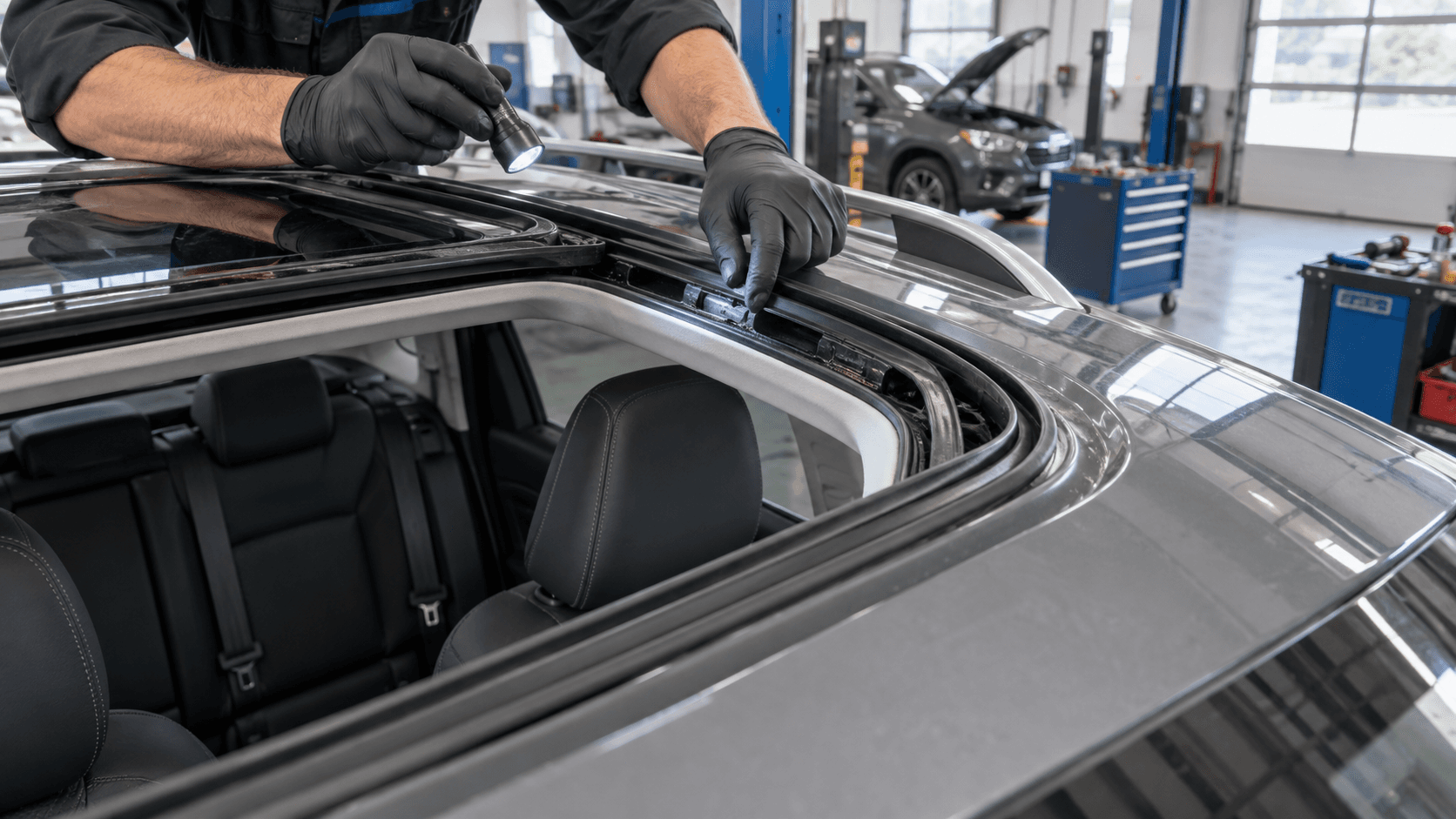
Check the panoramic roof, seals, drains, headliner, pillars, carpets and the area under the boot floor. On brakes, measure discs and pads and check calipers. A PHEV can use regeneration a lot, but the mechanical discs can corrode or the calipers can seize.
9. MBUX, cameras, headlights and assistance systems
The 2019 X253 facelift brought MBUX. X254 uses a later generation and can have cameras, radar, DIGITAL LIGHT, a head-up display, rear-axle steering and other expensive options. List the functions present on the car you are checking and test them one by one; a visible menu does not guarantee that the service is active or transferable.
Start the screen when cold, check the instruments, navigation, steering-wheel controls, climate control, cameras, sensors, Bluetooth and phone pairing. Ask for both keys. Before handover, the previous owner must remove the car from their account, and the buyer must be able to associate their own Mercedes me ID.
Look at the windscreen in the camera area, bumper mounts and headlights. After a windscreen change, a wheel impact or bumper repair, ask for the invoice and the calibration report. A diagnosis without a fault does not prove that the radar or camera is aligned correctly.
Euro NCAP tested a GLC 220 d 4MATIC X254 in 2022. The model received 92% for adult protection, 90% for children, 74% for vulnerable road users and 84% for assistance systems, under that year’s protocol. The Euro NCAP result describes the tested car, not the condition of an example repaired after an accident.
10. Digital history, RAR Auto-Pass and recalls
Compare the VIN on the body with the CIV, registration document, invoices and diagnosis. Mercedes-Benz Romania shows that a service partner can prepare a history from the digital service report. This document is useful, but it does not automatically cover work done outside the network. Ask for original invoices and follow the mileage sequence.
RAR Auto-Pass can include odometer readings, interventions reported by authorised workshops, repairs after serious accidents, ITP inspections and recall information available in the RAR database. RAR notes that the database is completed over time; a certificate with no entries does not certify the whole life of an imported car.
The Mercedes-Benz Romania page allows VIN checks for certain public recalls and recommends contacting a partner for further questions. Ask for the full status of technical campaigns and proof of closed interventions. Do not rely on a general recall list, because inclusion depends on VIN, build date and market.
How to calculate the real cost of a GLC before you buy
Use the same formula for each car:
purchase price + work required immediately + operations due within 12 months + tyres and brakes + insurance and taxes + a reserve for findings.
Ask for separate quotes for engine, 9G-TRONIC, 4MATIC, suspension, headlights, windscreen, ADAS and electronics. On PHEV, add the battery report and available AC/DC tests. A more expensive car with a coherent history and nearby work already done can need less money in the first year than a cheap one with mismatched tyres, worn brakes and cleared faults.
Compare Mercedes-Benz GLC listings in Romania only after you have established generation and engine. For a smaller car, read the used Mercedes-Benz GLA guide; for more space and another cost class, see used Mercedes-Benz GLE.
Checklist before you buy a used Mercedes-Benz GLC
- The VIN is identical on the body, in the papers, invoices and diagnosis.
- The X253/C253 or X254/C254 code is confirmed, not inferred from the registration year.
- Engine, power, gearbox, drivetrain and suspension have been identified from the VIN.
- The combustion engine is fully cold at the first start.
- There is no unexplained smoke, misfire, leak, noise or warning light.
- On diesel, DPF, EGR, injection, turbo and SCR/AdBlue have been read, as applicable.
- On petrol, ignition, turbo, cooling and oil history have been checked.
- The 12 V and 48 V systems have been diagnosed if the car is a mild hybrid.
- The gearbox has been tested cold, hot, in D, R, on a slope and in slow traffic.
- The gearbox maintenance plan has been established from the VIN and invoices.
- All tyres match in size and have similar wear.
- 4MATIC driveshafts, shafts, differentials and leaks have been checked on a lift.
- The suspension does not lose height after standing and has no faults, if it is air.
- Brakes, arms, bushes, bearings, wheels and geometry have been checked.
- The body has been measured, including sills and structural points.
- There is no water under the carpets or under the boot floor.
- The sunroof and drains have been tested, if present.
- On PHEV there is a report for the high-voltage battery and hybrid system.
- AC charging has been tested with the cable that will be handed over.
- DC charging has been confirmed in the equipment and tested, if the car has it.
- The combustion engine and electric-to-thermal changeover have been tested on PHEV.
- The battery shield and jacking points have been inspected on PHEV.
- Windscreen, headlights, cameras, radar and sensors work and are calibrated.
- MBUX, climate control, cameras and all controls have been tested cold and hot.
- Both keys are handed over, and the car can be transferred to a new account.
- RAR Auto-Pass, external history, the digital report and invoices do not contradict each other.
- Recalls and technical campaigns have been checked from the VIN.
- The workshop has issued written quotes for immediate and due work.
- After purchase a financial reserve remains, not only the budget for the first service.
Frequently asked questions
Is a used Mercedes-Benz GLC reliable?
Reliability is assessed on the specific car. The GLC has two generations, many engines, transmissions, hybrid systems and equipment. History, mileage, accidents and maintenance matter more than a label applied to the whole range. Choose the car that passes inspection and has coherent documents.
Which GLC suits town use better: diesel, petrol or PHEV?
Petrol avoids the usage requirements of a modern diesel. A PHEV can make sense if you charge it regularly and check the battery. Diesel is easier to justify on long journeys than on short urban trips. The decision should follow weekly routes, not the consumption in a listing.
Do all Mercedes GLC models have 9G-TRONIC?
No. Launch thermal X253 versions used 9G-TRONIC, but the GLC 350 e PHEV had 7G-TRONIC PLUS. The facelift GLC 300 e and the X254 generation use other configurations based on 9G-TRONIC. Confirm the transmission from the VIN.
Are all GLCs 4MATIC?
Many European examples are 4MATIC, and the official X253 and X254 launch ranges presented here were built around all-wheel drive. The offer differed, however, between years and markets. Check the car’s sheet, the CIV and the fitted components, not only the badge.
Are AIR BODY CONTROL and AIRMATIC the same thing?
Both are Mercedes names for air-suspension solutions, but they appear on different generations and configurations. X253 could have AIR BODY CONTROL, and X254 offers AIRMATIC in certain packages. Parts, functions and the quote must be established from the VIN.
What battery health should a GLC PHEV show?
There is no universal percentage that decides the purchase on its own. Ask for the measurement method, temperature, state of charge and the full report. Compare the result with observed range, charging tests and warranty conditions confirmed from the VIN.
How much does it cost to maintain a used Mercedes GLC?
The cost depends on generation, engine, gearbox, 4MATIC, suspension, wheels and equipment. After inspection, ask for quotes for a service, brakes, tyres, drivetrain, suspension and every fault. An annual average cannot replace the quote for the car you want to buy.
Which documents are decisive before a deposit?
The VIN, CIV, registration document, contract, invoices, digital service report, import documents and RAR Auto-Pass must describe the same car and the same mileage. For PHEV, add the battery report and warranty confirmation; for any version, ask for the status of technical campaigns from the VIN.
Verified sources
- Mercedes-Benz: X253 GLC launch, engines, 9G-TRONIC, 4MATIC and AIR BODY CONTROL
- Mercedes-Benz: 2019 GLC update, MBUX and the new engines
- Mercedes-Benz: 2019 GLC 300 e PHEV, battery, range and charging
- Mercedes-Benz: X254 mild-hybrid range launched in 2022
- Mercedes-Benz: X254 GLC 300 e, 400 e and 300 de, 31.2 kWh battery and charging
- Mercedes-Benz Romania: Service A/B and the digital service report
- Mercedes-Benz Romania: recall check by VIN
- Euro NCAP: 2022 Mercedes-Benz GLC X254 results
- Romanian Automotive Register: content and limits of the RAR Auto-Pass certificate