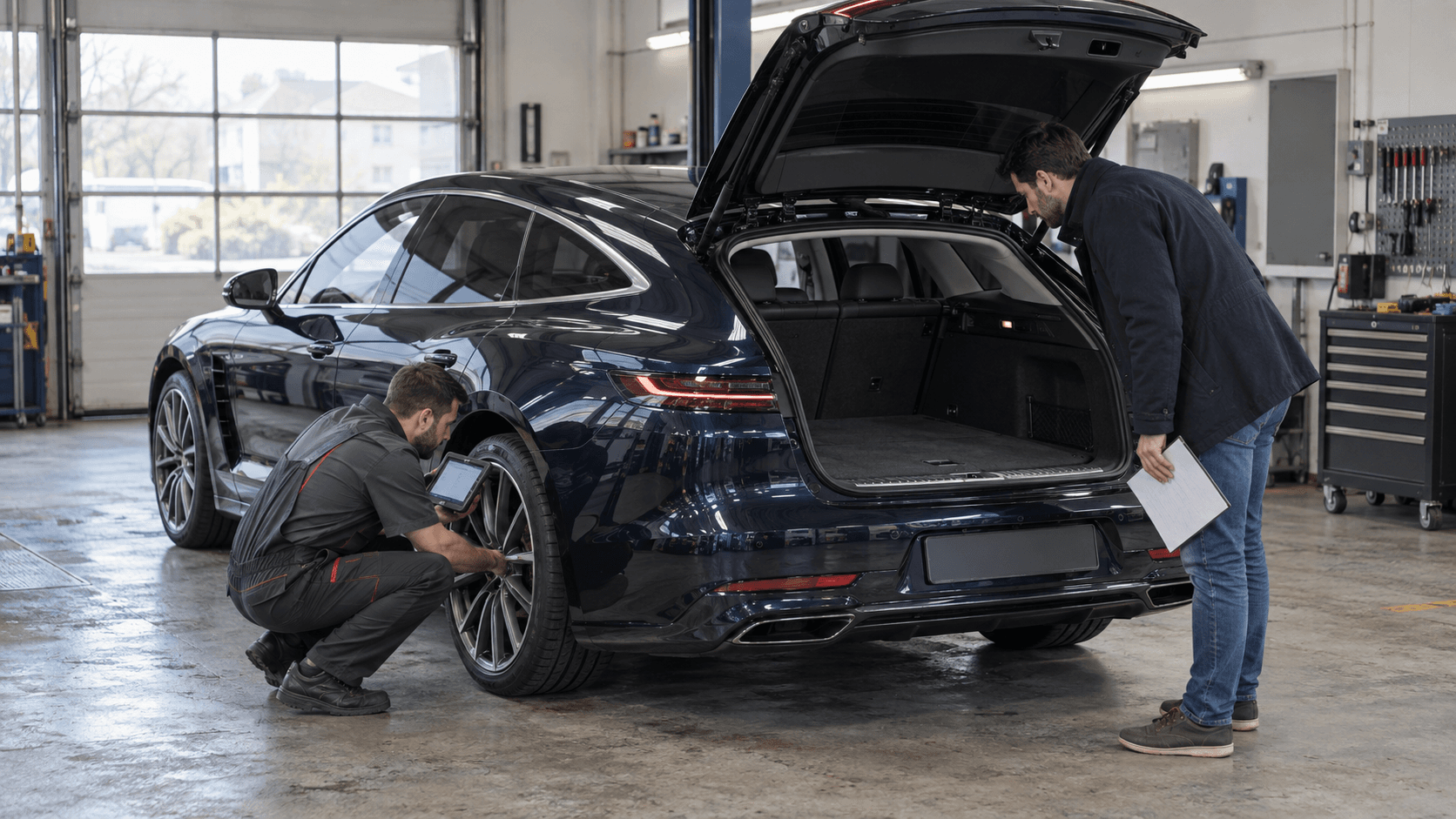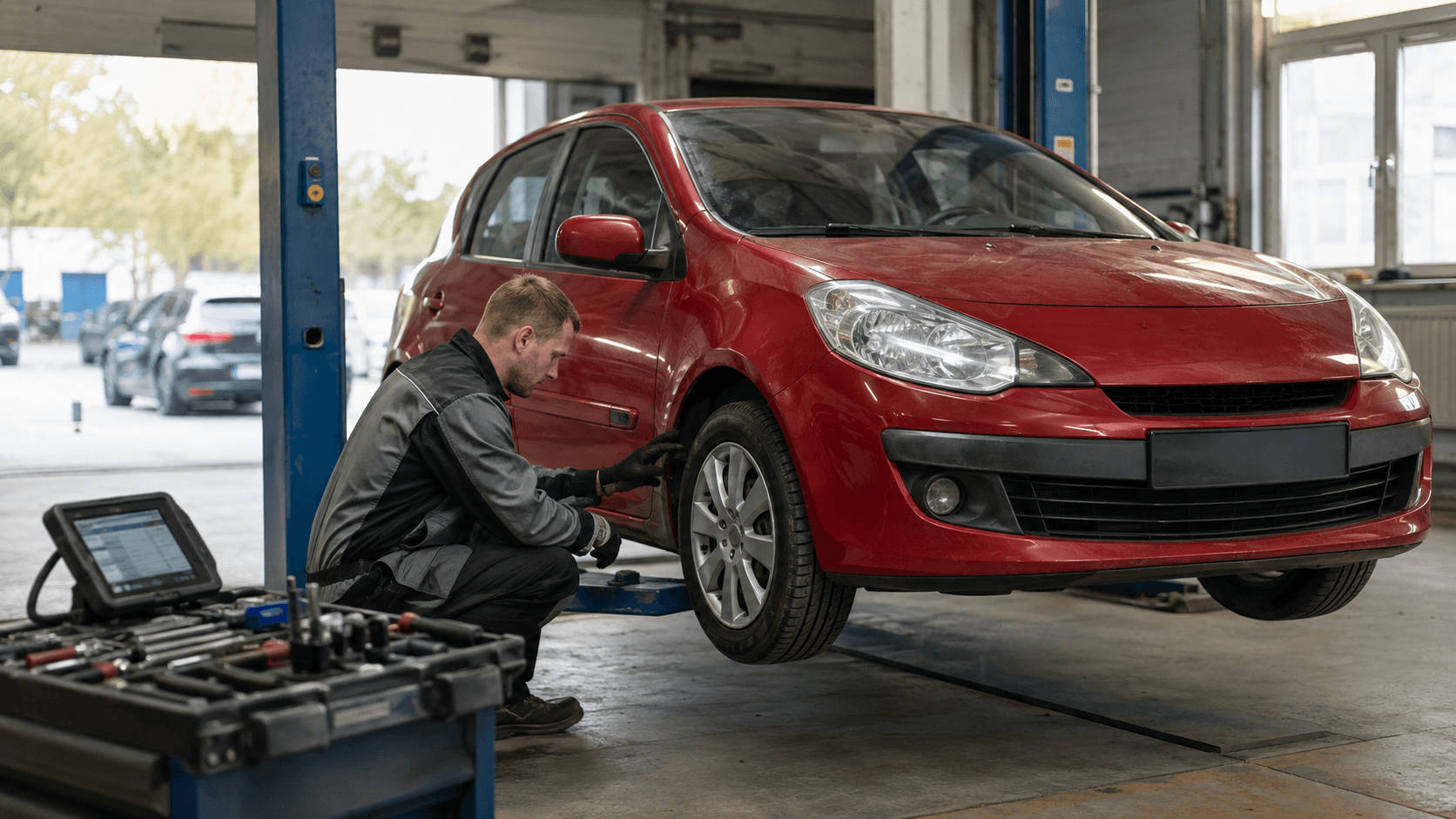
Illustrative image; the car does not represent a specific example or brand.
Used Renault Clio in 2026: what to check on TCe, dCi, E-Tech, LPG and city wear
Quick answer
A used Renault Clio can be a good choice in 2026 if you want a small car that is easy to park, with a large supply in Romania and running costs easier to control than on an SUV. Do not buy it only because it is a “simple city car”. On a Clio, generation, engine, gearbox, history, urban use and safety equipment matter a great deal.
Short checklist:
- identify the generation from the VIN, not only from the year in the advert;
- on TCe, check cold starting, idle, the turbocharger, oil consumption and the service history;
- on dCi, check the DPF, EGR, injectors, turbocharger and the type of roads the car has done;
- on EDC, test smooth pull-aways, hot shifts and any vibration;
- on E-Tech Hybrid, ask for a diagnosis of the traction battery, inverter, regenerative braking and stored faults;
- on LPG, confirm whether the installation is factory-fitted, when it was serviced and how it switches between petrol and gas;
- check the clutch, steering, brakes, suspension and tyres, because many Clios cover mainly city miles;
- do not ignore the seats, steering wheel, pedals, doors and boot: their wear can contradict the displayed mileage;
- check the accident history and that the safety systems work.
The practical rule: a Clio is more interesting when you buy it as a well-maintained small car, not as a universal solution. For a short commute, shopping and town it can be very logical. For frequent motorway use, a family with lots of luggage or poor roads, it should be compared carefully with a compact.
Why the Renault Clio needs its own guide
The Carboratory archive has articles on the new Clio, Clio E-Tech and other Renault models, but it did not have a complete guide for the buyer searching directly for a “used Renault Clio”. Market interest is clear.
At research on 7 September 2026, the CautiMasina page for Renault Clio cars for sale showed 2,780 cars available. The same list mixes generations, from cheap examples with more than 200,000 km to newer Clio V cars with petrol, diesel, hybrid or LPG.
That means the useful question is not “is a Clio worth it?”, but “which Clio do I buy, for which journeys and with what technical risk?”. A diesel Clio used on long trips can make sense. A diesel run almost exclusively in town can become expensive. A simple petrol Clio can suit the city, but only if the service history is coherent. An E-Tech can be excellent in congested traffic, yet it needs specific checks.
Which generations you will find in Romania
On the Romanian used market you mainly find:
- Clio III, at low budgets, usually old and high-mileage;
- Clio IV, very widespread, with many 0.9 TCe, 1.2 petrol and 1.5 dCi examples;
- Clio V, launched in 2019, with a more modern interior, better safety systems and E-Tech Hybrid variants;
- facelift or nearly new Clio, where the price must be compared with the current Renault offer.
Do not treat every generation as the same car. A fleet Clio IV diesel and an urban-used Clio V E-Tech have completely different risks. The VIN, engine code, emissions standard, history and real equipment matter more than colour, wheels or a “full” label.
Petrol TCe: good for town, but check the history
For many buyers, a petrol Clio TCe is the natural choice. It is the right size for town, consumption is decent and costs are easier to anticipate than on a modern diesel used wrongly. Still, a small turbo engine should not be judged like an old naturally aspirated unit.
At viewing, check:
- cold starting;
- idle after the first minutes;
- vibration or hesitation on light throttle;
- smoke at start-up or on acceleration;
- oil leaks;
- the oil-change history;
- spark plugs, coils and any ignition faults;
- turbocharger operation;
- operating temperature;
- real consumption reported by the trip computer and by the owner.
A Clio used daily on 2-4 km trips can have oil that degrades faster, a tired 12 V battery, a worn clutch and brakes affected by frequent stops. Looking clean is not enough. Ask for invoices and run a diagnosis before a deposit.
1.5 dCi: economical, but it depends on the route
The 1.5 dCi was very common on Clio in Europe and in Romania. It can be economical for extra-urban commuting, deliveries between towns or regular longer journeys. For short city hops, however, diesel adds components that do not always have good operating conditions.
Check:
- cold starting;
- smoke or a strong exhaust smell;
- injectors;
- the turbocharger;
- EGR;
- the DPF, if the version has one;
- the real oil-change intervals;
- the fuelling and service history;
- any frequent regenerations;
- AdBlue consumption only on versions that have the system.
A cheap diesel can look tempting if you cover few kilometres. But on short trips, the consumption gap can be smaller than the cost of a single emissions-system repair. If you drive mainly in Bucharest, Cluj-Napoca, Iași, Timișoara or Brașov, ask yourself realistically how many kilometres you do outside town.
EDC and the manual gearbox: the road test matters
Clio can have a manual gearbox or an EDC automatic, depending on engine, generation and market. The manual looks simple, but in a city car the clutch can wear early. EDC is convenient in traffic, yet it must be checked carefully.
On the manual, watch:
- the clutch biting point;
- slip in higher gears;
- noises when the pedal is pressed;
- engagement of reverse;
- vibration on pull-away;
- play in the linkage.
On EDC, test the car cold and hot. Pull-aways should be smooth, without obvious jerks. Shifts should be coherent, without large delays or repeated vibration in parking manoeuvres. Ask for proof of maintenance and do not accept “they all do that” without an independent check.
E-Tech Hybrid: attractive in town, but do not check it superficially
Clio E-Tech Hybrid is interesting for drivers who spend a lot of time in urban traffic and want an automatic, lower consumption and frequent electric running at low speeds. Renault Romania presents the current Clio range with full hybrid E-Tech 160, TCe 115 and Eco-G 120 LPG, and for the hybrid variant it communicates a range of up to 1,000 km in WLTP conditions.
On the used market, however, each car must be checked individually:
- starting in electric mode;
- the change between electric motor and combustion engine;
- regenerative braking;
- traction-battery charge level while driving;
- stored diagnostic faults;
- the 12 V battery;
- climate control;
- software updates;
- warranty history;
- any repairs after an accident.
Do not buy an E-Tech without a city test. That is exactly where the system’s advantage should show. If the car runs almost permanently with the combustion engine on, has faults or a weak 12 V battery, the promised economy can disappear.
LPG on Clio: economy only if the installation is in order
An LPG Clio can be a good solution for someone who covers many kilometres and wants a low cost per kilometre. In the current range, Renault Romania lists Eco-G 120 LPG EDC, with petrol + LPG fuelling and a claimed range of up to 1,450 km in WLTP conditions. On used cars, the important points are which version you have in front of you, whether the installation is factory-fitted and what servicing has been done.
Check:
- LPG installation documents;
- the tank date and periodic inspections;
- petrol/LPG switching;
- smells around the car;
- idle on both fuels;
- LPG injectors;
- the vaporiser;
- visible hoses and clamps;
- invoices for filters and spark plugs;
- any warning lights after filling.
Do not calculate only the pump price of LPG. Put the specific services, possible repairs and the fact that some car parks or workshops may have their own rules for gas cars into the budget.
City wear: a Clio can hide a lot in small details
Clio is an urban car, and town wears it differently from the motorway. Mileage can be low, but the clutch, brakes, suspension, driver’s seat and doors can show a hard life.
Check carefully:
- door edges;
- the front and rear bumpers;
- wheels and tyres;
- the steering wheel;
- the pedals;
- the gear lever;
- the driver’s seat;
- the belts;
- the carpet;
- the boot;
- the tailgate;
- the mirrors;
- the reversing camera and sensors, if fitted.
A Clio used for courier work, a driving school, ride-sharing or an urban fleet can be perfectly legal to sell, but it should be priced as such. Look for inconsistencies: low kilometres with a shiny steering wheel, a torn seat, worn pedals and many local resprays.
Safety and equipment: not every example is the same
Euro NCAP published the 2019 assessment for Renault Clio generation V, with high percentages for adult and child protection. The same sheet also shows important limits of interpretation: the rating depends on the equipment and variants tested, and rating validity is not the same as the actual condition of a used car.
For the buyer, that translates simply:
- check that the airbags work;
- watch the SRS warning light at ignition;
- check the belts and pretensioners;
- check ISOFIX if you have a child;
- test the camera, sensors and lane assist;
- confirm equipment from the VIN, not only from the advert;
- read the damage history;
- do not accept poorly refinished airbag covers or a dashboard that has been removed without explanation.
A well-equipped Clio can be a very safe small car for its class. A Clio repaired cheaply after an accident can be a poor choice, even if it starts and drives normally.
How much to keep for the first service
Do not spend the whole budget on the asking price. For a used Clio, keep money for:
- oil and filter change;
- brake fluid, if the history is unclear;
- tyres, if the DOT date or wear is poor;
- pads and discs;
- a 12 V battery;
- spark plugs on petrol or LPG;
- a full diagnosis;
- possible bushes, drop links or dampers;
- MTPL, vignette, paperwork and transfer.
On a cheap example, the first service can change the calculation completely. A 5,500 € car that immediately needs 1,200 € can be more expensive than a 6,500 € car with documented work.
What alternatives to compare it with
Clio should be compared with cars in the same use area, not with any model at the same price. Logical alternatives are Dacia Sandero, Volkswagen Polo, Ford Fiesta, Toyota Yaris, Opel Corsa, Peugeot 208, Hyundai i20, Kia Rio or Skoda Fabia.
If you need a larger boot and long journeys, also compare compacts such as Renault Megane, Ford Focus, Hyundai i30, Kia Ceed or Volkswagen Golf. If you need ground clearance and easier access, look at Renault Captur, Ford Puma, Volkswagen T-Cross or Nissan Juke, but remember that you will usually pay more for the body.
Is a used Renault Clio worth it in 2026?
Yes, it is worth considering if you choose the right engine for your routes and check the car before payment. For town, petrol, LPG or E-Tech can be more logical than diesel. For extra-urban commuting, a dCi with a good history can remain economical. For someone who only wants the lowest price, a Clio can become a trap if it has unclear mileage, hidden damage or deferred maintenance.
The best used Clio is not necessarily the cheapest or the newest. It is the example with a clear identity, a verifiable history, coherent wear, a clean diagnosis and costs you can support after purchase.
Frequently asked questions
Is a used Renault Clio good for town?
Yes, especially with petrol, LPG or hybrid. For short city hops, diesel should be chosen with caution, because emissions systems can suffer if the engine does not often reach the right temperature.
Which Renault Clio engine is the most suitable?
There is no single answer. TCe suits mixed and city use, dCi long commuting, E-Tech urban traffic with many stops, and LPG high mileage and a low cost per kilometre. The condition of the actual car matters more than the reputation of the engine.
Is a used Clio E-Tech Hybrid worth it?
It can be if you do a lot of town driving, want an automatic and the car has a clear history. The traction battery, 12 V battery, hybrid system and how the car switches between electric and petrol must be checked by diagnosis.
Is a Renault Clio enough for a family?
For a family with one child and moderate luggage it can be enough, especially in town. For two children, child seats, a pram and long trips, a compact or an estate can be more suitable.
How important is the service history?
Very important. On a small car, costs look low until a problem appears with the gearbox, engine, emissions system or hybrid. Invoices, the VIN, diagnosis and an independent inspection should count more than the seller’s claims.