The next Renault Megane could move towards a different shape and a wider set of family-car rivals, including the Tesla Model Y. Auto Express reports that Renault is developing its new RGEV Medium 2.0 platform for a first vehicle in 2028, with the Megane’s replacement under consideration. Renault’s official strategy confirms the underlying technology programme, but does not yet provide a complete production Megane specification.
The key number is up to 750 km of WLTP range for electric vehicles on the future platform. Renault published that ambition in its futuREady plan on 10 March 2026. It is a development target, not a homologated range result for a newly launched Megane and not a guaranteed minimum across every potential version.
What the latest report adds
In the Auto Express report dated 2 November, Renault technology chief Philippe Brunet describes the aim of a C-segment car combining an LFP battery, approximately 750 km WLTP and a maximum mass of two tonnes. He also discusses keeping battery energy below 90 kWh. These are reported engineering objectives, rather than final figures certified for a customer car.
The publication describes a platform spanning vehicles from 4.3 to 4.8 metres long and a move towards rear-wheel drive, with all-wheel-drive applications also envisaged. Those details belong to its account of the development programme. Renault’s broader official announcement allows multiple body styles and does not establish the dimensions or driven wheels of every future Megane derivative.
The platform date and charging target are different milestones
Renault officially describes RGEV medium 2.0 as an 800 V architecture for vehicles spanning the B+ to D segments, including saloons, SUVs and MPVs. The group links its approximately ten-minute charging ambition to 2030 and the expected capability of European charging infrastructure. That is a different milestone from the first-vehicle timing reported for 2028.
The voltage rating is not a charging-power figure. Understanding an eventual Megane’s performance will also require its battery capacity, charging curve, thermal conditions and the state-of-charge interval used for measurement. An 800 V platform does not by itself establish that an entire battery can be filled in ten minutes at any charger.
Renault plans two battery-chemistry families, one prioritising energy density and another affordability. The official plan says the new platform can deliver long range with the lower-cost chemistry too. It does not announce the price or final battery choice of a particular Megane. The LFP discussion in the interview should therefore remain an engineering direction until a production version is specified.
Structural integration and cost reduction
The group’s plan describes a cell-to-body arrangement, with the battery integrated into the vehicle structure. It targets 20% fewer parts in this area and compatibility with pouch, prismatic and blade cells. That flexibility is an engineering provision for developing different products, not a promise that owners will later be able to swap their car to another cell chemistry.
Renault also targets a 40% cost reduction against its current electric-vehicle generation. This is an industrial objective. It cannot be translated into a guaranteed 40% cut in showroom prices, or used to invent an entry price for a Megane replacement. The final commercial offer will depend on the model, equipment and market.
The software programme is similarly broad. Renault says the centralised Software Defined Vehicle architecture will allow firmware updates for 90% of functions and use a first carOS co-developed with Google on Android. These are platform plans; they do not tell buyers which services will be included, what subscriptions might apply or how a particular vehicle’s support will be organised.
A range extender does not mean 1,400 electric kilometres
A second headline number in futuREady is up to 1,400 km for an EV Range Extender configuration. In that arrangement, a combustion engine generates energy for the electric drivetrain. Its combined range must be kept separate from the battery-electric version’s targeted 750 km WLTP figure. The two numbers do not describe identical energy sources or ownership patterns.
Platform compatibility also does not confirm a range-extender Megane in every country. Renault still needs to specify the actual models, powertrains and local launch arrangements. A like-for-like value comparison with the Model Y would require real prices, equipment and certified figures on both sides, rather than a future Renault target paired with an existing Tesla version.
The 2026 Megane update is already a separate story
On 22 June 2026 Renault presented an update to the current Megane E-Tech electric. The group describes a 67 kWh LFP battery, range around the 500 km threshold and charging from 15% to 80% in 24 minutes. Those figures belong to the updated current car. They should not be mixed with the next platform’s 800 V and longer-range objectives.
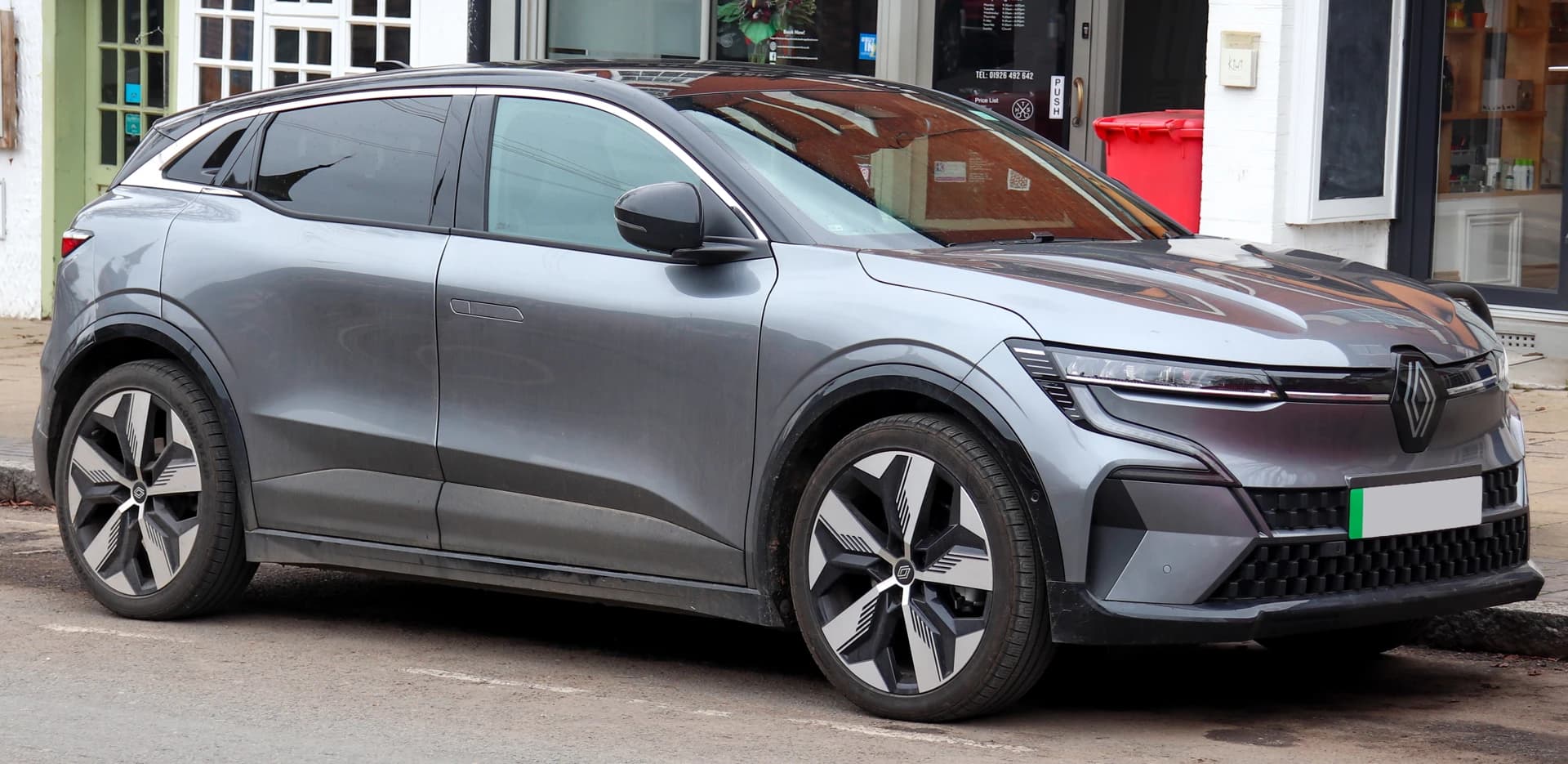
The announced line-up has Techno and Esprit Alpine trims. Renault says the vehicle and battery are assembled at Douai within ElectriCity, with the motor manufactured at Cléon. The photograph illustrating this article shows an earlier example of the current generation, before the 2026 restyling; it is not an image of the future car.
Auto Express’s published future-Megane images are illustrations credited to Avarvarii, not photographs of a revealed production model. The distinction matters while the car’s shape is still being discussed. Renault’s programme provides a technical direction and measurable ambitions. Exact dimensions, local prices, certified range and final charging conditions remain to be established for the Megane customers will eventually be offered.
Existing-generation Renault Megane E-Tech before the 2026 restyling, not the future model. Photo: Vauxford, CC BY-SA 4.0. Resized and converted to WebP; the adapted image retains the same licence.