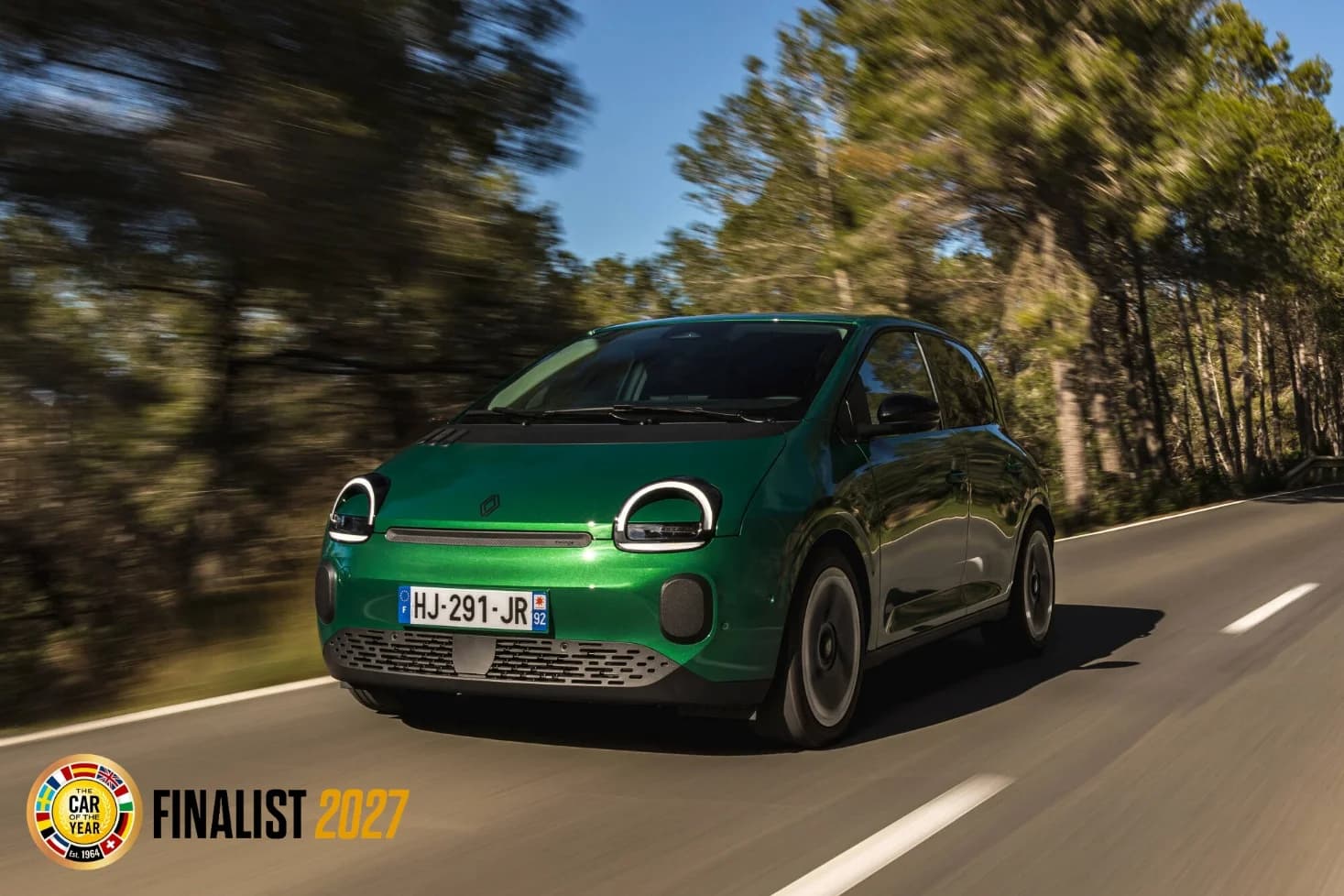
Renault Twingo E-Tech electric has been selected as one of seven finalists for the European Car of the Year 2027 award. The Car of the Year organisation published the shortlist on 30 October 2026. Renault issued a matching press release the same day. The winner will be announced on 8 January 2027 at the Brussels Motor Show.
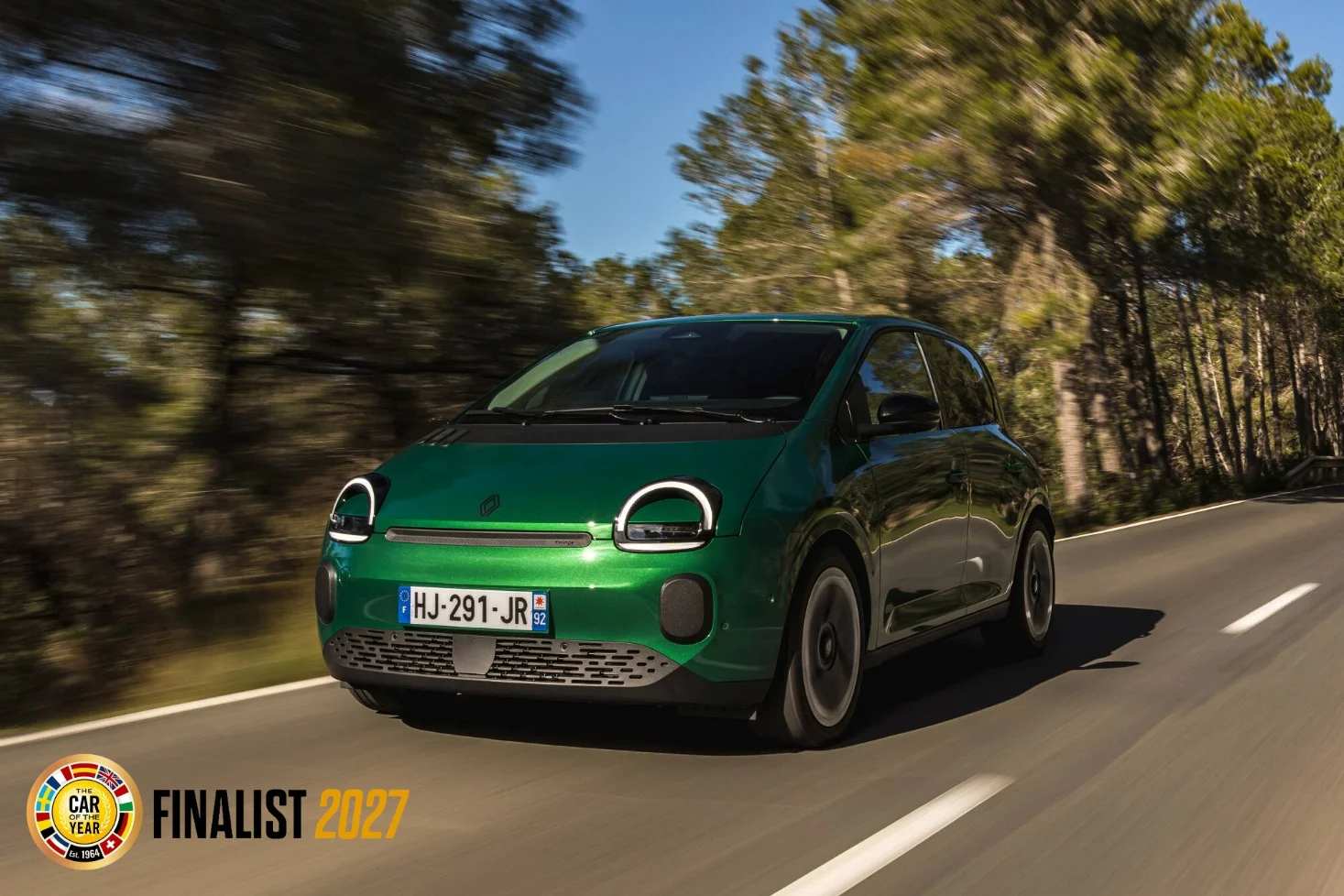
Image: Renault press material announcing Twingo E-Tech electric as a Car of the Year 2027 finalist. Used editorially from the manufacturer’s official press pack.
The official shortlist
In alphabetical order, the Car of the Year site lists BMW iX3, Cupra Raval, Hyundai Ioniq 3, Kia EV2, Renault Twingo, Volkswagen ID.Polo and Volvo EX60. COTY notes that all seven cars are fully electric — described as a first in the award’s 63-year history. The current title holder is Mercedes-Benz CLA, winner of the previous edition.
Renault’s release says a jury of 65 journalists from 25 countries tested and assessed 43 vehicles before naming the finalists. Hyundai’s separate statement on Ioniq 3 also refers to a 65-journalist European jury. Some specialist reports cite slightly different candidate counts; for the shortlist itself and the ceremony date, the Car of the Year publication is the primary reference.
According to COTY’s published timetable, jurors meet on 25–26 November at the Balocco circuit in Italy to evaluate the seven cars. Votes can be cast until 31 December. Each juror has 25 points to distribute among the finalists, with a maximum of 10 points for any single model.
Renault’s sixth consecutive final
Renault presents Twingo as its sixth successive appearance among the seven finalists. The brand’s published sequence for this run is:
- 2022: Megane E-Tech electric
- 2023: Austral full hybrid E-Tech
- 2024: Scenic E-Tech electric (winner)
- 2025: Renault 5 E-Tech electric (winner, with Alpine A290)
- 2026: Renault 4 E-Tech electric
- 2027: Renault Twingo E-Tech electric
Scenic took the 2024 title and Renault 5 won in 2025. A 2027 final place is not a result. Twingo sits beside six other finalists that range from affordable city and compact EVs to premium electric SUVs.
What Fabrice Cambolive said
In Renault’s statement, brand CEO Fabrice Cambolive links the nomination to a sub-€20,000 price target and to sales figures supplied by the company. He says Twingo was developed as an attractive, technologically advanced European electric car below that price threshold, that almost 26,000 units have been sold since launch, and that the model led its segment in European sales in the third quarter. Those volumes and rankings are Renault’s claims; they are not independently audited in this article.
Cambolive also says Twingo’s place among the seven finalists illustrates the brand’s product momentum, with a Renault model in every shortlist since 2022. That is a company position, not a COTY verdict.
What Twingo E-Tech brings on paper
Twingo E-Tech electric is an A-segment five-door hatchback measuring 3.79 metres. Renault highlights independently sliding rear seats with more than 17 cm of travel and a folding front passenger seat. Boot volume can reach up to 360 litres, the company says, with a loading length of up to 2 metres when the cabin is configured for it. Those figures are manufacturer data and depend on seat position.
The powertrain in the release is a 60 kW (82 hp) motor and an LFP battery with 27.5 kWh of usable capacity, for up to 263 km of WLTP range. Standard AC charging is rated at 6.6 kW. An Advanced Charge Pack is described with 11 kW AC, 50 kW DC, and bidirectional V2L and V2G functions. Assembly is at Novo Mesto in Slovenia.
Renault says every version has a dual-screen setup and connected multimedia. Techno adds OpenR Link with Google built in, including an EV route planner and access to Google’s Gemini conversational assistant — presented by Renault as a first in the A segment. The brand also cites up to 24 driver-assistance systems and One Pedal driving. The range recently gained Twingobay, a glass panoramic roof with a 0.7 m² surface area.
Price context and what the shortlist does not change
Renault positions Twingo with prices under €20,000 before subsidies in the European markets it highlights. That commercial claim sits alongside the technical sheet; local taxes, equipment and national incentives still determine the bill a buyer pays. Being shortlisted for Car of the Year does not alter WLTP range, charging hardware or delivery schedules on its own.
For readers comparing small EVs, the useful verified package remains length, power, battery chemistry and capacity, official range, charging options and factory location. COTY recognition is a journalism award process, not a homologation or a sales guarantee.
Who else made the cut
The rest of the shortlist spans several market roles. Cupra Raval, Volkswagen ID.Polo, Hyundai Ioniq 3 and Kia EV2 target compact and accessible electric buyers. BMW iX3 and Volvo EX60 represent new premium electric architectures; both brands have published much higher WLTP ranges on selected versions. Car of the Year is not a ranking by range or sticker price. Jurors weigh design, comfort, performance, innovation, environmental impact and value under the competition’s rules.
Renault attributes Twingo roughly 25 percent of its European segment and first place in third-quarter sales. Those statements belong to the manufacturer. The COTY shortlist confirms finalist status only.
What happens before 8 January
Balocco testing and the jury vote still lie ahead. No finalist is the winner until the official announcement in Brussels. Until then, Twingo’s public case rests on the published specification — 3.79 m, 60 kW, 27.5 kWh LFP, up to 263 km WLTP, European pricing communicated below €20,000 before subsidies — and on Renault’s own sales narrative, clearly labelled as such.