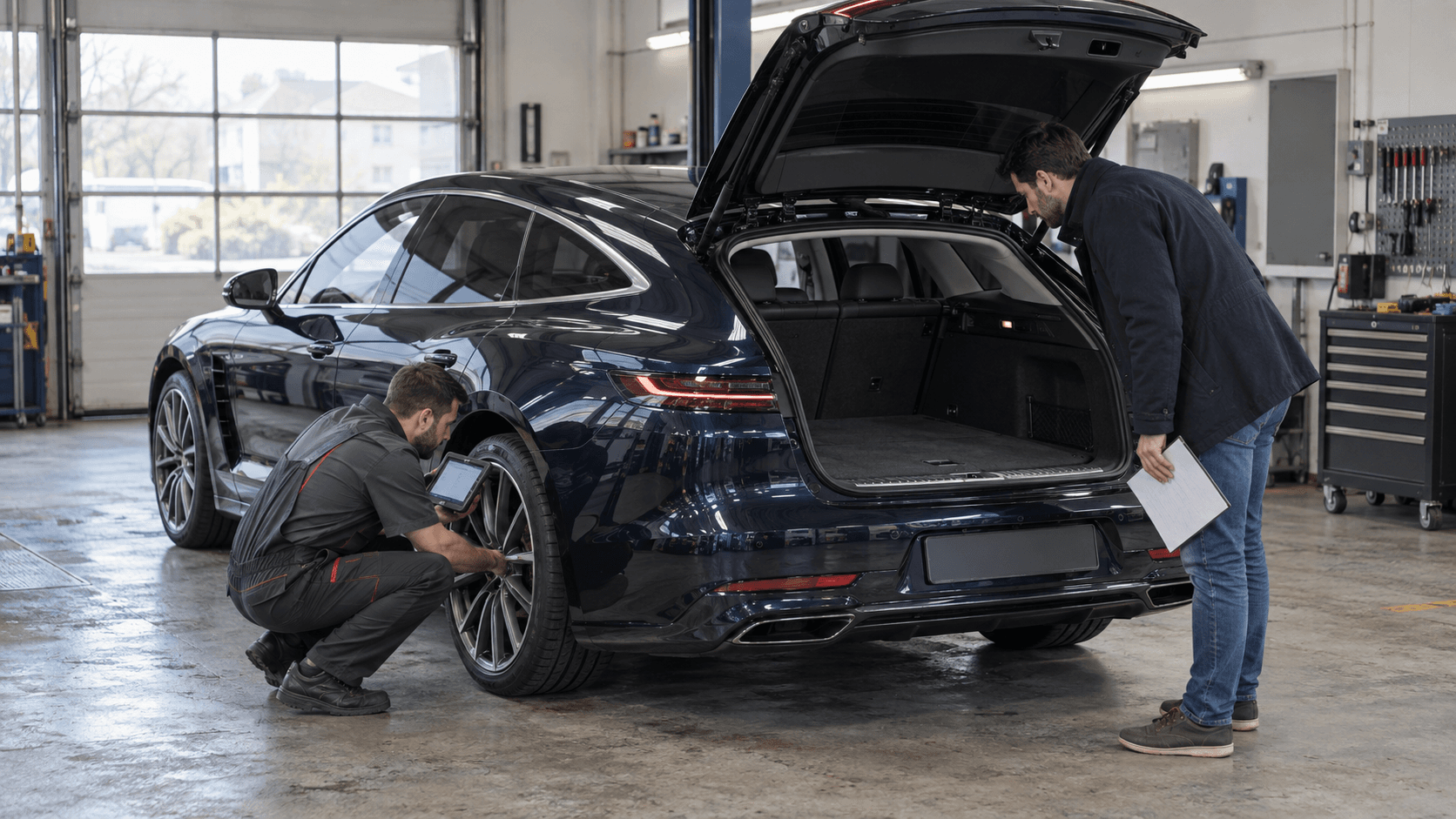
Illustrative image; the car does not represent a specific example or brand.
Used Renault Mégane in 2026: what to check on TCe, dCi, EDC, E-Tech, Estate and history
The short answer
A used Renault Mégane can be a very logical compact in 2026 if you match the engine to your journeys and do not buy on price alone. The model comes in many forms: hatchback, saloon, Estate, TCe petrol, dCi diesel, manual, EDC automatic and, on the fourth-generation facelift, E-Tech Plug-in Hybrid. That variety makes it attractive, and easy to buy badly.
Short checklist:
- identify the generation, body style and exact engine from the VIN;
- check whether the car was a fleet, rental, long-commute or city car;
- on diesel, inspect the DPF, EGR, injectors, turbocharger and regeneration history;
- on TCe, watch cold starting, oil consumption, the timing drive, cooling and leaks;
- on EDC, ask for proof of servicing and test pull-away, downshifts and stop-start traffic;
- on E-Tech Plug-in Hybrid, check the battery, charging, cable, climate control and software history;
- compare cabin wear with the mileage, especially on fleet saloons and Estates;
- measure the paint and inspect the sills, boot, tailgate and chassis rails;
- do not pay a deposit without a VIN report, invoices, a diagnostic scan and a cold and hot road test.
Simple rule: a cheap Mégane with no history can become expensive quickly. A dearer car with clear servicing, coherent mileage and an engine that fits how you drive is usually the better buy.
Why the Mégane needs its own guide
The Carboratory archive already has pieces on the Renault Clio, Captur, Arkana and Mégane E-Tech electric, plus round-ups of French cars, compacts and automatics. What was missing was a dedicated guide to the conventional Mégane on the used market: petrol and diesel generations, the saloon, the Estate wagon and the E-Tech Plug-in Hybrid.
Demand is clear. At documentation on 10 September 2026, CautiMasina showed 3,295 Renault Mégane listings filtered for Romania, with petrol, diesel, manual and automatic examples. OLX grouped more than 2,400 results in the cars category for a Renault Mégane search. That means a large supply, and very mixed quality.
In short, the Mégane is not a rare car you buy because there are no alternatives. It is a common compact, with many comparable prices, so you can afford to be selective.
Which generations you will find in Romania
On the used market you often see:
- Mégane II, already old and bought mainly on a small budget;
- Mégane III, hatchback, saloon, estate or coupé, often with the 1.5 dCi;
- Mégane IV, more modern, with TCe, dCi, EDC and better equipment;
- Mégane IV facelift, including E-Tech Plug-in Hybrid;
- Mégane Sedan, very common in fleets;
- Mégane Estate, useful for a family and boot space.
Do not compare year and mileage alone. A fleet Mégane IV diesel with 190,000 km and clear invoices can be better than an apparently private car with low miles and an empty history. Likewise, a cheap Mégane III can be sound if the structure is good and the engine has been serviced, but it should not be bought with new-car expectations.
1.5 dCi: good on long journeys, sensitive to history
The 1.5 dCi is one of the most common choices on a used Mégane. Many companies, commuters and families bought it for low consumption. It can be very economical, but it does not forgive neglected servicing.
Check carefully:
- cold starting;
- smoke under acceleration;
- the injectors;
- the turbocharger;
- EGR;
- the DPF;
- differential pressure at the particulate filter;
- oil-change history;
- the timing drive;
- any oil or coolant leaks;
- how the car was actually used.
Diesel is worth it if you do long trips, extra-urban commuting or enough kilometres for the emissions system to work properly. If you mostly drive 3–5 km in town, look at petrol or hybrid. A diesel used only from cold can have a more tired DPF, EGR and intake than the mileage suggests.
TCe engines: check cooling, oil and the timing drive
A petrol Mégane can suit town use and low annual mileage better. Several TCe engines appear on the market, and generation differences matter. Do not buy on a generic “1.2 engine” or “1.4 petrol” label. Confirm the engine code, year, emissions standard and history.
At the viewing, watch:
- cold starting;
- idle;
- vibration;
- timing-drive noises;
- oil consumption;
- engine temperature;
- coolant traces;
- spark plugs and coils;
- the turbocharger;
- service invoices.
A properly serviced TCe can be a good choice for town, a short commute and occasional trips. A TCe with no history, long oil intervals and noises on start-up should not be rescued by optimism.
The EDC gearbox: convenient, but it must be tested in real conditions
EDC is the dual-clutch automatic used on many Renaults. It is pleasant in town and on long journeys when it works properly, but it can become expensive if it has been abused, overheated or left unserviced.
Test:
- pull-away from rest;
- bumper-to-bumper traffic;
- 1–2 and 2–3 shifts;
- downshifts;
- reverse;
- vibration or snatch;
- noises when hot;
- diagnostic faults;
- proof of oil changes, if they apply to the exact version.
Do not accept a test only on an empty boulevard. A gearbox with problems can feel fine at a constant speed and show its faults in parking, on a ramp, in manoeuvres and in heavy traffic.
E-Tech Plug-in Hybrid: do not judge it only on the promised consumption
Renault introduced the Mégane E-Tech Plug-in Hybrid on the Estate and then on the hatchback. Renault materials describe the system as a 1.6-litre petrol engine, two electric motors and a 9.8 kWh battery, with up to 50 km of electric range in the combined WLTP cycle and up to 65 km in town.
On the used market, the question is not whether the technology sounds good, but whether that car was used and charged correctly. At inspection, ask for:
- a traction-battery test;
- a hybrid-system diagnostic;
- a check of the charging cable;
- a charging test at a socket or wallbox;
- a climate-control check;
- service history;
- software updates, if any;
- a test in electric and hybrid modes;
- a brake check, because regeneration can reduce use of the conventional brakes.
A plug-in hybrid makes sense if you can charge it often. If you buy it only for brochure consumption and drive it with an empty battery, the advantage shrinks a lot.
Hatchback, saloon or Estate
The Mégane hatchback is the balanced choice for town and commuting. The saloon can be interesting for price and boot space, but it often appears with fleet history or heavy use. The Estate is the most practical for a family, holidays, a pram, a child’s bicycle or luggage.
Specific checks:
- on the hatchback, look at the tailgate, rear lights and leaks;
- on the saloon, check the boot, hinges, floor and fleet wear;
- on the Estate, inspect the rear dampers, tailgate, seals, boot floor and signs of heavy loading;
- on any body, measure the paint and compare panel gaps.
If you are choosing a family car, do not buy boot space alone. Check real room for child seats, access to the rear bench, space for the front passenger and visibility.
Interior, electronics and equipment
Mégane IV brought a more modern cabin, infotainment, a digital instrument cluster on some versions and assistance systems. Those extras are useful, but on a used car they must be checked as parts, not as sales arguments.
Check:
- the central screen;
- climate-control switches;
- the reversing camera;
- parking sensors;
- the keyless key;
- electric windows;
- the mirrors;
- seat heating;
- dashboard warning lights;
- lighting operation;
- the 12 V battery.
A large screen does not offset a car with warning lights on. Electronics need checking cold, hot and after a restart.
Fleet history: risk or opportunity?
The Mégane was often bought by companies. That does not make it automatically bad. A fleet car can have clear services, invoices and steady mileage. The problem appears when fleet history is hidden, the cabin looks far more tired than the mileage, and the seller asks a private, immaculate-car price.
Signs to check:
- the driver’s seat;
- the steering wheel;
- the pedals;
- the gear lever;
- the driver’s seatbelt;
- the wheels;
- the doors;
- resprays;
- the tyres;
- invoices issued to a company;
- the number of keys.
A fleet Mégane can be bought if the price reflects the wear and the history is transparent. It is not worth it if every sign points to heavy use but the paperwork is missing.
What to check on a lift
In a workshop, do not stop at a diagnostic scan. Raise the car and check:
- engine leaks;
- gearbox leaks;
- play in the steering;
- bushes;
- dampers;
- discs and pads;
- brake lines;
- the exhaust;
- engine mounts;
- the floor;
- chassis rails;
- sills;
- signs of structural repairs.
On cars from areas with salt or hard roads, corrosion and the suspension can matter as much as the engine.
What price makes sense
On CautiMasina, results from 10 September 2026 showed a very wide range: from older Méganes under €5,000 to 2019–2022 examples in the €9,000–12,500 area, depending on engine, mileage, body and seller. Do not treat these figures as a fixed price list, because listings change. Use them as a signal: supply is large enough to compare.
The right price depends on:
- generation;
- engine;
- gearbox;
- body style;
- mileage;
- country of origin;
- number of owners;
- services;
- damage;
- tyres;
- cosmetic condition;
- dealer warranty, if any.
Do not negotiate the sum alone. Negotiate after you have a list of costs: timing drive, service, brakes, tyres, battery, body repairs and any gearbox issues.
What to compare it with
Before you buy, compare the Mégane with:
- Renault Clio, if you want a smaller car and lower costs;
- Ford Focus, if you want more pleasant steering;
- Kia Ceed, if you want remaining warranty on some examples;
- Hyundai i30, if you want a Korean alternative;
- Skoda Octavia, if boot space matters more;
- Opel Astra, if you find a better history at the same budget.
The Mégane is competitive when the price is fair and the history is good. It is not automatically the best choice if the car in front of you has the wrong engine, an unclear gearbox or hidden fleet wear.
Verdict
A used Renault Mégane belongs on a 2026 shortlist for large supply, varied prices, economical engines and practical bodies. The best town choice can be a well-serviced TCe petrol. For long journeys, a dCi with a clear history remains efficient. For a family, the Estate makes sense. For a commute with home charging, the E-Tech Plug-in Hybrid can be interesting, but only if it is checked properly.
Do not buy a Mégane on reputation, consumption or equipment. Buy it on VIN, invoices, diagnostics, a road test and a lift inspection. On a model this common, the good example matters more than the ideal configuration in the advert.