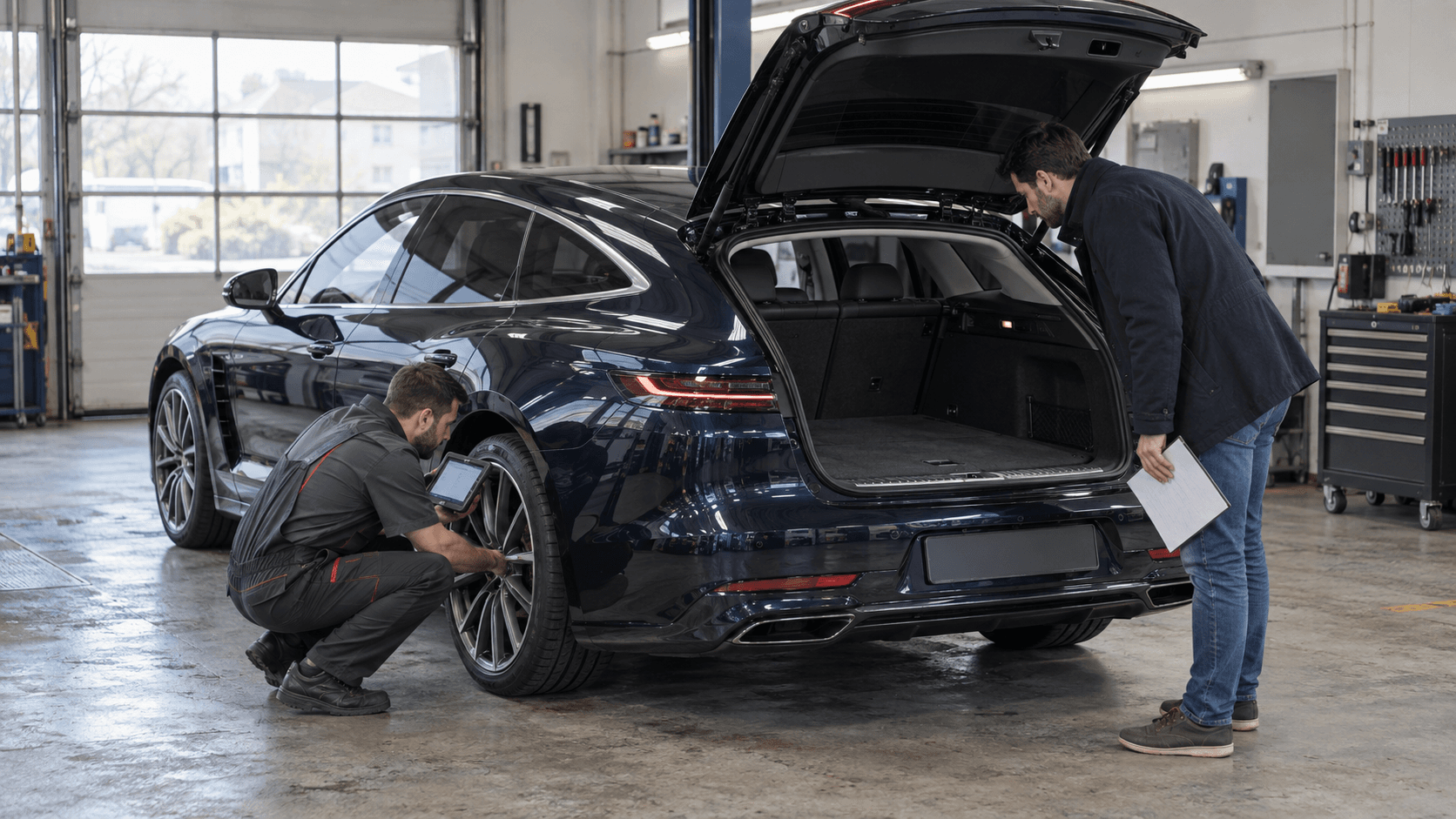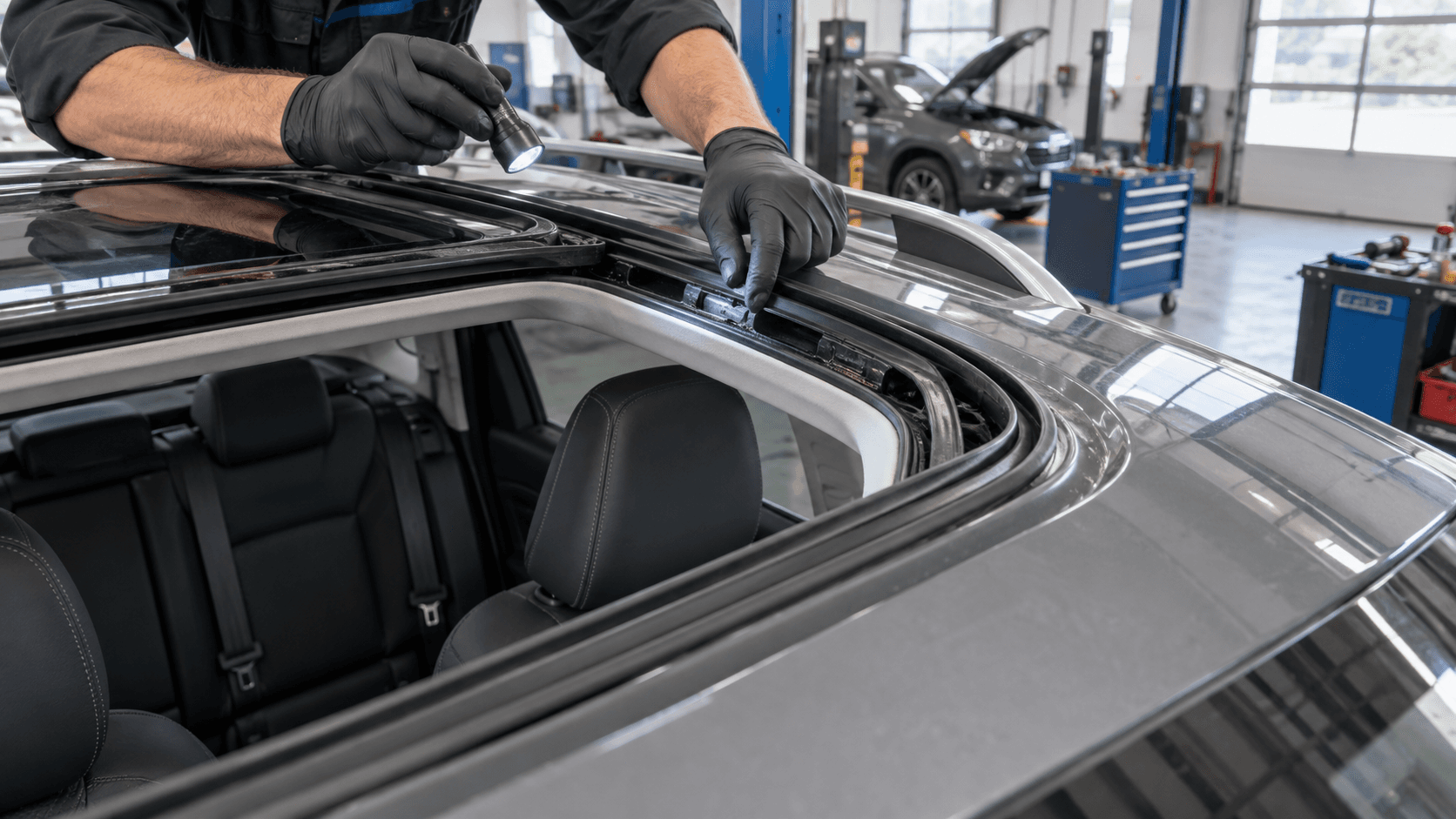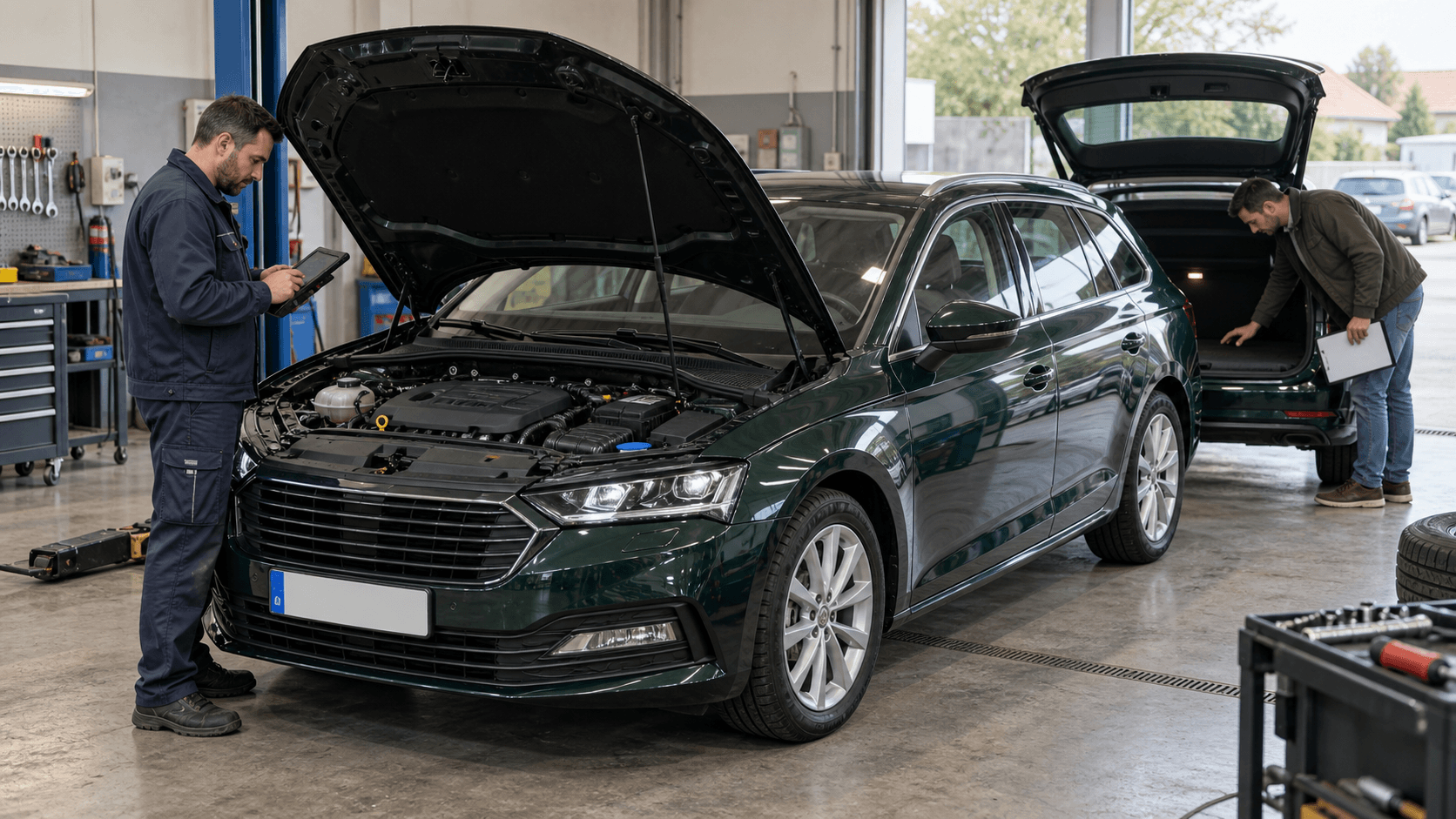
Illustrative image; the car does not represent a specific model or brand.
Used Škoda Superb in 2026: what to check on TSI, TDI, DSG, 4×4, iV and fleet history
The short answer
A used Škoda Superb can offer a lot of space for a family and long trips, but the choice must be made by generation, engine code, gearbox code and the history of the example, not only by the name in the advert. The third generation, launched in 2015 and updated in 2019, exists with TSI and TDI engines, manual or DSG gearboxes, front-wheel drive or 4×4 and, from 2020, as the Superb iV plug-in hybrid. The fourth generation brought from 2024 a new range, standard DSG, mild-hybrid power and an iV system with a larger battery.
Before a deposit, ask for the VIN and check the engine, transmission, body, model year and country of first delivery. Start the car cold, run diagnosis on every module, test the DSG cold and hot, inspect the engine and emissions systems, then put the car on a lift. On 4×4, check the tyres and the entire drivetrain. On iV, ask for a written high-voltage battery test and check charging. If the car was in operational leasing, a documented history is useful, but wear and mileage must be confirmed separately.
Which Superb is in the advert: generation III, facelift or generation IV
Škoda launched the third-generation Superb in June 2015 on the MQB architecture. The range included liftback and Combi bodies, several turbo petrol and diesel engines, manual or dual-clutch transmissions and 4×4 versions. The 2019 update brought Matrix LED headlights on certain trims, revised engines, new assistance systems and the first Superb iV plug-in hybrid, which reached the market at the beginning of 2020.
The fourth generation was presented in November 2023 and arrived on the market as a 2024 model. At launch, all engines were paired with DSG: 1.5 TSI mild-hybrid, 2.0 TSI, 2.0 TDI and iV plug-in hybrid, with 4×4 on the top combustion versions. The iV configuration was initially announced for the Combi, then the range was extended to the liftback as well. Do not automatically transfer the specifications of a new version onto a car built in another year.
| Marker | Configurations found | What to confirm before viewing |
|---|---|---|
| Superb III, 2015–2019 | TSI or TDI, manual or DSG, front-wheel drive or 4×4, liftback or Combi | engine code, gearbox code, emissions standard, drive and equipment from the VIN |
| Superb III facelift, from 2019 | TSI, TDI, DSG, 4×4, DCC, Matrix LED and iV, depending on version | model year, headlight type, ADAS systems and update history |
| Superb iV, from 2020 | 1.4 TSI plus electric motor, 13 kWh gross battery, 6-speed DSG, front-wheel drive | battery report, cables, AC charging, cooling and hybrid-system history |
| Superb IV, from 2024 | 1.5 TSI mHEV, 2.0 TSI, 2.0 TDI or iV; standard DSG | body, power, drive and software version from the VIN |
| Superb IV iV | new-generation PHEV system, 25.7 kWh gross battery, AC and DC charging | configuration year, system power, battery warranty and charging equipment |
The first-registration year is not always the model year. A car built before the facelift can be registered later, and an import can have an engine and equipment combination that was not sold officially in Romania. Decoding the VIN and the equipment sheet are more useful than the badges on the tailgate.
1. Identify engine, gearbox, drive and body from the VIN
Start with the 17-character serial number. Compare it on the body, in the CIV, registration document, invoices, service history and diagnosis report. Note the engine code, transmission code, power in kW, emissions standard, drive type and build date. A description such as “2.0 diesel automatic” does not say which engine and DSG variant the car has.
Check whether it is a liftback or Combi and whether the extras in the advert exist on the car. DCC, Matrix LED headlights, auxiliary heating, electric seats, an electrically operated tailgate and assistance systems can change the cost of a repair. On an import, ask for documents from the country of origin, proof of deregistration and earlier invoices. Do not accept photographs with a partially covered VIN before travel or payment.
An older example with documented work can be easier to assess than a newer one with gaps in the history. Compare cars only after you have established the exact specification. Otherwise you risk putting a manual TDI liftback, a DSG 4×4 Combi and an iV with a traction battery on the same list.
2. Choose TSI, TDI, mild-hybrid or iV by the real route
TSI engines make sense for mixed use and moderate annual mileage, but each engine code must be checked separately. Follow the oil-change history, cooling, ignition, intake, turbocharger, any leaks and documented oil consumption. Start the engine cold and repeat the check after warm-up and after progressive acceleration. The reputation of an engine family does not replace measurements on the specific car.
A TDI can suit motorway and long trips. If the car has mostly been used in town, check the particulate filter, EGR, injection, turbocharger, SCR system and AdBlue level, where fitted. Ask diagnosis for the available values for DPF loading, regenerations, injector corrections and stored faults. A warning light that is off does not prove the problem has been solved.
On generation IV, the 1.5 TSI mHEV uses a 48 V system. This is not a full hybrid and does not run like a Superb iV charged from a socket. Identify the 48 V battery, converter, starter-alternator and fault history. For iV, the route must include regular charging; without practical access to a socket, the extra mass and complexity can remain without the intended benefit.
Do not choose the engine by the consumption declared by a single owner. Temperature, speed, traffic, load, tyres, trip length and charging frequency change the result. Calculate cost using your own urban and extra-urban mileage.
3. The DSG is tested cold, hot and in slow manoeuvres
“DSG” alone does not identify the transmission. Across generations, years and engines there can be six- or seven-speed gearboxes, with different specifications and maintenance procedures. Ask for the gearbox code and the service plan tied to the VIN. Do not automatically apply an oil-change interval found on a forum for another transmission.
At start-up, hold the brake and select R and D in turn. Watch delays, bangs, vibration and dashboard messages. In slow traffic, test a gentle take-off, stopping, driving on a slope and parking. On the road, check shifts under light and medium acceleration, downshifts, running after warm-up and behaviour in manual mode, if fitted.
Diagnosis must include the transmission module, not only the engine computer. Ask for the values and adaptations the tester can read for the specific gearbox, temperature and stored faults. An adaptation reset before sale is not a repair. If slip, shocks, noises or delays appear, the workshop must establish whether the problem comes from clutches, mechatronics, dual-mass flywheel, mounts, software or another component.
The guide on checking a used automatic gearbox explains the differences between DSG, CVT, Powershift and torque-converter gearboxes.
4. On TDI, check the entire emissions system, not only the DPF
A modern diesel combines DPF, EGR, temperature and pressure sensors, and some versions use SCR with AdBlue. A single fault can have several causes. Ask for a full scan before and after the road test and do not allow codes to be cleared before you receive the report.
Start the engine cold. Listen to the timing drive, injection and accessories, watch the smoke and check whether the coolant level is stable. After warm-up, inspect hoses, the expansion tank, oil traces and any exhaust smell. On diagnosis, compare measured values with the specifications of the specific engine; an isolated soot percentage does not by itself give a verdict.
Ask the owner what routes they have done and request invoices, not general explanations. A fleet car that has covered motorway miles can have high mileage but coherent wear and documented service. A low-mileage diesel used only on short trips may need extra investigation. Mileage does not replace the usage profile.
5. On Superb iV, test the battery, charging and both propulsion systems
The generation III Superb iV combines the 1.4 TSI engine with an electric motor and a 13 kWh gross lithium-ion battery. At launch Škoda quoted up to 62 km electric in the WLTP cycle and AC charging at 3.6 kW. Generation IV moved to 1.5 TSI and a 25.7 kWh gross battery, with AC charging of up to 11 kW and DC of up to 50 kW. They are different systems; cables, charging times and parts are not interchangeable through the iV badge alone.
Ask for a written high-voltage battery report, with VIN, mileage, faults and the values the network or a specialist can measure. The range shown after the last charge is an estimate influenced by temperature, climate control and recent trips. It is not a battery-health certificate.
Connect the car to a compatible station. Check session start, plug locking, accepted power, cables, port flap and messages in the app or on the dashboard. Do a test in electric mode, hybrid mode and with the combustion engine running. Check cooling of the battery and power electronics, climate control, regenerative braking and the 12 V battery.
Škoda publishes for the high-voltage battery a warranty of 8 years or 160,000 km, whichever limit is reached first, but the conditions and type of cover must be checked in the car’s documents. For a PHEV, the defect warranty must not be confused with a general promise of a minimum capacity percentage. Ask for written confirmation for the VIN and first-delivery date.
For the full procedure, see the guide on checking a used plug-in hybrid.
6. On 4×4 and DCC, tyres and a lift inspection are mandatory
Superb III used a fifth-generation Haldex multi-plate clutch for 4×4 versions. On generation IV, 4×4 is associated with certain powerful engines. In both cases, confirm drive from the VIN; the badge can be missing or added later.
Compare all four tyres by brand, pattern, size, index, wear, pressure and DOT date. Large differences in circumference or wear are not a cosmetic detail for a 4×4 system. On a lift, check leaks, the clutch housing, differentials, propshaft, gaiters and mounts. On the road, listen for vibration and rumble under acceleration, deceleration and tight turns.
Ask for invoices for all-wheel-drive maintenance and use the fluid and procedure specified for the exact code. The phrase “lifetime oil” does not replace inspection. If the seller has recently changed only two tyres, ask why and measure wear on all of them.
On DCC, cycle through the available modes and check the dampers for leaks, faults and differences in response. Noises over bumps can also come from springs, bushes, joints, bearings or wheels. The finding must be made mechanically and electronically before a quote. For the drivetrain, also consult the guide on checking a used 4×4.
7. Fleet history can be useful, but it must be read critically
The Superb is often used as a company car, executive transfer, taxi or rental vehicle. None of these uses automatically condemns the car. What matters is the routes, who maintained it, which parts were fitted, what damage it has had and whether the price reflects the wear.
Look for invoices and repair orders with VIN and mileage. Compare intervals between services with odometer readings, ITP records and leasing documents. Check the steering wheel, driver’s seat, pedals, buttons, boot sill and rear bench. Wear alone does not prove false mileage, but any mismatch must be explained with documents.
On a fleet car, equipment can be simpler than the photographs suggest. Confirm physically the camera, adaptive cruise, seat heating, headlights, navigation and electric tailgate. At the end of a lease there can be cosmetic resprays, mismatched tyres or work done strictly for handover. Measure the paint and ask for findings on a lift.
RAR Auto-Pass can include odometer readings, ITP data, reported interventions and certain serious repairs recorded in Romania. For an import, do not automatically reconstruct the period before it entered the country. The guide on cars coming out of operational leasing shows which documents are worth requesting.
8. Liftback or Combi: check space and leaks on the specific car
For generation III, Škoda quoted 625 litres for the liftback boot and 660 litres for the Combi. On generation IV, the figures rose to 645 and 690 litres. iV versions have a different architecture under the floor, and the volume and shape of the compartment can differ. Do not compare only the brochure figure.
Open the tailgate several times, including from the button, key and sensor, if the car has those functions. Check the struts or electric operation, lock, roller cover, double floor, net, anchor points and folding of the rear seat. Put in the boot the pushchair, suitcases or boxes used by the family.
Lift the floor and look for dampness, condensation, rust, oxidised connectors and traces of repair. Check seals, tail lights, roof joints and the panoramic sunroof. On the Combi, also check the roof rails; on the liftback, watch the alignment of the large tailgate and any noises over bumps.
A large space can hide intensive use for transport. Scratches are negotiable, but a deformed floor, leaks or repaired wiring need investigation. For family alternatives, see the selection of used cars with a large boot under €15,000.
9. Headlights, ADAS, climate control and multimedia are tested function by function
The 2019 facelift brought Matrix LED headlights on certain trims, and generation IV has newer sensors and assistance functions. List the extras from the VIN, then test them individually. An icon in the menu does not prove the car has the complete, calibrated hardware.
Check headlights on dipped and main beam, indicators, automatic levelling, front camera, radar, parking sensors, blind-spot monitoring and adaptive cruise, where fitted. After a windscreen change or a frontal claim, ask for the invoice and calibration report. A wrongly positioned radar may not light a warning immediately.
Test both keys, keyless access, climate control in every zone, auxiliary heating, seats, windows, mirrors, screen, sound, camera and all ports. Make sure the previous owner can remove the car from their account and that connected services can be transferred. Software updates must be confirmed in the history, not assumed.
Euro NCAP assessed generation III in 2015 and generation IV in 2024. The results belong to the configurations and protocols tested then; they do not describe the condition of a repaired car. Structural integrity, airbags, belts, sensors and calibrations of the specific example must be inspected.
10. Calculate the first year before you negotiate the price
Use the same formula for every example:
purchase price + work required immediately + services due within 12 months + tyres and brakes + insurance and taxes.
Add separately the risks identified on the DSG, flywheel, 4×4 system, DCC, DPF/SCR, headlights, ADAS, tailgate, climate control and multimedia. On iV include the battery test, cables, charging and cooling. Ask for written quotes after VIN and part code. A verbal estimate from the seller is not a budget.
Compare Škoda Superb adverts available in Romania, but filter manually by generation, body, power, gearbox and drive. For a more compact alternative, consult the guide on the used Škoda Octavia. After purchase, keep a reserve for findings that cannot be ruled out at a single viewing.
Checklist before you buy a used Škoda Superb
- The VIN is identical on the body, in the CIV, registration document, invoices and diagnosis.
- Build date and model year are confirmed separately from first registration.
- The body is identified correctly: liftback or Combi.
- Engine code, power in kW and emissions standard match the paperwork.
- Gearbox code and number of speeds are confirmed from the VIN.
- Front-wheel drive or 4×4 is confirmed from the car’s sheet.
- Country of first delivery and import documents are known.
- The engine is cold at the start of the viewing.
- Starting does not produce unexplained smoke, noises, vibration or warning lights.
- There are no leaks of oil, coolant, fuel or transmission fluid.
- Diagnosis includes every module and stored faults.
- On TSI, ignition, turbocharger, cooling and documented oil consumption have been checked.
- On TDI, injection, turbocharger, EGR, DPF and SCR/AdBlue have been checked, as applicable.
- The DSG has been tested cold and hot, in R and D.
- Slow take-offs, a slope and parking manoeuvres do not produce shocks or slip.
- Gearbox maintenance history matches the transmission code.
- Flywheel, mounts and drivetrain do not produce unexplained vibration.
- On 4×4 there is proof of maintenance and no leaks at the transmission.
- Propshaft, clutch and differentials have been inspected on a lift.
- All four tyres have compatible specifications and wear.
- DCC, if fitted, works in every mode without faults.
- Suspension, steering, bearings and brakes have been checked on the road and on a lift.
- Paint thickness has been measured on every panel.
- Sills, floor and jacking points have no structural damage or serious corrosion.
- There is no water under the carpets or under the boot floor.
- Tailgate, roller cover and folding of the rear seat work correctly.
- On iV there is a written high-voltage battery report.
- On iV, charging, cables, port and cooling have been tested.
- The iV battery warranty is confirmed in writing from the VIN.
- The 12 V battery has been measured, not judged by eye.
- Headlights, camera, radar and sensors have no faults.
- There is proof of calibration after a windscreen change or frontal repairs.
- Climate control, heating, seats and multimedia have been tested.
- Both keys are present and working.
- The car can be removed from the old account and linked to a new one.
- ITP records, RAR Auto-Pass, invoices and external history do not contradict each other.
- Recall campaigns have been checked by VIN and the work is closed.
- An independent workshop has issued quotes for immediate and due work.
- After purchase a reserve remains for unforeseen repairs.
Frequently asked questions
Is a used Škoda Superb reliable?
There is no verdict valid for every example. Generation, engine, DSG, drive, mileage, accidents and maintenance change the risk. Choose the car with a clear specification, coherent history, full diagnosis and an independent inspection.
What should I choose for long trips: TSI or TDI?
A TDI can make sense at high mileage and long routes, if the emissions systems are healthy. A TSI can be more suitable for mixed use and moderate mileage. Calculate on your route and check the specific engine; fuel alone does not settle the choice.
Must the Superb’s DSG shift perfectly?
Not every gearbox has the same feel, but bangs, slip, large delays, vibration and faults need diagnosis. Test it cold, hot and in slow manoeuvres, then check the transmission module and service history.
Is a Superb 4×4 a good choice for winter?
All-wheel drive can help with take-off and stability, but it does not compensate for unsuitable tyres and does not automatically shorten braking. Check all tyres, the clutch, propshaft, differentials and maintenance before purchase.
Is a Superb iV worth it if I cannot charge at home?
The PHEV advantage depends on regular charging and the route. Without predictable access to a socket, compare mass, space, consumption with a depleted battery and system complexity with a TSI, TDI or mild-hybrid suited to your use.
How do I check a Superb iV battery?
Ask for a workshop report with VIN and mileage, a scan of the high-voltage modules and a charging test. Estimated range on the dashboard is not enough. Confirm cooling, the 12 V battery, cables and remaining warranty separately.
Liftback or Combi for a family?
The liftback has a large opening and a generous boot, and the Combi offers a taller compartment that is easier to load. Try the pushchair, luggage and child seats on the specific car; the iV version can have a different floor.
Which documents are decisive before a deposit?
VIN, CIV, registration document, contract, invoices, service history, import documents and RAR Auto-Pass must describe the same car. On iV add the battery report and warranty status; on 4×4 and DSG ask for the specific maintenance invoices.
Verified sources
- Škoda Storyboard — launch of the third-generation Superb and 2015 technical configurations
- Škoda Storyboard — engines and transmissions of the 2019 Superb facelift
- Škoda Storyboard — 13 kWh Superb iV and WLTP range announced at launch
- Škoda Storyboard — fourth-generation engines, DSG, 4×4 and the new iV system
- Škoda Storyboard — dimensions and boots of the fourth generation
- Škoda Auto — warranty and conditions for the high-voltage battery
- Škoda Romania — recall campaign check
- Euro NCAP — 2024 Škoda Superb assessment
- Euro NCAP — 2015 Škoda Superb results
- Romanian Automotive Register — information included in the RAR Auto-Pass certificate