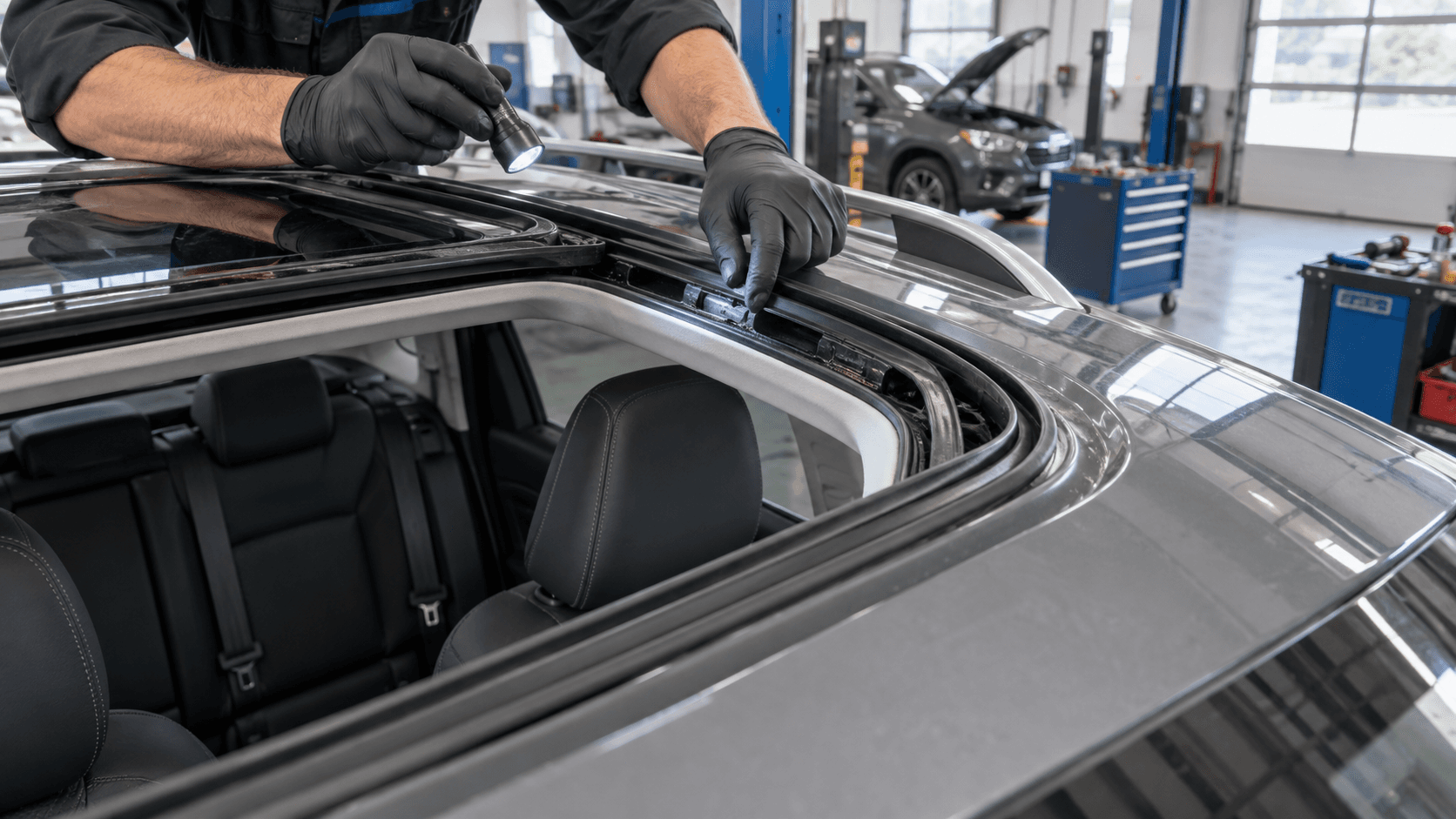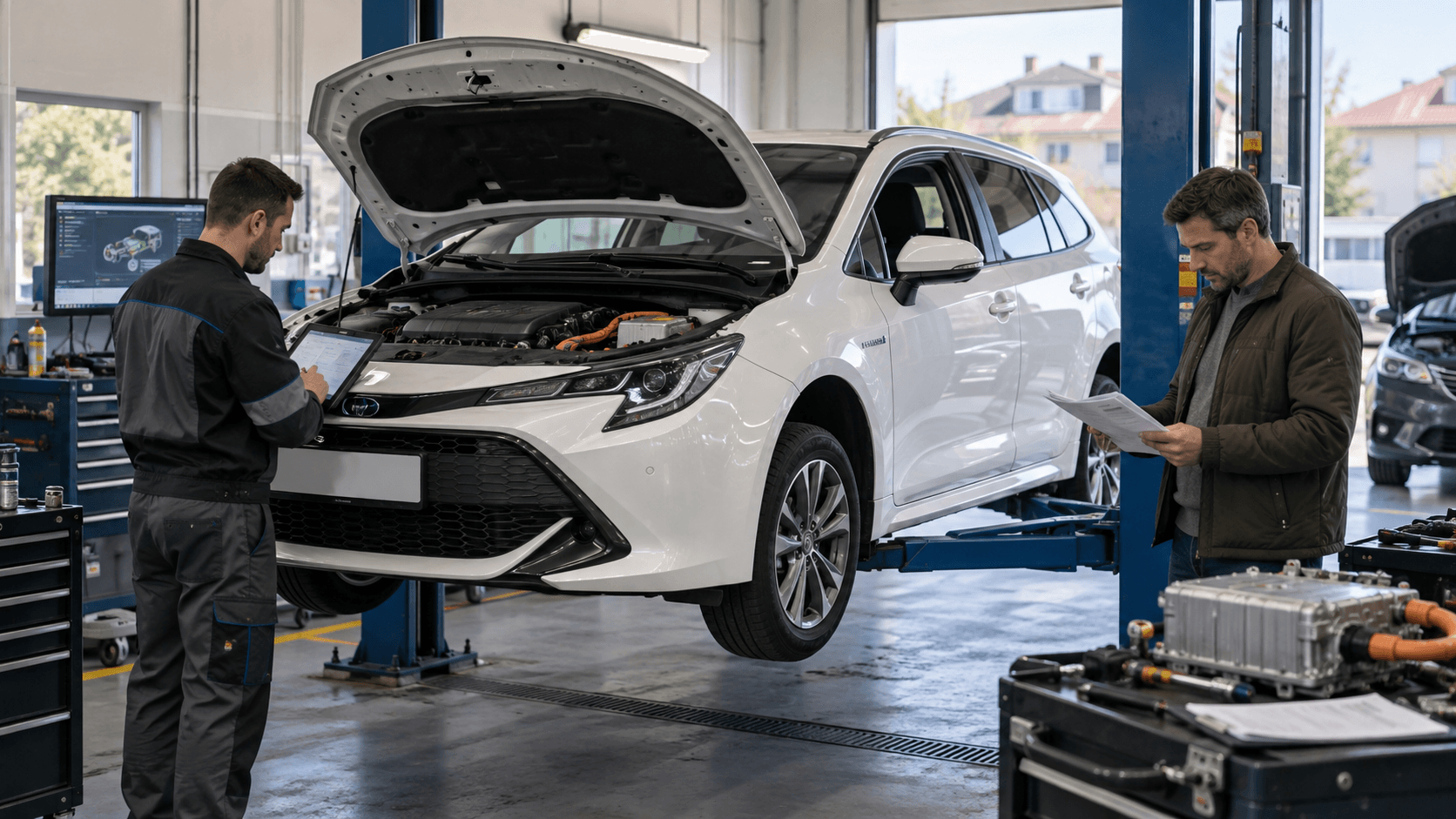
Illustrative image; the car does not represent a specific example or brand.
Used Toyota Auris in 2026: what to check on Hybrid, e-CVT, diesel, Touring Sports and history
The short answer
A used Toyota Auris can be one of the more rational used compacts in 2026, especially if you choose correctly between petrol, diesel and Hybrid. It is not, however, a purchase you make on Toyota’s reputation alone. On the Auris, generation, powertrain, gearbox, service history, city or fleet use and battery condition on hybrids all matter.
Short checklist:
- identify the generation and body: hatchback or Touring Sports;
- confirm the exact engine from the VIN, not from the advert wording;
- on Auris Hybrid, ask for a hybrid-battery test, inverter, cooling and stored faults;
- on e-CVT, do not confuse constant revs under acceleration with a fault, but investigate vibration, noises and warning lights;
- on diesel, check DPF, EGR, injectors, turbocharger and how the car was actually used;
- inspect the brakes, because on a hybrid they can rust if the car did a lot of urban work and used regeneration often;
- measure the paint and inspect the boot, sills and chassis rails;
- compare cabin wear with the mileage, especially on taxi, ride-sharing or fleet cars;
- do not pay a deposit without a VIN report, invoices, a diagnostic scan and a cold and hot road test.
Practical rule: the Auris is worth buying when the history is better than the price. A Hybrid with 220,000 km and clear servicing can be more logical than a “low-mileage” car with no invoices, no diagnosis and an unclear story.
Why the Auris needs its own guide
The Carboratory archive includes the Toyota Auris in round-ups of hybrids, Japanese cars, reliable automatics and compacts under certain budgets. What was missing was a dedicated guide for the reader looking specifically for a used Toyota Auris in 2026 and choosing between Hybrid, diesel, petrol, hatchback and Touring Sports.
Market interest is there. At documentation on 9 September 2026, OLX showed more than 160 results for Toyota Auris, and Autovit had active listings of diesel, petrol and hybrid examples, including 2013–2018 cars with mileages often past 150,000 km. On CautiMasina, the model appears in Toyota internal searches and is worth comparing with Toyota Corolla, Toyota Prius, Hyundai i30 and Honda Civic.
The Auris attracts precisely because it looks like a low-drama choice. In practice, an example can be very good or tired, depending on years, kilometres, servicing, damage and how it was used.
Which generations you will find
On the Romanian used market you mainly see:
- the first-generation Auris, including older petrol, diesel and Hybrid cars;
- the second-generation Auris, launched in Europe in the early 2010s;
- the facelift of the second generation, more sought after for cabin, equipment and engines;
- Auris Touring Sports, the estate, interesting for a family and boot space;
- cars imported from Germany, the Netherlands, Belgium or other European markets.
Do not buy on the year in the advert alone. A 2013 Auris can be in better condition than a 2017 if it had complete servicing, coherent mileage and a careful owner. Likewise, a Touring Sports can be more useful for a family, but it may have been used more heavily for commuting, transport and holidays.
Auris Hybrid: the main reason the model is sought after
For many buyers, Auris means Auris Hybrid. The Toyota system uses a 1.8-litre petrol engine, an electric motor, a hybrid battery and an e-CVT transmission. Toyota communicated 136 hp of system output for Auris Hybrid, and the Touring Sports version was presented as a compact full-hybrid estate, with the battery packaged so the boot stayed practical.
The real advantage is more predictable urban consumption, the absence of a conventional clutch and mature hybrid technology. The drawback is that many examples already have age, high mileage and intensive urban use.
At the viewing, check:
- cold starting;
- the change between combustion and electric;
- noises on pull-away;
- climate-control operation;
- the 12 V battery;
- hybrid-system temperature;
- diagnostic faults;
- hybrid-battery ventilation;
- service history;
- invoices, not only the claim “Toyota service”.
A hybrid battery is not assessed from the displayed range or from the car covering a few hundred metres electrically. Ask for a specialist check and watch whether the system charges and discharges normally on the move.
e-CVT: how to understand it on the road test
Toyota’s hybrid transmission is often called e-CVT, but it should not be judged as a conventional automatic. Under acceleration, the engine can rise in revs and stay there while speed builds progressively. For someone coming from a manual or a DSG, the sensation can feel odd, but it is not automatically a fault.
What is worth checking:
- pull-away from rest;
- reverse;
- vibration under acceleration;
- bearing noises;
- hybrid-system faults;
- braking response;
- behaviour after the car has warmed up;
- any unusual knocks or snatch.
Do not accept a five-minute test around the block. An Auris should be tried in town, on a faster boulevard and with progressive braking. If warning lights, noises or hesitation appear, a workshop check takes priority over the seller’s explanations.
The hybrid battery and its cooling
The hybrid battery is one of the parts that scare buyers, but the real issue is not its existence, it is the lack of a check. Many Toyota hybrids have covered hundreds of thousands of kilometres, but that does not mean every example is sound.
Look at:
- service history;
- the car’s age;
- real mileage;
- taxi or ride-sharing use;
- stored faults;
- the fan and air intake for the hybrid battery;
- smells, damp or dust around the rear bench;
- battery behaviour under repeated acceleration and braking.
If the car often carried passengers, animals or a lot of dust, battery cooling can matter more than it looks. A workshop that knows Toyota hybrids can say more than a generic scan done in a car park.
D-4D diesel: do not buy it for short city trips
An Auris diesel can be a good choice for a long commute and low consumption. For short city journeys, it can become more expensive than a Hybrid or a simple petrol.
Check carefully:
- the particulate filter;
- EGR;
- the injectors;
- the turbocharger;
- cold starting;
- smoke under acceleration;
- DPF differential pressure;
- regeneration history;
- oil and change intervals;
- any modifications to the emissions system.
A diesel that has done a lot of motorway work can still be very good. A diesel used for 3–5 km a day can have tired emissions equipment even if the advert promises low consumption. For town, Auris Hybrid is usually more logical.
Plain petrol: sometimes the easiest to budget
Not every Auris is a hybrid. Petrol cars also appear, including 1.33-litre, 1.6-litre or 1.2 turbo engines on the second-generation facelift. For someone doing few kilometres and wanting costs that are easier to anticipate, petrol can be a good choice.
On petrol, check:
- cold starting;
- idle;
- oil consumption;
- the timing belt or chain, depending on the exact engine;
- spark plugs and coils;
- the clutch;
- leaks;
- service history.
Do not buy Hybrid automatically if your routes do not favour it, or if you find a simple petrol with a clearly better history. A good model reputation does not replace the actual condition of the car.
Hatchback or Touring Sports
The Auris hatchback is enough for town, commuting and a small family. Touring Sports is the more interesting variant if you have a child, a pram, luggage or frequent trips out of town. Toyota emphasised that the full-hybrid estate keeps a practical boot solution, which makes it attractive on the used market.
On Touring Sports, also check:
- the tailgate;
- the boot floor;
- the spare wheel or puncture kit;
- signs of heavy transport;
- rear dampers;
- seals;
- leaks;
- the folding rear bench;
- child-seat anchorages.
A compact estate can be very useful, but that usefulness means some examples have worked harder than a hatchback used only in town.
Brakes, suspension and tyres
On Auris Hybrid, regenerative braking reduces use of the mechanical brakes in many situations. That can cut pad wear, but it can also lead to rusty discs, lazy calipers or brakes that do not work evenly if the car sat a lot or only did urban work.
Check:
- disc thickness;
- rust on the working surface;
- the pads;
- the calipers;
- brake fluid;
- vibration under braking;
- geometry;
- dampers;
- bushes;
- wheel bearings;
- tyre size and age.
On a car bought for economy, tyres and brakes should not be treated as details. They are the first things that can change the real cost after purchase.
Interior, taxi, fleet and mileage
Auris Hybrid was attractive for taxi, ride-sharing, fleets and commuting. Not all such cars are bad, but they must be priced correctly. A professionally used example can have a more tired seat, steering wheel, doors, suspension and brakes than the photos suggest.
Check:
- steering-wheel wear;
- the driver’s seat cushion;
- the pedals;
- window switches;
- the seatbelts;
- door hinges;
- the carpet;
- boot fittings;
- cabin smell;
- any traces of wrapping or removed equipment.
Mileage must be checked through service history, technical inspections, VIN reports and the coherence of worn parts. A car with a genuine 280,000 km can be buyable if price and condition justify it. A car with 150,000 km declared, but no trace of history, needs caution.
Safety and equipment
Euro NCAP published 2013 results for the Toyota Auris, including test material and a technical sheet. For a buyer, the rating is only a starting point. Exact equipment, airbag condition, accident repairs and how the systems work matter more than the model name.
At inspection, watch:
- the airbag warning light;
- seatbelts and pretensioners;
- ISOFIX;
- side airbags;
- headlights;
- the reversing camera, if fitted;
- sensors;
- the windscreen;
- damage history;
- alignment of body panels.
An Auris cheaply repaired after an accident can look correct in photos and still have affected airbags, sensors or mountings. Paint measurement and a lift inspection are mandatory.
What price makes sense
The right price depends on generation, body, engine, kilometres, history, country of origin and battery condition on Hybrid. In autumn 2026, public listings in Romania show a wide range: older examples can drop towards small budgets, and well-equipped Auris Hybrid facelift or Touring Sports cars can stay above €10,000.
Do not judge only by “the cheapest” and “the most expensive”. Compare:
- the same year;
- the same body;
- the same engine;
- similar kilometres;
- similar history;
- similar tyre and brake condition;
- number of owners;
- Romanian origin or import.
If a Hybrid is much cheaper than the rest of the market, ask why. If one is much dearer, ask for proof: complete history, real warranty, verified kilometres, a tested battery and above-average technical condition.
Frequently asked questions
Is a used Toyota Auris Hybrid worth it in 2026?
Yes, if you do a lot of town or mixed commuting and find an example with clear history, a good diagnosis and a checked hybrid battery. It is not worth buying only for the consumption promised in the advert.
Is e-CVT a conventional automatic gearbox?
No. On Toyota hybrids, e-CVT is part of the hybrid system and feels different from a stepped automatic. High revs under acceleration do not on their own indicate a problem, but noises, vibration and warning lights must be investigated.
Is an Auris diesel a good choice?
It can be good for long journeys and extra-urban commuting. For short city use, diesel can bring costs with DPF, EGR, injectors and turbo. Real use matters more than the consumption on the dash.
Is Touring Sports worth it versus the hatchback?
Yes, if you need boot space and use the car for a family or long trips. Check the tailgate, seals, boot, rear suspension and signs of heavy transport.
What check is mandatory before a deposit?
VIN, service history, diagnostics, a cold and hot road test, a lift, paint measurement, a hybrid-battery check on Hybrid, and coherent paperwork. Without these, a good price does not mean much.
Verdict
A used Toyota Auris is a very good compact when you choose the example, not the legend. The hybrid is attractive for town and commuting, Touring Sports is practical for a family, and plain petrol can be the easiest to budget. Diesel only makes sense with suitable routes and checked emissions equipment.
Buy an Auris if history, diagnosis and the road test confirm the story in the advert. Walk away if the seller avoids the VIN, has no invoices, rushes the deposit or says “all hybrids do that” without a check.