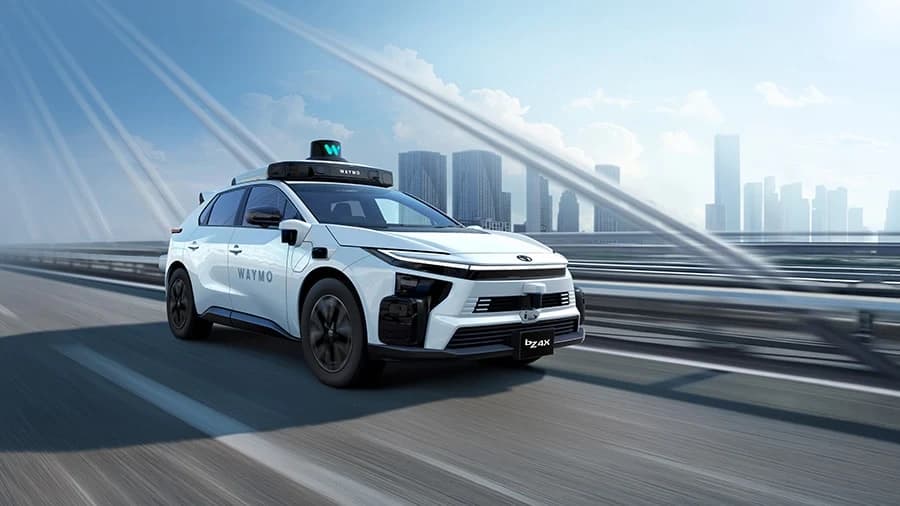
Toyota and Waymo are moving their autonomous-driving partnership into an initial testing phase. The companies say they will begin testing and validating a fleet of autonomous Toyota bZ4X vehicles in Japan in 2027. They also plan to take the vehicle to the United Kingdom and other Waymo-served markets in the following years. The announcement does not yet give a Japanese launch city, fleet size, passenger tariff or date for a fully commercial service.
The programme builds on a preliminary agreement announced in April 2025. The new announcement is more specific about manufacturing. Toyota will build the vehicles at its Takaoka plant in Toyota City, Aichi Prefecture, and integrate Waymo's autonomous-driving hardware at the same site. The base vehicle and the autonomous equipment will therefore be handled under one roof rather than through a separately described conversion operation.
What is confirmed for Japan
The first phase in 2027 will involve initial operations to test and validate an autonomous bZ4X fleet. That wording matters. It describes a test and validation programme, not an immediate promise that any passenger in Japan will be able to summon a driverless car. Toyota and Waymo say the project is intended to support a fully autonomous ride-hailing service, but the approval process and commercial expansion plan have not been published.
Toyota describes the programme as a step toward Japan's first fully autonomous ride-hailing service using high-volume vehicles manufactured domestically. That statement should be read as the companies' stated objective. No operating area, passenger app, fare structure, fleet capacity or customer eligibility rules have been announced.
Waymo contributes its autonomous-driving technology, while Toyota provides vehicle development and manufacturing. The companies do not specify in the release which exact generation of Waymo's system will be fitted to every Japanese vehicle, nor do they publish a complete sensor list. The confirmed manufacturing point is that Waymo hardware will be integrated at Takaoka.
Why the bZ4X is the platform
The Toyota bZ4X is an electric SUV. For an autonomous ride-hailing vehicle, that body style offers a raised seating position and an interior that can be arranged around passenger access. The partnership announcement focuses on comfort and accessibility rather than a new technical specification. It does not announce a different battery, a revised range figure or a dedicated charging system for the Waymo fleet.
The autonomous version is designed with more rear legroom and features including automatic doors, a power liftgate and ambient lighting. Toyota says these features are intended to make entry and exit smoother. The release does not clarify whether every vehicle will receive exactly the same equipment or whether the specification will vary by service and market.
Automatic doors and a power liftgate have a practical role in a robotaxi. A passenger should not need to search for a handle or operate every access point manually after the vehicle stops. At the same time, each function has to be coordinated with the autonomous system and its safety procedures. Toyota has not explained how door release will be authorised at a pick-up point or how the system will respond if a passenger tries to open a door in an unsafe location.
What Level 4 means here
Toyota describes the project as a Level 4 autonomous-vehicle programme. Under the SAE classification, Level 4 means that the system performs the driving task within defined conditions and areas. It does not mean that the car can operate without restrictions on every road, in every weather condition or in every country.
Waymo says that, in the areas where it operates, its technology has demonstrated safety up to 20 times better than human drivers for serious crash injuries. That is Waymo's statement, not an independent conclusion by Carboratory. The Toyota release does not provide the full methodology, time period or comparison base behind the figure, so it should remain attributed to Waymo.
Testing in Japan will have to account for local road layouts, markings, signs, weather, cyclists, pedestrians and intervention procedures. The announcement publishes no Japanese test results and does not announce a consumer product based on Waymo technology. Validating a ride-hailing service is a different step from homologating a system for sale in privately owned cars.
The role of Woven by Toyota
Toyota and Waymo also say they will continue exploring autonomous-driving technology for personally owned Toyota vehicles. Alongside Woven by Toyota, they will consider how insights, data and technology from Waymo's real-world operations could contribute to safer conditions for other road users.
This is described as a future direction, not as a product launch. There is no Toyota vehicle with Waymo's system available for private purchase and no retail launch date in the announcement. Woven by Toyota is identified as a participant in future initiatives, but the companies do not describe a final system, model or commercial package.
What happens next
The next public milestone is 2027, when the initial bZ4X operations are expected to begin in Japan. Toyota and Waymo then plan to expand into the United Kingdom and other markets served by Waymo, but “the following years” is not a detailed timetable. Each country will require its own approvals, operating rules and technical validation.
The announcement says nothing about a Romanian deployment. Its wider significance is more specific: Toyota is using its manufacturing operation for an autonomous mobility vehicle, while Waymo is extending its vehicle partnerships beyond the markets where it already operates. The number of bZ4X vehicles, Japanese cities, passenger prices, approval route and commercial start date remain unknown.