The short answer
A used Volkswagen T-Cross is worth considering in 2026 if you want a small city SUV, with a high driving position, good visibility and costs closer to a B-segment car than to a Tiguan. Do not buy it only for the Volkswagen badge or because it looks more practical than a Polo. On a used example, the exact engine, gearbox, service history, city wear, real equipment and space measured with your own things matter.
Short checklist:
- ask for the VIN and check the year of manufacture, date of first registration, engine, gearbox and equipment;
- separate 1.0 TSI versions from 1.5 TSI and do not assume they all have the same dynamics or the same cost;
- on DSG, test pull-away, slow traffic, a slope, parking manoeuvres and shifts when hot;
- on a manual gearbox, check the clutch, linkage and reverse engagement;
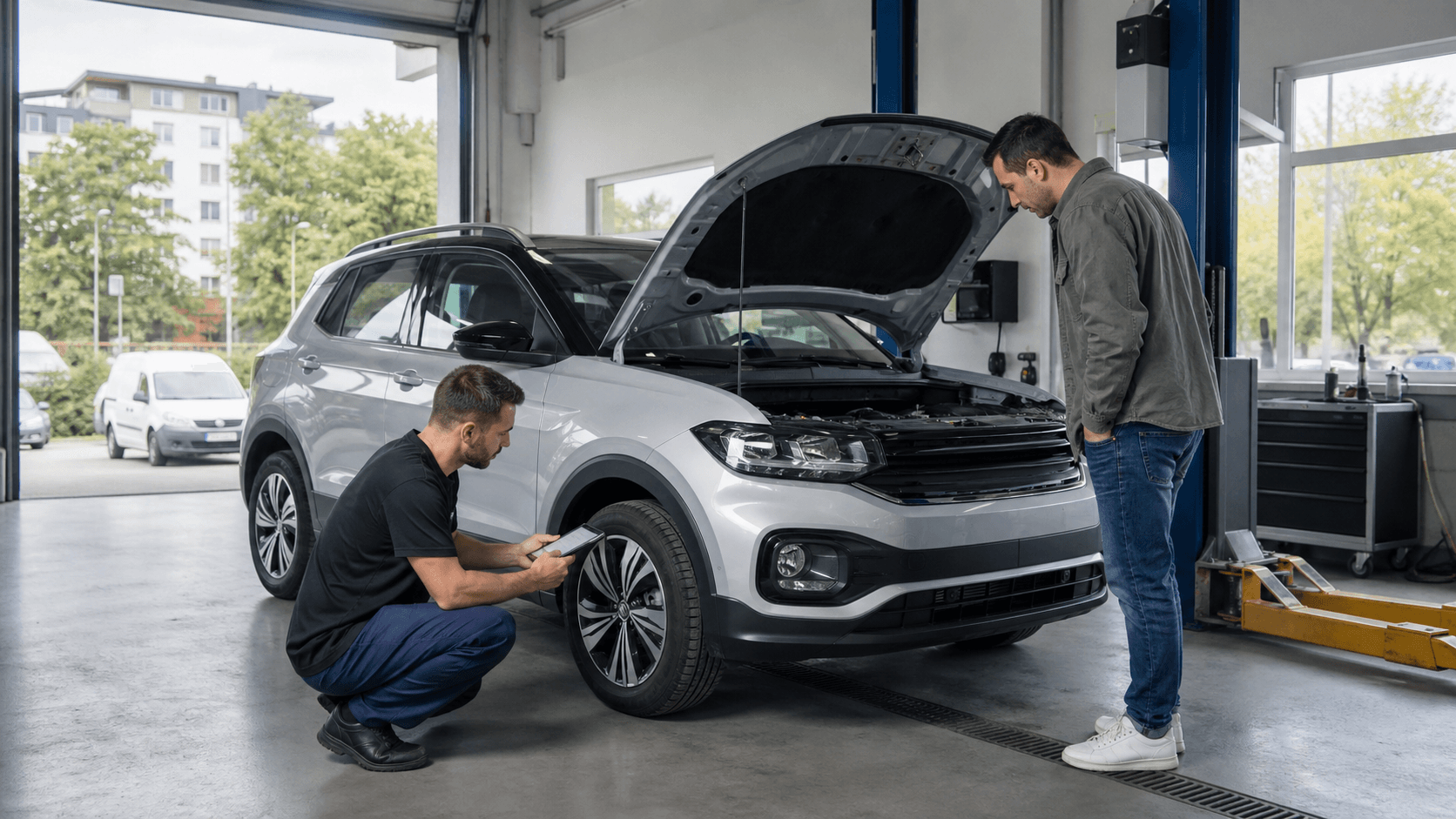
- check the brakes, wheels, tyres, suspension and undertrays, because many T-Cross cars have been used in town;
- test the LED headlights, camera, sensors, Front Assist, Lane Assist and the functions in the car’s menu;
- do not assume space from the SUV shape: try it with a child seat, luggage and the real rear-bench position;
- compare the price with similar cars by year, mileage, history and equipment, not only with the cheapest advert.
Practical rule: the T-Cross is a good choice when you buy a simple, checkable example that fits town use. It becomes a risky purchase when the price is justified only by equipment, while the history, gearbox or city damage remain unclear.
Why the T-Cross needs its own used-car guide
The Carboratory archive already covers important Volkswagen models, including Golf, Passat, Tiguan and T-Roc. The T-Cross appeared mainly in comparisons, news or pieces on small SUVs, but it did not have a dedicated guide for a buyer searching specifically for a “used Volkswagen T-Cross”.
Interest is justified by the supply. When the article was researched, the CautiMasina page for the Volkswagen T-Cross showed thousands of available results in the aggregated filter, including used cars from Romania, nearly new examples and imports. A large supply helps comparison, but it requires discipline: under the same name you can find different years, different equipment, different gearboxes and cars with very urban use.
Which T-Cross are you actually looking for?
The T-Cross is a small front-wheel-drive crossover. It should not be compared directly with a Tiguan, because it has a different class, different space and a different use case. In use it is closer to a taller Polo or to rivals such as Renault Captur, Ford Puma, Peugeot 2008, Hyundai Kona, Kia Stonic and Seat Arona.
On the market you will mainly find:
- 1.0 TSI, in different power variants;
- 1.5 TSI, usually on more expensive equipment and with DSG;
- a 5- or 6-speed manual gearbox, depending on the version;
- DSG on the more powerful or better-equipped versions;
- simple equipment, but also cars with Matrix LED headlights, camera, sensors, Travel Assist or Lane Assist;
- low-mileage examples, but also city cars with many pull-aways, parking manoeuvres and short trips.
The Volkswagen Romania configurator lists for the T-Cross, in 2026, petrol engines with front-wheel drive, outputs between 95 and 150 hp and manual or DSG transmissions, depending on equipment. That does not mean every used example has the same kit. Check the car from the VIN, not from the advert title.
1.0 TSI: the engine you are most likely to meet
For many buyers, the 1.0 TSI is the logical engine: enough for town and normal roads, cheaper than the 1.5 TSI and usually easier to find. It is, however, a small turbo engine, not an old naturally aspirated unit that tolerates any maintenance.
On inspection, watch for:
- cold starting;
- idle;
- unusual vibration;
- hesitation under acceleration;
- smoke or a smell of burnt oil;
- oil or coolant leaks;
- the condition of spark plugs and coils;
- servicing done on time;
- a diagnostic scan before and after the test drive.
A 1.0 TSI with a clear history can be a good choice for town. An example with rare oil changes, warning lights recently cleared or an engine washed before viewing needs a tougher inspection and negotiation based on the findings.
1.5 TSI: more pleasant, but not necessarily better for everyone
The 1.5 TSI brings more power and can make the T-Cross more relaxed on the motorway or with the car loaded. It is, however, more expensive to buy and often comes with DSG and richer equipment. That means a higher price and more components to check.
It makes sense if:
- you often drive extra-urban;
- you frequently carry passengers and luggage;
- you want more relaxed overtaking;
- you have the budget for a newer, better-maintained example;
- the price gap versus the 1.0 TSI is justified by history, not only by power.
It is not worth paying well above the market if you use the car almost exclusively in town. In that case, the condition of the example and the total cost can matter more than the 150 hp.
DSG: test it exactly where wear shows
The DSG gearbox can make the T-Cross more convenient in Bucharest, Cluj, Timișoara or Iași, but it must be tested slowly, not only on an open road. Many problems are felt in pull-aways, manoeuvres, on a slope and in dense traffic.
On the test drive, check:
- shifting from P into D and R;
- pull-away without strong snatch;
- very slow stop-start traffic;
- parking forwards and backwards;
- the reaction on a slope;
- shifts after the gearbox has warmed up;
- vibration, delays or error messages;
- invoices for the recommended maintenance.
Do not accept “the DSG just does that” without a diagnostic scan. Some behaviour can be normal, but repeated snatch, long delays and errors should be treated as risk signals.
Manual gearbox and clutch
A manual T-Cross can be simpler and cheaper in the long run, especially for someone who is not stuck in traffic every day. City wear, though, can appear quickly: frequent pull-aways, slopes, tight parking and driving with a foot on the clutch.
Check:
- the clutch bite point;
- slipping under acceleration;
- noises when pressing the pedal;
- first gear and reverse;
- play in the gear lever;
- vibration at idle;
- leaks around the gearbox.
If the pedal engages very high or the gears go in with difficulty, ask for a workshop estimate before negotiation.
Space: the real advantage is flexibility, not size
The T-Cross looks larger than it is. The driving position is high, access is good, and the boot can be enough for shopping, commuting and short holidays. It does not, however, replace a compact SUV.
Before you buy, try it with:
- a child seat;
- a pushchair or a child’s scooter;
- backpacks and weekend bags;
- the driver’s seat position;
- knee room for rear passengers;
- the loading sill;
- the spare wheel or puncture kit.
Volkswagen presents the T-Cross as a practical urban model, and the new-car offer includes equipment with modern technologies. For the used car, the important question remains simpler: does your real life fit in it?
ADAS, headlights and electronics
Euro NCAP has published safety results for the T-Cross, and modern equipment can include Front Assist, Lane Assist, traffic-sign recognition, a camera, sensors and LED headlights. On the used market, though, the actual kit and the condition of the systems matter, not the generic list on a website.
Check:
- whether the car actually has the systems mentioned in the advert;
- the reversing camera;
- parking sensors;
- LED or Matrix headlights;
- braking-assistance functions;
- lane warning;
- the windscreen and front bumper after any repairs;
- diagnostic faults;
- sensor calibration after damage.
If the windscreen or front bumper has been replaced, ask explicitly about calibration. A car can show the menus while the systems work poorly after a superficial repair.
City wear: where to look
The T-Cross is often bought for town. That means kerbs, parking, short trips, frequent braking and repeated pull-aways. The exterior can look fine, but costs can sit underneath.
Check carefully:
- wheels damaged on the inner rim;
- tyres with uneven wear;
- discs and pads;
- calipers;
- bushes and track-rod ends;
- dampers;
- undertrays and sills;
- scuffed spoilers;
- doors hit in car parks;
- noises over bumps.
An inspection on a lift is mandatory if the car has high mileage or comes from a large city. The difference between “looks good” and “needs brakes, tyres and bushes” can mean hundreds or thousands of euros.
What to ask the seller before viewing
Send the questions before you waste time on the road:
- What is the VIN?
- What engine and gearbox does it have exactly?
- Is the car from Romania or an import?
- Is there a complete service history?
- When was the last service?
- Has it had damage?
- Have the windscreen, front bumper, headlights or sensors been replaced?
- Are there two keys?
- What tyres does it have, and what DOT date?
- Do all assistance systems work?
- Are there invoices for work, not only stamps?
If the answers are vague, do not rush to a viewing. On a model with a large supply, you have room to choose.
When it is worth buying
The T-Cross is worth it if:
- you want an urban car with a higher driving position;
- you do not need the space of a Tiguan;
- you find an example with a clear history;
- the engine and gearbox pass the cold and hot tests;
- the real equipment matches the advert;
- the price reflects the condition, not only the brand;
- future costs are acceptable for your budget.
It is not worth it if:
- it has a snatching DSG and no history;
- it has unexplained frontal damage;
- it has warning lights cleared or recurring faults;
- the space is insufficient for a family;
- the price is close to a more suitable compact SUV;
- the seller avoids an independent inspection.
Verdict
A used Volkswagen T-Cross is a good choice for buyers who want a car that is easy to use every day, with good access, reasonable consumption and modern technology. The best example is not necessarily the cheapest or the most heavily equipped, but the one with a correctly identified engine, a checked gearbox, a complete history and normal traces of use.
If you buy it for town, do not pay unnecessarily for what you will not use. If you buy it as a family car, test the space before any negotiation. And if the advert promises a lot, check every promise on the real car.