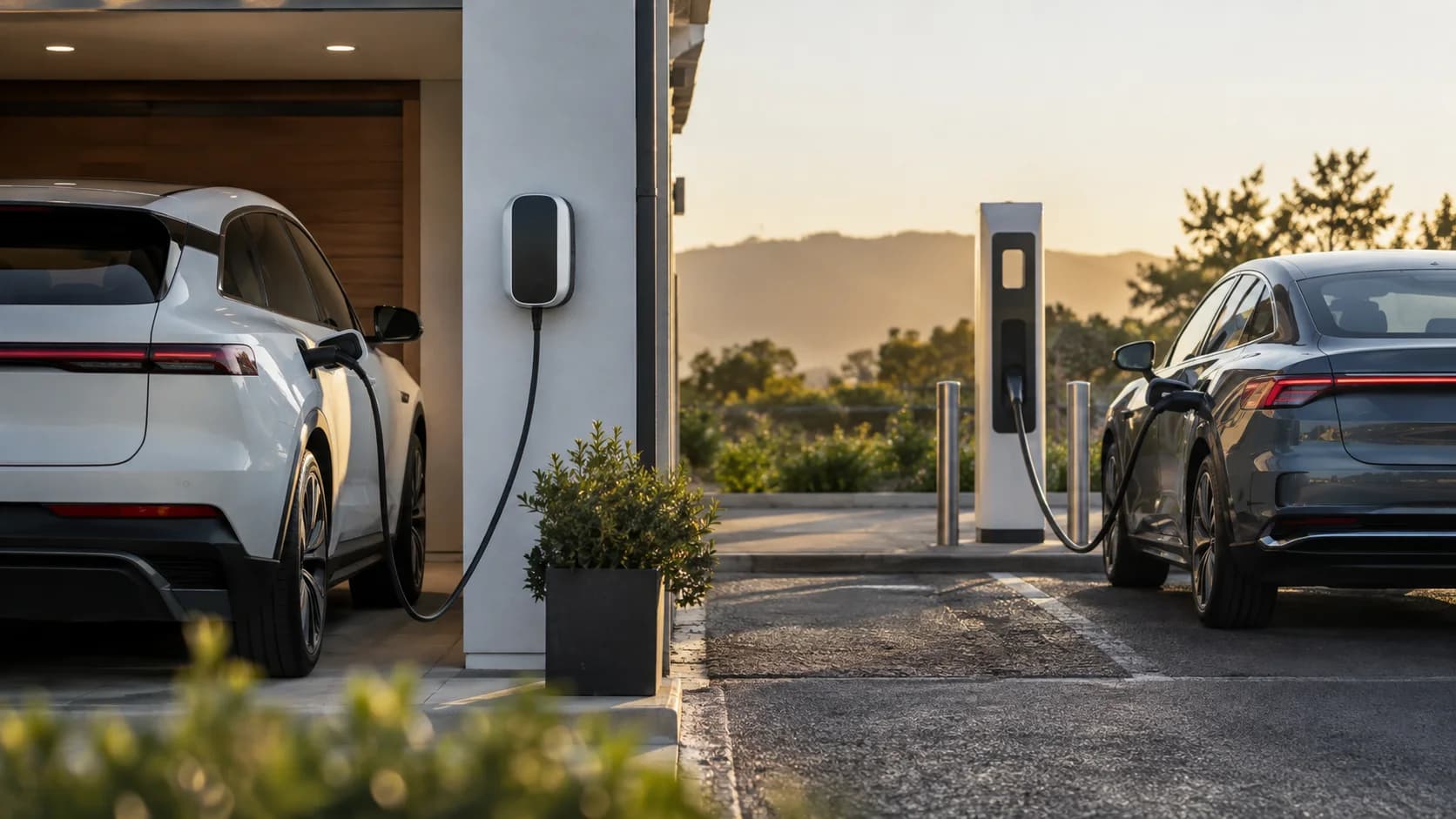
Alternating current (AC) and direct current (DC) charging both transfer electrical energy to an electric vehicle's high-voltage battery, but they differ in where the AC-DC conversion occurs. AC charging relies on the vehicle's onboard charger for conversion, while DC charging performs this conversion externally in the charging station itself.
AC Charging: Onboard Conversion and Widespread Access
AC charging uses the alternating current supplied by the electricity grid. Since vehicle batteries store energy as direct current, an onboard charger within the vehicle converts the AC input to DC. The power output of AC charging is limited by the capacity of this onboard charger, which typically ranges from 3.7 kW to 22 kW in passenger vehicles. Common AC charging points include domestic wall sockets (Mode 2 charging, often up to 2.3 kW), dedicated home wallboxes (Mode 3, typically 7.4 kW or 11 kW), and public AC charging stations (Mode 3, often 11 kW or 22 kW).
The widespread availability of AC power outlets makes AC charging highly accessible. For many drivers, daily charging at home or work using a wallbox covers typical commuting needs. For instance, an overnight charge at 7.4 kW can replenish a substantial portion of a battery's capacity. Public AC charging points are also common in urban areas, at supermarkets, and in car parks, offering convenient top-ups during errands or longer stops.
Compatibility for AC charging is generally universal across Type 2 connectors in Europe, as mandated by the Alternative Fuels Infrastructure Regulation (AFIR). Drivers can verify their vehicle's maximum AC charging rate in the owner's manual or official technical specifications. This figure dictates the fastest AC charging speed the vehicle can accept, regardless of the charging station's higher potential output.
DC Charging: External Conversion and Rapid Replenishment
DC charging, often referred to as "fast charging" or "rapid charging," bypasses the vehicle's onboard charger. The AC-DC conversion takes place within the charging station itself, which then delivers direct current directly to the vehicle's battery. This external conversion allows for significantly higher power outputs, typically starting from 50 kW and extending to 350 kW or more.
The primary advantage of DC charging is speed. It enables drivers to add substantial range in a relatively short period, making it suitable for long-distance travel or situations where time is critical. For example, during a cross-border journey from Brussels to Berlin, a driver might use a high-power DC charger for a 20-30 minute stop to continue their journey with sufficient range.
DC charging points typically use CCS (Combined Charging System) connectors in Europe, which combine a Type 2 AC inlet with two additional DC pins. Drivers should consult their vehicle's manual or manufacturer's specifications to confirm the maximum DC charging rate the vehicle can accept. Charging at a station with a higher power output than the vehicle's maximum will not damage the battery, but the vehicle will only draw power up to its specified limit.
Impact on Battery Longevity and Efficiency
Both AC and DC charging contribute to the overall energy throughput of a vehicle's battery over its lifetime. The UNECE Global Technical Regulation No. 22 addresses the durability of vehicle batteries, focusing on capacity retention over time and usage. While high-power DC charging generates more heat within the battery pack than lower-power AC charging, modern battery management systems (BMS) are designed to mitigate potential degradation by controlling charging rates and managing temperature.
From an energy efficiency perspective, both AC and DC charging involve energy losses. In AC charging, losses occur during the AC-DC conversion within the onboard charger and during the charging process itself. In DC charging, losses occur during the AC-DC conversion within the charging station and during power delivery to the battery. The overall efficiency can vary depending on the specific vehicle, charger, and environmental conditions. Official laboratory figures for energy consumption, such as those derived from the EU WLTP type-approval procedure, account for the energy drawn from the grid, including charging losses, to provide a representative consumption value.
Scenarios for AC Preference
AC charging is generally preferable for routine, daily charging where time is not a critical factor. This includes overnight charging at home, workplace charging, or charging during extended stops like shopping or leisure activities. The lower power output of AC charging typically results in less thermal stress on the battery compared to high-power DC charging, which some argue may contribute to better long-term battery health, although modern BMS largely mitigate this concern. The lower infrastructure cost of AC charging points also contributes to their wider availability in residential and urban settings. For drivers who consistently cover less than their vehicle's full range daily, AC charging provides a convenient and often sufficient solution.
Scenarios for DC Preference
DC charging is indispensable for long-distance travel and situations requiring rapid energy replenishment. When undertaking a journey across multiple countries, such as from Paris to Rome, relying solely on AC charging would necessitate frequent and lengthy stops, significantly extending travel time. DC fast chargers enable drivers to quickly add hundreds of kilometres of range during a short break, making such journeys practical. DC charging is also beneficial for professional drivers or those with unpredictable schedules who may need to quickly top up their battery during the day. Furthermore, in emergencies or unexpected situations where a rapid charge is needed, DC charging offers the quickest solution.
Verifying Charging Compatibility
To ensure optimal charging experience and avoid compatibility issues, drivers should consult their vehicle's official documentation. The owner's manual, manufacturer's website, or dedicated vehicle app will specify:
- Maximum AC charging power: This indicates the highest power (in kW) the vehicle's onboard charger can accept.
- Maximum DC charging power: This indicates the highest power (in kW) the vehicle's battery management system can accept from a DC charger.
- Connector types: In Europe, this will almost universally be Type 2 for AC and CCS for DC.
- Battery capacity: While not directly related to charging type, knowing the battery's usable capacity (in kWh) helps estimate charging times.
These specifications are crucial for planning journeys and selecting appropriate charging stations. For example, a vehicle with a maximum AC charging rate of 11 kW will charge at that rate even if connected to a 22 kW AC public charger. Similarly, a vehicle capable of 150 kW DC charging will only draw up to 150 kW from a 350 kW DC charger. Understanding these limits prevents unrealistic expectations about charging speed.