Home charging an electric vehicle effectively balances available power with desired charging speed. Realistic charge times are determined by the vehicle's onboard charger capacity, the installed charging equipment's output, and the grid connection's limits.
Understanding AC Charging Power
Electric vehicles (EVs) primarily use alternating current (AC) for home charging. The vehicle converts this AC to direct current (DC) via its onboard charger to replenish the battery. The power available for charging is a product of voltage and current, typically expressed in kilowatts (kW). In Europe, standard single-phase household electricity operates at 230 V. Three-phase connections, common in some European properties, offer 400 V.
The most basic home charging option uses a standard domestic socket, typically rated for 10 A or 16 A. At 230 V, a 10 A connection provides up to 2.3 kW, while a 16 A connection offers up to 3.7 kW. These are suitable for overnight charging for drivers with low daily mileage. For example, a driver covering 50 km daily might find a 2.3 kW charger sufficient to replenish the energy consumed over several hours.
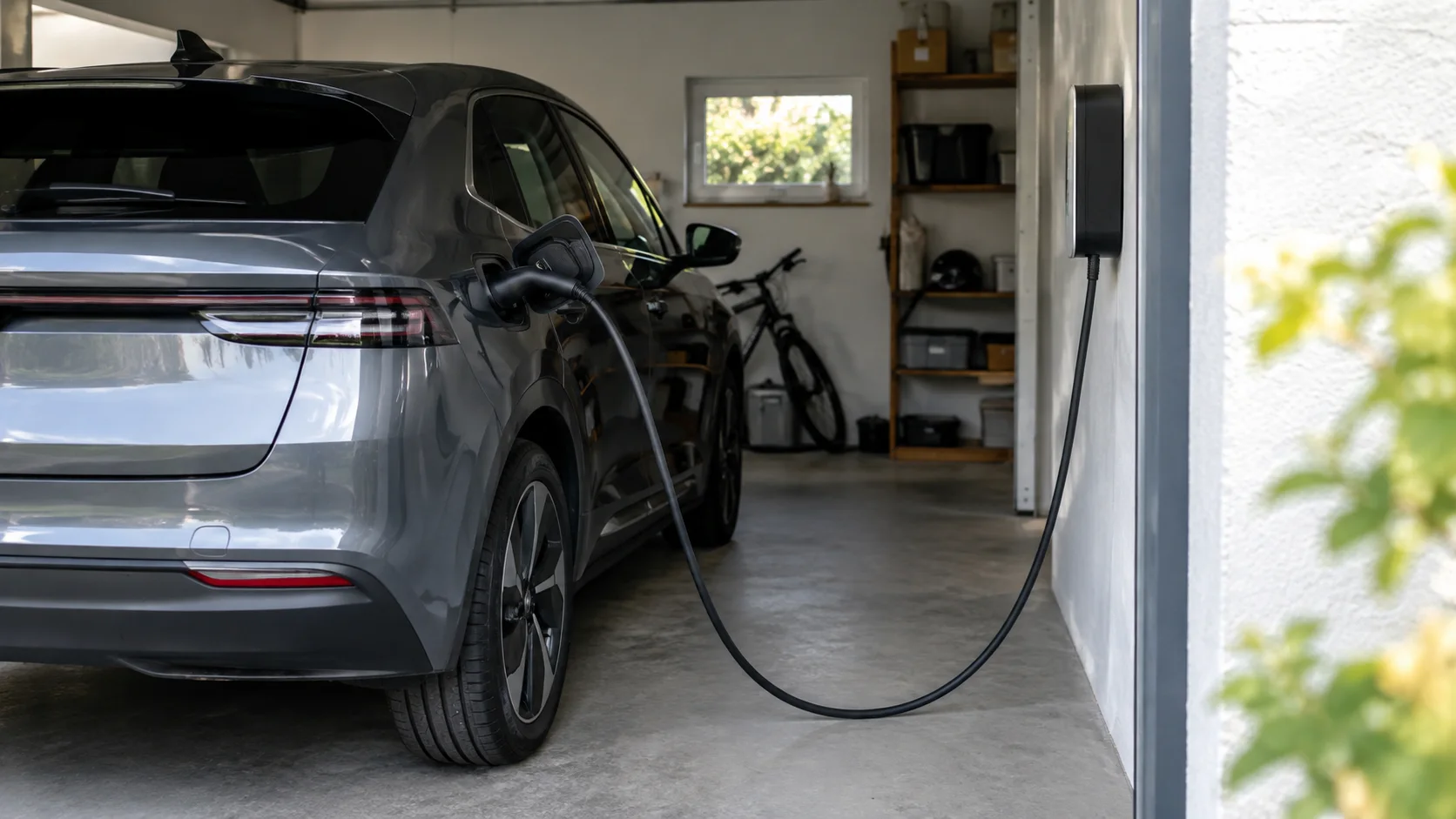
Dedicated wall-mounted charging units, often called Wallboxes, offer higher power outputs. Common single-phase Wallboxes provide 7.4 kW (230 V, 32 A). Three-phase Wallboxes can deliver 11 kW (400 V, 16 A per phase) or 22 kW (400 V, 32 A per phase). The choice between single-phase and three-phase depends on the property's electrical installation and the vehicle's onboard charger capabilities.
Vehicle Onboard Charger Limits
An EV's onboard charger dictates the maximum AC power it can accept. This capacity varies significantly between models and even within the same model line, often offered as an optional upgrade. Common onboard charger capacities for AC charging are 3.7 kW, 7.4 kW, 11 kW, and 22 kW.
If a vehicle has an 11 kW onboard charger, connecting it to a 22 kW Wallbox will still result in a maximum charging power of 11 kW. The Wallbox will only supply what the vehicle can accept. Conversely, connecting an EV with a 22 kW onboard charger to a 7.4 kW Wallbox will limit the charging power to 7.4 kW. The charging system operates at the lowest common denominator between the supply and the vehicle's acceptance.
Drivers can verify their vehicle's onboard charger capacity in the owner's manual or the manufacturer's official technical specifications. This information is crucial for selecting appropriate home charging equipment.
Grid Connection and Installation Constraints
The electrical infrastructure of a property imposes fundamental limits on home charging power. Most European homes have a single-phase connection, often with a main fuse rating of 40 A, 63 A, or 80 A. A 32 A single-phase Wallbox (7.4 kW) consumes a significant portion of this capacity. Installing such a charger requires a professional electrical assessment to ensure the existing wiring and main fuse can safely support the load without overloading the system.
Properties with a three-phase connection, typically rated for 3x25 A or 3x32 A, can support higher power charging. An 11 kW three-phase Wallbox (3x16 A) draws 16 A per phase, which is generally manageable for a 3x25 A connection. A 22 kW three-phase Wallbox (3x32 A) requires a robust three-phase connection, ideally 3x32 A or higher. Upgrading a property's grid connection from single-phase to three-phase, or increasing the main fuse rating, is a complex and potentially costly undertaking that involves the local grid operator.
Dynamic load management systems can help optimize charging by adjusting the power delivered to the EV based on the property's overall electricity consumption. This prevents overloading the main fuse by temporarily reducing EV charging power when other high-demand appliances are active.
Realistic Charge Time Calculation
Calculating realistic charge times involves considering the battery's usable capacity, the charging power, and inherent inefficiencies. The usable battery capacity, not the gross capacity, determines how much energy needs to be replaced. The EU Batteries Regulation (EU 2023/1542) mandates specific information on battery capacity.
A simplified calculation for charging time is:
Charging Time (hours) = Usable Battery Capacity (kWh) / Charging Power (kW)
However, this formula provides an ideal scenario. Real-world charging is not 100% efficient due to energy losses in the charging cable, the vehicle's onboard charger, and battery conditioning. These losses can reduce effective charging efficiency, meaning more energy is drawn from the grid than is stored in the battery. Additionally, charging speed often tapers off as the battery approaches full capacity, particularly above 80%, to protect battery health and extend its lifespan, as addressed by UNECE Global Technical Regulation No. 22.
For instance, an EV with a 60 kWh usable battery capacity charging at a consistent 7.4 kW might theoretically take approximately 8.1 hours to fully charge from empty. Accounting for efficiency losses and tapering, the actual time could be longer.
Scenarios for Different Charging Powers
The optimal home charging power depends on individual driving habits and property infrastructure.
For drivers with short daily commutes (e.g., under 50 km) and ample overnight parking, a 2.3 kW or 3.7 kW charger can be sufficient. This allows for a full charge over 10-12 hours, easily achieved overnight. This option is often the least expensive to install, using existing domestic sockets or minimal wiring upgrades.
Drivers with longer daily commutes (e.g., 100-200 km) or those who want faster replenishment for occasional longer journeys may prefer a 7.4 kW single-phase Wallbox. This significantly reduces charging time compared to lower power options, allowing a substantial charge within a few hours. This is a common choice for many European households with single-phase connections.
For multi-EV households, or those with very high daily mileage, an 11 kW or 22 kW three-phase Wallbox offers the fastest AC charging. This is particularly beneficial for vehicles with larger battery capacities or when rapid turnaround is needed. However, this requires a three-phase grid connection and a vehicle equipped with a compatible onboard charger. For example, a cross-border journey from Brussels to Berlin (approximately 770 km) would necessitate multiple charging stops en route, but a high-power home charger ensures the vehicle starts each day fully prepared. The Alternative Fuels Infrastructure Regulation (EU 2023/1804) aims to ensure sufficient public charging infrastructure, but home charging remains the primary method for most EV owners.
Verifying Compatibility and Installation
Before purchasing any home charging equipment, it is essential to verify compatibility. The vehicle's owner's manual or official technical specifications will detail the maximum AC charging power it can accept. This information is also part of the EU WLTP type-approval procedure (EU 2025/1706), which includes details on energy consumption and electric range.
For the home charging equipment, the manufacturer's specifications will state its maximum output power. An electrician must assess the property's electrical installation to confirm it can safely support the desired charging power. This includes checking the main fuse rating, wiring gauge, and the availability of a suitable circuit. Professional installation is mandatory for dedicated Wallboxes to ensure compliance with electrical safety standards.
Choosing the right home charging solution involves a balance between convenience, cost, and electrical feasibility. Understanding these factors allows for an informed decision that meets individual needs without over-specifying or under-equipping.