
Image credit: Alfa Romeo, published by Motor1.com. The source page credits Alfa Romeo but does not state a commercial reuse licence.
Alfa Romeo Cuorerosso is a 2+2 manifesto with a possible V6 hybrid future
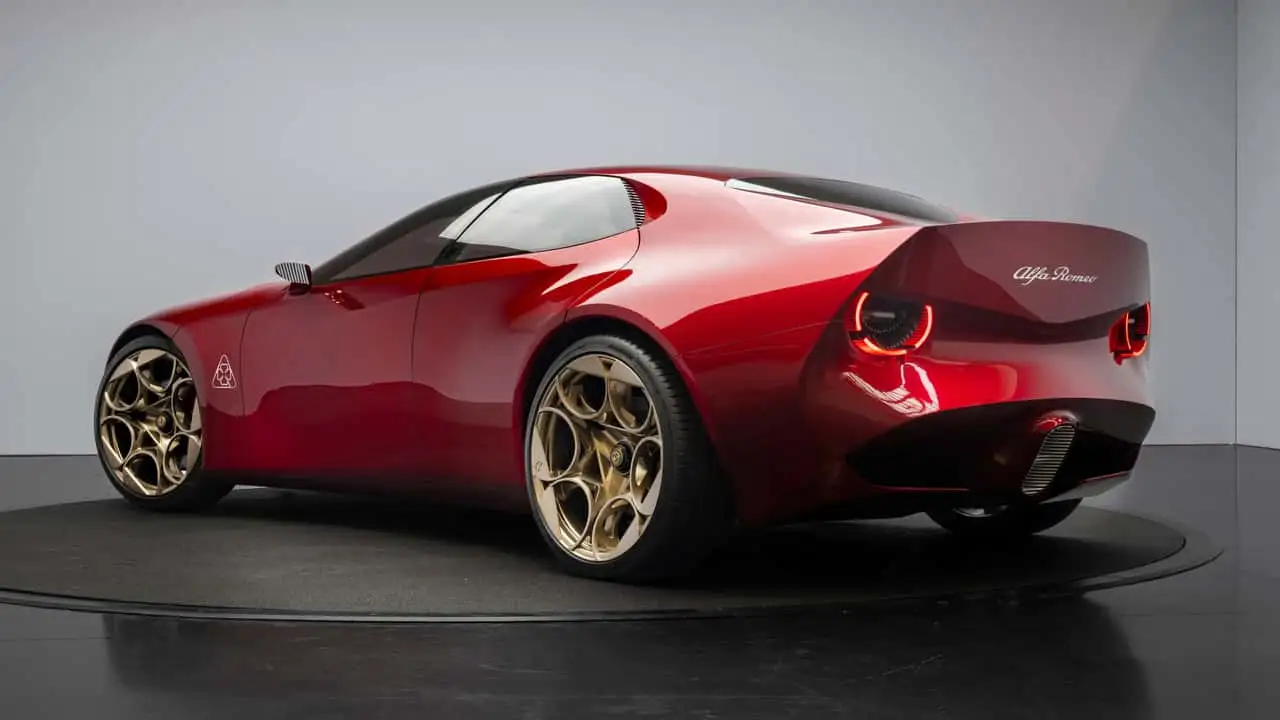
Alfa Romeo has revealed the Cuorerosso concept at the 2026 Paris Motor Show. It is a low 2+2 coupé with four individual seats, a 4.7-metre body and a design brief that leaves room for several powertrain types. The company does not describe it as a direct preview of a production car. Instead, Cuorerosso is a manifesto for future Alfa Romeo models and for the way the brand wants to connect performance, technology and electrification.
The numbers describe a large, low concept
The official dimensions are 4,700 millimetres long, 1,980 mm wide and 1,331 mm high. Its wheelbase is 2,930 mm and its declared mass is 1,750 kg. Those figures apply to the concept shown in Paris; they are not homologated production-car specifications. Alfa Romeo says the proportions are realistic enough to leave room for two normal-sized adults in the rear, but the car remains a 2+2 rather than a full-size family saloon.
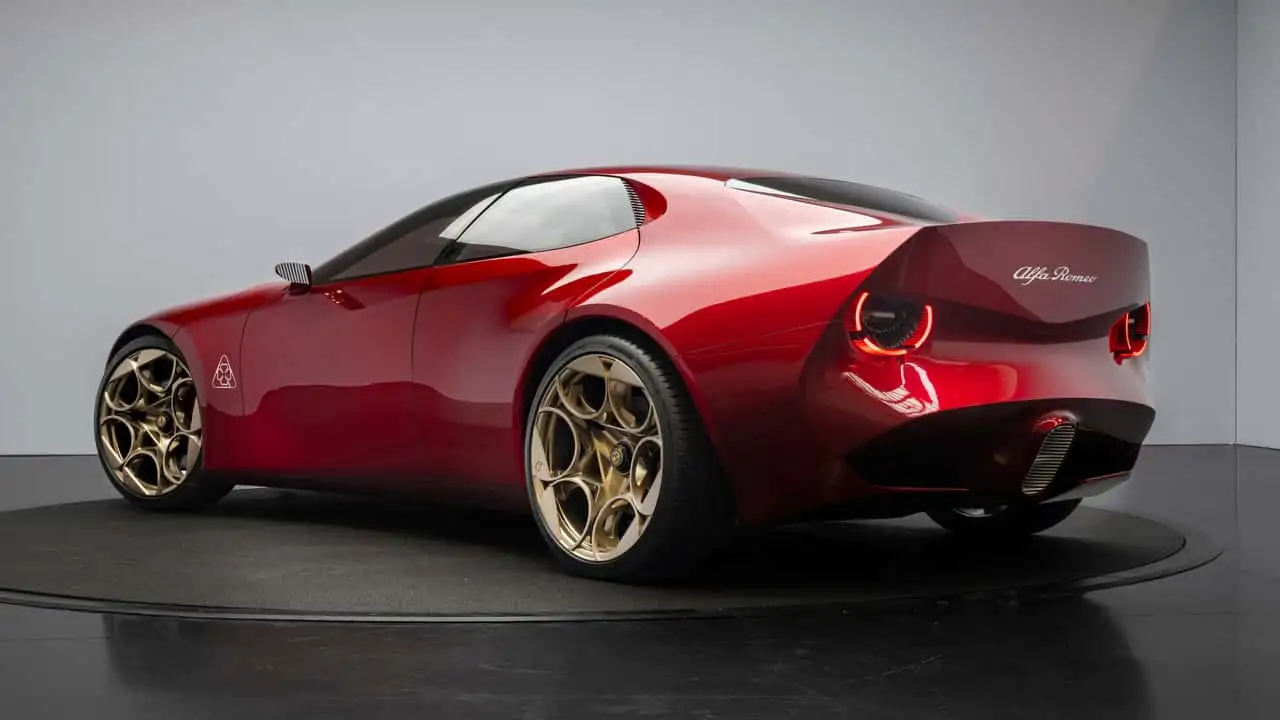
The body is built around one continuous surface, a wedge-shaped side line and a truncated rear, or Coda Tronca. The rear glass recalls the shape of Alfa Romeo's Scudetto, while two round lamps sit inside the cut-off tail. Alfa Romeo quotes a drag coefficient of 0.28. That is an official claim for the concept, not an independent Carboratory measurement, and it cannot be used to predict the efficiency of a future production model with different wheels, ride height or powertrain cooling requirements.
At the front, the Scudetto and the lamps form a modern interpretation of the Trilobo. The grille contains small illuminated triangular elements inspired by Alfa Romeo's cross and Biscione symbols. Conventional door handles have been removed; a touch control in the roof opens the doors. The rear doors are rear-hinged. These solutions make sense for a design study, but cost, crash requirements and service access would all have to be resolved before production.
The V6 is a possibility, not a specification
Motor1.com reports that the displayed car is based around Alfa Romeo's twin-turbocharged 2.9-litre V6, the engine associated with Giulia and Stelvio Quadrifoglio. Alfa Romeo has not published the Cuorerosso's output, acceleration, top speed, fuel consumption or emissions. A German Stellantis release gives one possible technical scenario: a 2.9-litre V6 combined with full-hybrid technology, Q4 all-wheel drive, an automatic transmission and a carbon-fibre propeller shaft.
The wording matters. Alfa Romeo presents the V6 arrangement as an example of what its future multi-energy approach could support, not as a confirmed production specification for Cuorerosso. The company also refers to battery-electric, plug-in hybrid, mild-hybrid and full-hybrid possibilities across future architectures. No battery capacity, electric range, charging rate or system power has been announced for this concept.
That leaves an important distinction between the car shown in photographs and the product strategy around it. A V6 hybrid and a battery-electric car would require different packaging, cooling, mass distribution and software. Even if some design features move into production, the technical layout could change substantially. Santo Ficili, Alfa Romeo and Maserati CEO, said that technology, function and quality should remain in the service of driving pleasure. That is a statement of intent, not a launch promise.
A cabin built around the driver
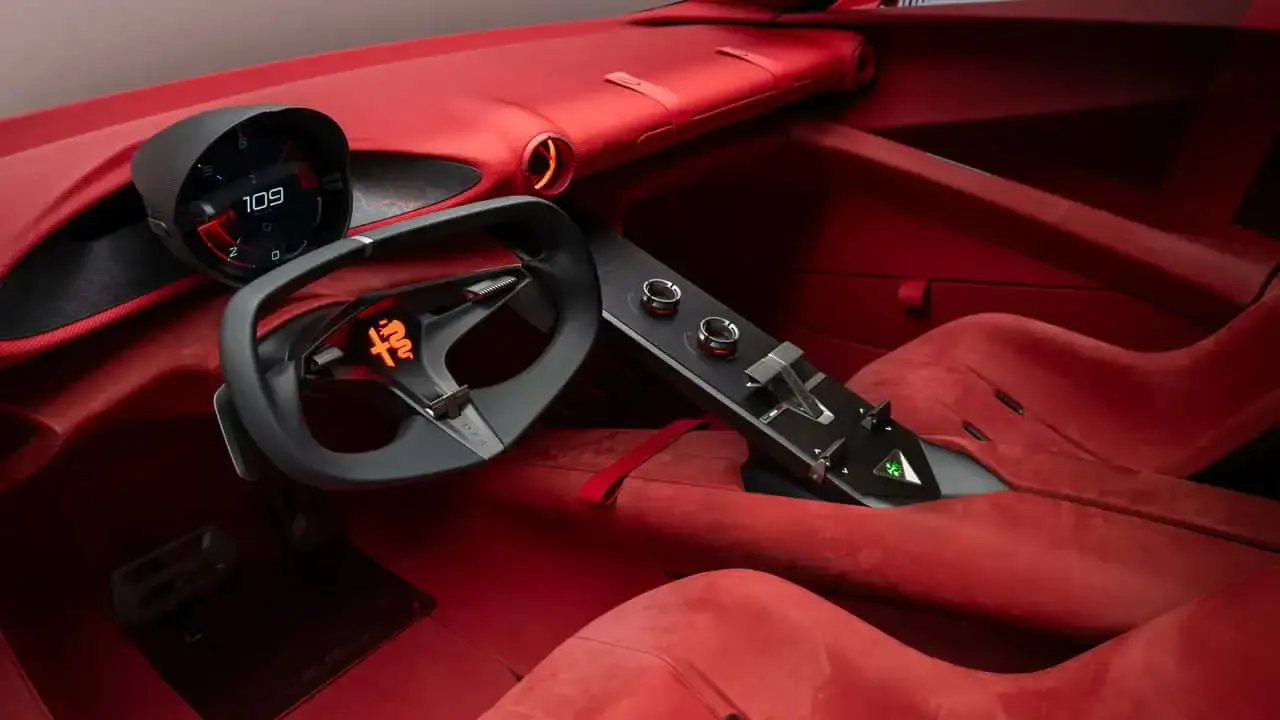
The interior has four individual seats, a long centre console and sculpted door panels that wrap around the occupants. The thin horizontal dashboard takes inspiration from the original 1967 Alfa Romeo 33 Stradale and the modern 33 Stradale. Alfa Romeo says the cockpit should show controls and information only when they are needed.
The central driver display is called Cannocchiale Vivente, or Living Telescope. In the Immersivo setting, two elements retain a traditional instrument layout and can show vehicle information alongside navigation. In Concentrato, the two elements physically merge into one, reducing the visual field to the information considered essential for more committed driving. Cruise, Sport and Quadrifoglio modes alter the interaction and the quantity of information presented.
There is also a Magma display in the centre tunnel, combining a touchscreen with rotary controls and physical switches. The steering system is steer-by-wire, with haptic and acoustic feedback intended to preserve a sense of direct connection. Stellantis SmartCockpit is named as a possible technical foundation for further development, but Alfa Romeo has not identified a production model or timing for the system.
Red paint, regenerated leather and sailing technology
The exterior uses a colour called Liquid Ink Red. Alfa Romeo says it combines a fine aluminium base with a tinted transparent layer. Depending on the light and viewing angle, the surface can appear bright red or almost black. In the cabin, Poltrona Frau nubuck is combined with metal finishes inspired by titanium, anthracite and gunmetal.
The company also describes a regenerated leather containing 60 per cent post-industrial waste from premium upholstery production. A light, transparent monofilament fabric developed with Luna Rossa takes inspiration from technical sailing clothing. These are interesting material choices, but the concept announcement does not provide costs, repair procedures, supply volumes or confirmation that the same materials could be used in a series vehicle.
The dynamic hardware includes air suspension and Brembo carbon-ceramic brakes with Alfa Romeo-specific callipers. The Quadrifoglio emblem links the study to the brand's performance family, but it does not confirm a future Cuorerosso Quadrifoglio model. There is no public test result to establish how the suspension or brakes behave on the road.
What Paris did not confirm
Alfa Romeo has not announced a price, production date, production volume or sales market for Cuorerosso. It has also not confirmed the V6's power, the capacity of a possible hybrid battery or whether the concept is driveable in the displayed form. The company says future multi-energy architectures could support vehicles up to 4.7 metres long and could allow Quadrifoglio versions, but that language describes a direction for the range rather than a shopping list.
For European readers, the practical conclusion is simple: Cuorerosso is not an orderable Alfa Romeo and has no retail price. Its value is in the design decisions Alfa Romeo wants to test and carry forward, from the low, continuous body to the reduced cockpit and the combination of physical controls with digital interfaces. Future production cars will show how much of that language can survive safety rules, cost targets and the packaging demands of different powertrains.
A second frame of the concept, published by Motor1.com and credited to the manufacturer.
Interior frame published by Motor1.com and credited to the manufacturer.


